
To approach Hong Kong technology employers, connect a genuine role to evidence of your own technical contribution, then clarify the hiring entity and any work-permission assessment. A portfolio, an interview invitation or the word sponsorship does not establish a job or visa outcome. This guide helps engineers, developers and other technology candidates build a role-to-project evidence card, choose useful work samples and ask practical employer questions. It distinguishes ordinary professional-employment discussions from the specific research-and-development context of TechTAS.
- 1. Read the engineering problem before choosing a portfolio
- 2. Turn one project into evidence of your own contribution
- 3. Choose a safe demonstration and keep its limits visible
- 4. Use the six-field role-to-project evidence card
- 5. Verify the hiring channel and ask about the working arrangement
- 6. Distinguish professional employment from TechTAS
- 7. Questions technology candidates should resolve
1. Read the engineering problem before choosing a portfolio
Start with what the employer needs the person to do. A vacancy may involve developing a product, maintaining systems, analysing data, supporting customers or conducting research. These activities can overlap, but a fashionable title does not show their relative importance. Save the advertisement, role version and application channel, then identify the main problem the successful candidate will be expected to handle.
Translate the specification into a small set of questions. What is being built or maintained? Who uses it? What constraints matter? Who reviews the work, and what would count as a satisfactory result? These are original preparation questions, not a statutory checklist. Use them to choose a relevant project rather than sending a large collection of unrelated repositories and hoping a manager will infer the connection.
For a fictional backend role concerned with dependable transaction processing, an authorised example explaining failure handling may be more useful than a visually impressive but unrelated design. For a product-analysis role, a clear account of a decision and its evidence may matter more than a long list of programming languages. Neither example predicts the employer's selection criteria; the actual vacancy and clarification remain authoritative.
Record uncertainty instead of supplying details from another company's advertisement. A role called research engineer may still need clarification about its actual activities. A company located in a technology park is not automatically offering a qualifying research position or an available immigration route. Your first task is to understand the work, not to fit a convenient label around it.
2. Turn one project into evidence of your own contribution
Use a project you can explain and are permitted to discuss. Begin with the problem and the constraints at the time. Then describe what you personally designed, implemented, tested or reviewed. Explain why you chose that approach and what alternative you considered. Close with the result you can support and one limitation. This gives an interviewer a coherent account to investigate.
An original rewrite might change “Worked on a data platform using several tools” to “Implemented validation checks for an ingestion workflow, documented failure cases and coordinated the review of rejected records.” Only use the stronger sentence if those were your actions. It is more precise without inventing an improvement percentage, claiming ownership of the whole platform or presenting team work as a solo result.
A defensible measurement needs a basis. If you genuinely measured a change, keep the relevant period, unit, method and comparison conditions. If you cannot verify the number, omit it or explain the qualitative result accurately. Do not invent a benchmark because CV advice says every sentence must contain a metric. An honest account of a design decision can be stronger than an impressive figure that collapses under one follow-up question.
Prepare a short account for an initial conversation and supporting detail for a technical discussion. The short version should still distinguish your role from the team's work. The longer version can explain the data assumptions, testing choices, review process and unresolved limitations. Neither version needs to reveal source code, credentials, customer data or restricted architecture diagrams.
3. Choose a safe demonstration and keep its limits visible
A public repository is useful only when it contains material you are entitled to publish and the employer can understand what it demonstrates. Confirm ownership and disclosure permission before reusing work from a current or former employer. Removing the company name does not necessarily make confidential code or data suitable for a portfolio. Do not upload it simply because another applicant has done so.
The following original comparison helps select a demonstration. It is not a required hiring format or a legal conclusion about ownership.
| Demonstration | What it can help explain | Limit to state | Preparation action |
|---|---|---|---|
| Original practice repository | Implementation and testing approach | Practice, not production deployment | Explain setup, assumptions and tests |
| Authorised redacted project account | Your contribution and decisions | Shared details are limited | Confirm permission and remove sensitive material |
| Self-created system diagram | Boundaries, dependencies and trade-offs | Simplified teaching model | Identify assumptions and excluded components |
| Research presentation | Question, method and evaluation | Publication and contribution scope | Clarify your role and what the evidence supports |
| Interview exercise | Reasoning under an agreed brief | Assessment task, not an employment result | Clarify scope, tools and handling of the output |
If you build a synthetic demonstration, label the data as synthetic and describe how it differs from real operation. A small working example can show reasoning without pretending to represent an employer's live system. Make instructions reproducible enough for a reviewer to follow, but do not promise enterprise reliability from a practice project.
Ask about an interview exercise before beginning: the intended scope, expected format, permitted tools, assessment purpose and handling of the output. If the request turns into productive work or a deployment for the business, pause to clarify the arrangement and applicable permission. This guide does not classify every coding exercise as employment or supply a blanket rule for cross-border work.
If the difficulty is explaining your contribution rather than choosing a tool, share your job-search background with HKJobHunt. Bring a non-confidential role description and a summary of the project. A preparation discussion can help structure your CV and interview account without promising a technical endorsement or employer introduction.
4. Use the six-field role-to-project evidence card
The accompanying technology evidence card is designed to connect a particular vacancy to a particular contribution. It is not a list of sponsoring employers or an immigration eligibility calculator. Complete one card for each role that merits a detailed approach, and update it when the specification changes.
Field one records the role, actual hiring entity, source and version. Field two identifies the engineering problem and any unclear duties. Field three records your own project action and the relevant technology. Field four holds the result, measurement basis or limitation, together with disclosure permission. Field five captures the employer's clarification of team needs and selection. Field six records the work-permission question, responsible person and next action.
For a fictional workflow example, the employer needs someone to investigate failed data transfers. Your project evidence concerns validation checks and rejected-record review. The remaining question might be whether the role mainly develops the pipeline or handles production incidents. That distinction changes which example to discuss, which interview questions to practise and what working arrangements need clarification.
The card also prevents a common overstatement: a manager liking your demonstration is not evidence that the company has agreed to support an employment application. Record technical feedback and hiring or permission discussions separately. If a recruiter says another department handles the latter, identify the appropriate contact and leave the status unresolved until there is an actual answer.
For general CV wording, refer to the Hong Kong CV guide. This article adds the technical chain from role problem to contribution, evaluation and disclosure. It should not replace the original vacancy with a generic skills inventory or repeat every detail of a visa guide.
5. Verify the hiring channel and ask about the working arrangement
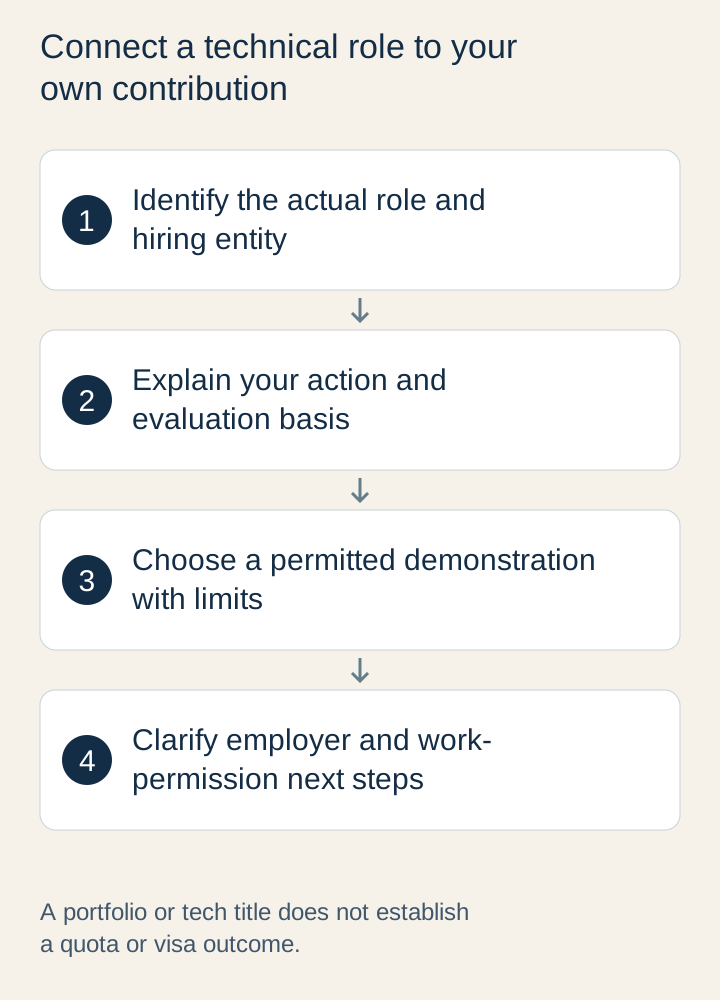
Start with the employer's own careers channel where available, or verify a recruitment intermediary's relationship to the role through an appropriate company contact. Preserve the original source and the details of the employing entity. A platform's sponsorship filter is a lead to investigate, not official evidence that a specific application can be approved.
Ask who employs the person, who manages the work and where the duties are performed. Clarify whether the position involves product development, research, client delivery, support or a combination. For an agency or client-site arrangement, ask how the written role and reporting relationship will be described. Do not assume the brand displayed on a project is necessarily the company that would employ you.
An original first message could say: “Your role describes validation and failure investigation in the data workflow. I implemented related checks and can explain a permitted, non-confidential example. Could you clarify the balance between development and incident support, the employing entity, and whether the company can discuss the work-permission assessment required for my background?” Adapt it to the actual role and your experience.
Keep the initial enquiry focused. You can state relevant location and present permission accurately without attaching a passport or confidential project archive to an unverified message. When supporting documents become necessary, establish the purpose and verified recipient first. A request for documents still needs to be distinguished from an offer, an application submission and a government decision.
Before accepting an offer, compare the documented duties with the technical conversation. Check the reporting line, location, remuneration components and any unresolved start condition. Use the offer and duties review for that separate decision. A technically attractive assignment can still require clarification about who is offering the employment and under what conditions.
6. Distinguish professional employment from TechTAS
A technology job does not automatically select an immigration route. The General Employment Policy and ASMTP have different applicant scopes and consider the actual professional role and relevant background. Mainland residence, overseas circumstances, qualifying graduate arrangements and existing permission need their own assessment; an English-language engineering interview does not resolve them.
The Innovation and Technology Commission's TechTAS overview describes a company-led arrangement for non-local talent undertaking R&D, involving company quota applications. The Immigration Department's TechTAS guidance sets out the applicant and employment conditions. It also distinguishes submission while a quota application is underway from the conditions for a favourable decision. Do not describe a pending quota as an approved one.
For a practical employer conversation, ask whether TechTAS is actually being considered, who is responsible for the company-side assessment and which duties are relevant to that discussion. Do not infer suitability merely from an AI-related title, a product demonstration or an office in a technology park. Technical Professionals Stream terminology and TechTAS are also distinct; a similar English word does not make them interchangeable.
This guide does not quote a processing period, fee, salary threshold or guaranteed approval date. Do not schedule resignation or commencement around an unsupported promise. The visitor guidance prohibits paid or unpaid employment by visitors. A portfolio review, interview or pending application does not create general work permission.
For immigration background, use PremierVisa Group's Hong Kong professional-employment information, with the individual service scope and responsibility confirmed. A strong portfolio can support an explanation of your work; it cannot create qualifications, an employer quota or an immigration approval that does not exist.
7. Questions technology candidates should resolve
Do I need an open-source portfolio to apply?
This guide does not impose one. Use the actual role requirements and a format that demonstrates your contribution without breaching disclosure limits. A permitted project explanation, original practice exercise or appropriate presentation may be relevant. Ask the employer what it needs rather than publishing restricted work to fill a perceived gap.
Can I describe a team achievement as my own result?
Explain your contribution and how it connects to the wider result. Do not imply that you designed or delivered everything. If a measurement belongs to the whole team, state that context and keep evidence for your part, including the limitations of what the figure proves.
Does an AI job title mean TechTAS applies?
No automatic conclusion follows. The actual duties, company-side arrangements and applicant conditions need assessment under the current official guidance. A title is not a quota allotment, an eligibility decision or evidence that the employer has agreed to pursue that route.
What should I do if a recruiter says sponsorship is available?
Ask which employing entity, role and assessment the statement concerns, and who will confirm the next step. Record the actual answer and distinguish willingness to discuss support from a prepared or submitted application. Do not treat a platform label or verbal statement as approval.
Can I start while documents are being prepared?
Do not infer work permission from preparation or recruitment progress. Check your existing conditions and the arrangement required for the actual role before beginning. A request to demonstrate skills should also have a clear scope; productive work or cross-border activity may need further assessment.
Submit your job-search background to discuss your CV, interview preparation and practical employer-contact directions. Bring the role-to-project evidence card and a non-confidential summary, so the discussion can address a real technical match and a clear next question.