
Discuss your next employment and work-permission steps when the proposed job extends beyond your verified authorization, when duties or conditions may change, or when the employer needs time to consider documents and responsibilities. Start with the permit you actually hold, rather than a general promise that a PGWP can be renewed. This guide helps existing PGWP holders prepare an employer discussion, an evidence record and conditional next actions. It does not determine your eligibility for another permit or permanent residence, and no single month-count fits every situation.
- 1. Explain your current permission before discussing future support
- 2. Use decision triggers instead of a universal countdown
- 3. Separate a PGWP exception from another permit route
- 4. Build a six-field record for the employer conversation
- 5. Check the basis for working while an application is pending
- 6. Prepare useful documents and a conditional employment plan
- 7. Frequently asked questions
1. Explain your current permission before discussing future support
Read the permit, including its expiry and any conditions, and prepare a concise description of your present situation. Distinguish “I hold a valid permit covering this work” from “I expect another permission later.” The employer needs to understand what you can substantiate now and what remains unresolved; combining both into a confident but inaccurate sentence makes that discussion harder.
IRCC’s open-work-permit information includes PGWP applicants among the relevant situations and explains that an open permit is not job-specific, while restrictions can still apply. A valid open permit covering the work does not require the employer to obtain an LMIA for that work. This is different from deciding how employment could continue after the current authorization ends.
For an initial recruitment conversation, state your actual permit type, relevant expiry and any condition affecting the proposed duties. Keep unrelated identifiers out of a general enquiry. Provide appropriate evidence through the employer’s genuine recruitment or HR process when needed, rather than circulating a full immigration file to every person who might know about a vacancy.
The open versus employer-specific permit guide explains the broader distinction. Here, the practical question is when the current job discussion needs a second conversation about future conditions. A hiring manager’s willingness to talk does not itself establish an employer-supported route or an application outcome.
2. Use decision triggers instead of a universal countdown
Begin the discussion when a real dependency appears. The proposed employment period may extend beyond the permit you can show; the company may need a different person to review a request; or you may need information that only the employer can supply. Those are reasons to act while there is still room to clarify matters, without inventing a guaranteed processing schedule.
Ask who handles the issue and what they would need to consider it. The person interviewing you may not control company policy, immigration documents or approval of professional support. A useful next action can be a meeting with the appropriate contact, rather than an immediate promise of sponsorship. Record the actual commitment so that interest is not reported as a completed decision.
Review the plan when the work changes. A new location, substantially different responsibilities or another employing entity can create questions that an earlier conversation did not answer. Do not assume that a company name remaining similar makes every condition identical. Bring the changed facts to the appropriate reviewer before relying on the old conclusion.
Keep your own task dates, but label them correctly. A reminder to request documents is a personal planning date; an employer’s agreed reply date is a communication commitment; an official application deadline has a separate basis. Putting them in one calendar is useful only if you can still distinguish what each date means and who controls it.
3. Separate a PGWP exception from another permit route
The official PGWP overview describes the passport-shortened validity situation and its particular extension process. That is not a general opportunity to obtain a fresh PGWP whenever a job continues. Check why your permit has its actual end date before using the word renewal in a discussion with HR.
If your circumstances involve another possible route, identify it as a question for individual assessment. An employer may need to consider whether it has a role in the applicable process; a valid open permit today does not answer that future question. Ask what information can be supplied and by whom, without selecting a category simply because it appears convenient.
IRCC’s bridging-open-work-permit page has program-specific conditions and distinguishes an Express Entry pool profile from a permanent-residence application. A plan to apply for permanent residence should not be presented to the employer as proof that another work permit already exists or is assured.
Keep the discussion focused on verified facts: the document held, the proposed employment, the question requiring assessment and the evidence still missing. This article does not quote a fixed BOWP month threshold, an LMIA processing period or a PR points requirement. Those numbers are not needed to ask the employer who will provide the next employment document.
4. Build a six-field record for the employer conversation
This topic’s original record contains six fields: actual permit validity and conditions; the proposed employment need or change; the employer document and responsible contact; the permission question and appropriate reviewer; the next decision and its dependencies; and a lawful contingency with an update owner. Use it to organize information, not to certify your status or predict an approval.
Start with one employment question. For example, a company might be considering a continuing role while the applicant’s current permit has a known end date. The record can show that HR has agreed to clarify the employer’s position while an independent review examines the individual permission question. This is an original hypothetical teaching situation, not a real employer arrangement or successful case.
| Trigger in the discussion | Useful next action | What remains separate |
|---|---|---|
| Role may continue beyond current permission | Identify the responsible HR contact | Eligibility for a future permit |
| Employer requests supporting evidence | Agree the relevant document and channel | Approval of an application |
| Duties, location or employing entity change | Recheck the facts and applicable conditions | Automatic permission for the change |
| Application is said to be submitted | Identify the actual application and evidence | A blanket right to keep working |
| A decision or travel plan changes circumstances | Review the next lawful step promptly | The assumptions in an older plan |
An original employer question is: “My current authorization and its relevant end date are documented. If this role is intended to continue beyond that period, who would consider the company’s part in the next-step discussion, and what information should I provide?” Adapt it to your actual facts rather than implying that support has already been agreed.
If you need help presenting your background, submit your candidate details to discuss resume preparation, interviews and practical employer-contact directions. The actual service scope and contractual arrangements are confirmed separately. A consultation does not issue a permit or establish an employer’s willingness to provide a particular document.
5. Check the basis for working while an application is pending
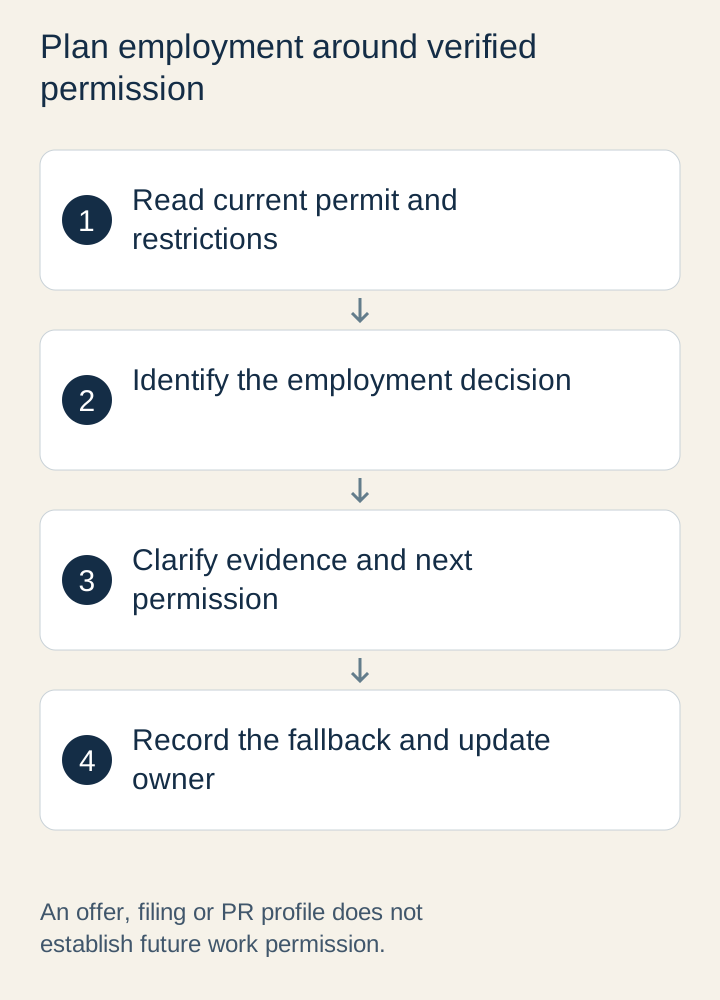
IRCC’s information about an expiring work permit makes continued work conditional on the applicable application and requirements, including staying in Canada and respecting the original conditions. Do not turn “an application was submitted” into a universal answer. A visitor-record or study-permit application does not extend work beyond the current permit’s expiry.
For the employer discussion, identify what was actually applied for, when and through which method, and what evidence exists. Keep your right to remain and your authority to perform the job as distinct questions. An employer’s LMIA application is not the same document as your individual permit application, and a PR plan is not a substitute for identifying the applicable work-permission basis.
IRCC’s after-application guidance explains that the available proof can differ, including for paper applications. Do not promise that every applicant receives the same automated letter. Ask an appropriate reviewer which evidence applies to your own situation and what it actually establishes before describing it to HR.
Include proposed travel in that review before acting. A planning sheet should not assume that departure and return have no effect on permission to work. If the facts change, update the employer through the appropriate channel. The point is to prevent an old assumption from continuing into a roster or start arrangement after the basis for it has changed.
6. Prepare useful documents and a conditional employment plan
Collect the written job description, employer identity, relevant employment dates and any proposed changes. Make a separate index of the permission documents and application evidence that an appropriate reviewer needs. Label each file by purpose and version. This is more useful than forwarding an unstructured collection that mixes recruitment evidence, employer correspondence and unrelated personal records.
Ask what the company can actually confirm: duties, location, hours, pay basis or employment history, as applicable. Do not rewrite the work to fit an assumed category or ask someone to sign facts they cannot verify. A letter’s title does not make inaccurate contents acceptable, and an informal assurance does not establish that the organization has approved a specific undertaking.
Agree a factual update method. If HR will consider a request, record who is responsible and when to check back. If the company has not made a decision, keep that status visible. Your own contingency plan should identify what needs review if the expected permission is not available, rather than promising that you will continue working regardless of the result.
Keep immigration assessment separate from career preparation. The offer-to-work-permit handover guide supports document coordination, while PremierVisa Group’s Canada information provides a separate starting point for an appropriate individual immigration engagement. There is no need to claim a future permanent-residence outcome to explain your genuine experience and current work availability.
Before the next interview, rehearse a short explanation of present permission, the relevant future question and the next person who can answer it. Keep it accurate when speaking to different employers. A clearer explanation can make the conversation easier to assess; it cannot remove a legal condition, require an employer to support you or guarantee a job.
7. Frequently asked questions
Does an employer need an LMIA simply because I hold a PGWP?
A valid open permit covering the work does not require an LMIA for that work. Check the actual permit conditions. The possible need for a different arrangement after that permission ends is a separate discussion.
Can I automatically renew my PGWP because I found a long-term job?
Do not assume so. The official page describes particular circumstances such as passport-shortened validity. Continued employment does not itself create a fresh PGWP entitlement; identify the applicable next-step question individually.
Does an Express Entry profile prove that I can obtain a BOWP?
No. A pool profile is different from a permanent-residence application, and BOWP requirements depend on the relevant program and actual circumstances. Do not report an expected route as an existing permit.
Can I keep working after any application is submitted?
No. The application type, timing, location and applicable conditions matter. Review the actual evidence rather than relying on the word pending. A visitor or study application does not extend work beyond the current permit’s expiry.
When should I raise the issue with a prospective employer?
When the proposed work creates a genuine future dependency, or the company needs to identify a responsible contact and documents. Use the verified permit date and actual employer process, not an invented universal month-count or approval deadline.
Complete the planning record and identify one question that the employer can answer. Submit your candidate background if you need help with your resume, interviews and practical employer-contact directions. Employment, employer support, a further permit and permanent residence remain separate outcomes, with no guarantee of approval.