
If local recruitment has not filled a Canadian vacancy, record the real process before writing that nobody suitable was available. Preserve the advertisement version, the job-related requirement, the evidence considered, the action taken and the actual outcome. This guide is for employers organising an LMIA recruitment file after applications begin arriving. It provides an original assessment record and report checks; it does not supply rejection reasons, certify compliance or replace the current requirements for the relevant stream.
- 1. Separate an empty inbox from an unfinished assessment
- 2. Fix the requirement and advertisement version before assessing evidence
- 3. Track Job Match, Direct Apply and interviews as different activities
- 4. Use a six-field application-to-outcome record
- 5. Reconcile the report with its underlying evidence
- 6. Preserve records and continue the activities that remain required
- 7. Questions about recruitment records
1. Separate an empty inbox from an unfinished assessment
“No applications,” “applications not reviewed,” “information missing” and “no appointment made” describe different events. None should be substituted for another to produce a convenient summary. Begin by establishing which vacancy, campaign version, channels and period the report covers. Someone reading it later should be able to find the underlying records.
The ESDC high-wage requirements describe recruitment as efforts to find and select qualified employees and require records of those efforts and results. An advertising invoice shows a purchase; it does not show that applications were considered. An interview invitation shows an action, not that an interview happened or that the applicant declined the job.
Ask the campaign owner where applications arrived and who reviewed each source. Include the channels operated by a recruiter, not just the company inbox. If the team cannot establish what happened to a set of applications, record that gap and investigate it. Do not convert an unavailable recruitment history into a count of zero.
This article starts after recruitment begins. For vacancy definition, wage checks, channel selection and responsibility before launch, see our employer LMIA preparation guide. Keep the records linked, but avoid creating several contradictory versions of the same campaign history.
2. Fix the requirement and advertisement version before assessing evidence
Give the vacancy a stable internal reference and retain each advertisement version with its actual dates and channels. Link the stated duties, worksite, pay and required skills to the version an applicant could have seen. If terms changed during the campaign, identify when the change happened instead of silently treating the latest wording as the original.
For a job-related requirement, write what evidence would help the team assess it. For example, a real role might require a particular practical task; the file can identify the relevant experience or a reasonable clarification question. This is a way to organise assessment, not permission to invent qualifications that the actual job does not need.
Do not rewrite requirements around a preferred overseas worker after local applications arrive. A candidate’s wording may differ from the advertisement while describing relevant experience. Read the evidence before deciding what it supports, and distinguish a missing detail from a demonstrated failure to meet a requirement. Use appropriate professional or HR advice if the assessment itself raises uncertainty.
Keep the working copy and the final version identifiable. A useful correction note states who corrected a date or description, why, and where the original is retained. Backdating a document or deleting the earlier version makes the chronology less reliable. A truthful explanation of a genuine correction is more useful than an artificially tidy record.
3. Track Job Match, Direct Apply and interviews as different activities
The current official pages distinguish invitations through Job Match from applications received through Direct Apply. For the general high-wage instructions checked on 25 October 2026, matches rated four stars or more within the first 30 days must be invited to apply. The low-wage instructions use two stars or more for that invitation requirement. Check the applicable current category and any variation; do not turn this comparison into a universal interview rule.
Both pages require consideration of Direct Apply applications. Disabling the feature or ignoring its applicants may mean the recruitment effort requirements are not met. Keep a record of the actual invitations and received applications, with the date and responsible person. A platform match is not a completed application, and an invitation to apply is not a completed interview.
If an applicant sends the same resume through two channels, preserve both receipt events but reconcile the person in the working report. Otherwise an application-event count can be mistaken for a count of distinct people. State the counting basis clearly; do not invent a government-mandated counting convention from this editorial suggestion.
When an interview is proposed, record the invitation, reply and whether it took place. “No reply by the internal review date” is a factual status if supported by the communication record. It is not evidence that the person lacks skills or refused the offer. If a later reply arrives, update the assessment rather than leaving an obsolete outcome in the report.
4. Use a six-field application-to-outcome record
Our original record has six fields: application reference and receipt source/date; advertisement version and actual requirement; evidence reviewed and precise gap; clarification, invitation or assessment action; actual outcome and supporting record; and reviewer, review date and unresolved follow-up. Keep personal identities in a restricted file linked by reference, not in a publicly shared worksheet.
| Record status | What the team can accurately say | What it cannot infer |
|---|---|---|
| Application received, not yet reviewed | A submission is waiting for review | The applicant is unsuitable |
| Relevant detail missing | The file does not yet show that detail | The person cannot meet the requirement |
| Invitation sent, reply pending | A specified action and date are recorded | An interview was completed |
| Interview held, assessment recorded | The actual evidence and assessment can be reviewed | Every other applicant had the same result |
| Applicant withdraws in a recorded message | The documented withdrawal can be described | An unprovided personal reason for leaving |
Consider an invented teaching situation: the same applicant submits twice, and one resume does not explain a task mentioned in the vacancy. The reviewer links the duplicate receipts, records the missing detail and asks an appropriate clarification question. The record remains pending until there is an actual response or decision. This is not a real applicant, an approved LMIA or a suggested rejection outcome.
A practical internal question is: “Which stated requirement are we assessing, what did we actually read or hear, what remains unknown, and who owns the next action?” Use that question before writing an outcome sentence. Avoid vague labels such as “bad fit” where the file cannot explain what job-related evidence was assessed.
Employers needing help coordinating talent search, screening and interviews can submit their hiring requirements. Scope and contracts must be agreed. Recruitment support does not create assessment evidence that never existed or guarantee an LMIA decision.
5. Reconcile the report with its underlying evidence
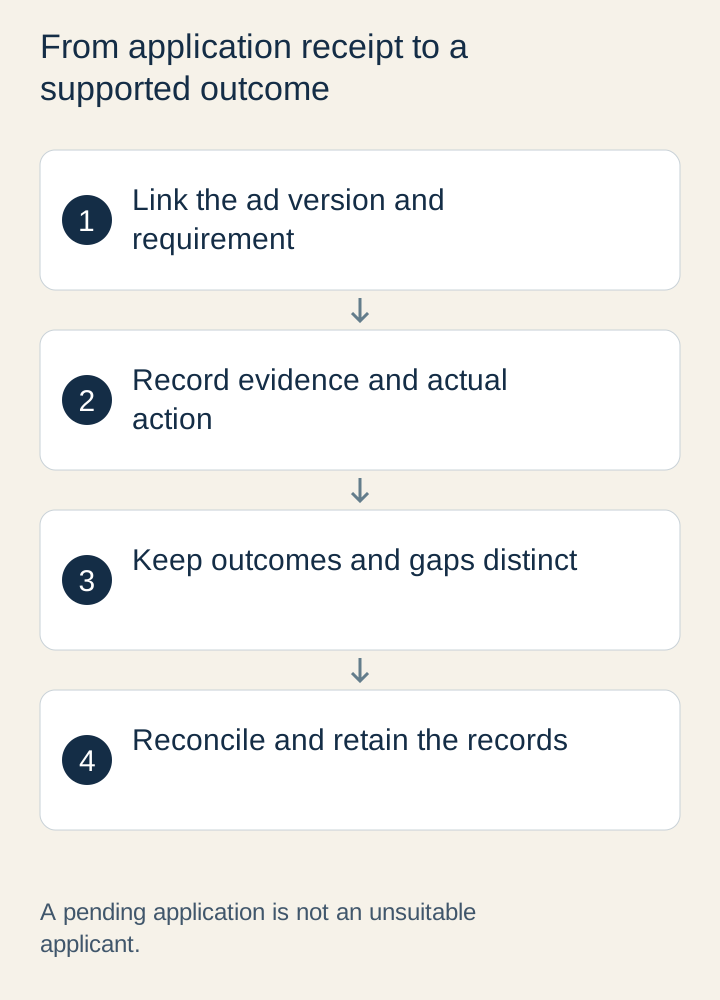
Start the summary with the vacancy reference, campaign versions, channels and period. Explain the counting basis used in the internal working paper and reconcile it with the actual fields required by the current application or a formal request. A report should not make readers guess whether its number represents messages, applications or distinct applicants.
Check totals against the underlying record rather than calculating whatever number makes the narrative convenient. If the file is incomplete, identify which source is missing, who can obtain it and what the report can currently support. Do not fill missing counts with zero, infer that an unopened resume was assessed or copy another employer’s report as your own history.
For outcomes, use a description supported by the actual assessment and communications. A genuine gap might call for more information; a documented withdrawal can be recorded without guessing why. An employer decision should have an accountable reviewer and its real basis, not a sentence generated to make a preferred recruitment result inevitable.
Ask any external recruiter: “Please give us the dated advertisement versions, the actual application and action records, your counting basis and the unresolved gaps. Which conclusions can the documents support, and which still need review?” This original handover message is not a government form or a request to manufacture reasons.
Keep a clear distinction between the employer’s account and the authority’s assessment. The company can explain its recruitment and supply evidence; it cannot award itself a positive LMIA or certify that an incomplete campaign is compliant. Follow the actual application instructions and respond accurately to any official request for further information.
6. Preserve records and continue the activities that remain required
The high- and low-wage recruitment pages require retention of recruitment and advertising records for at least six years. They also describe continuing at least one of the three recruitment activities until the positive or negative LMIA decision under their general requirements. Do not archive the mailbox and stop handling every application simply because a filing has been made.
Give continuing activities an owner, and update the record with the applications and actions that actually follow. Keep date-stamped advertisement evidence, relevant assessment records, communications and report versions in a controlled location. Restrict access to the people who need it and avoid copying unrelated sensitive information into general management summaries. These organisational suggestions are not a universal privacy-law retention schedule.
The separate ESDC employer-compliance guidance describes relevant employment records kept for six years beginning on the first day of the employment period for which the work permit was issued. That context is different from the recruitment pages’ minimum-retention instruction. Record the applicable requirement for each record category rather than assuming one clock starts on the advertising invoice date.
When handing a file to another HR officer or an appropriate reviewer, include the record index, source location, final campaign version and unresolved issues. Preserve genuine corrections and later responses. If an official inspection or request arrives, follow its scope and deadline rather than presenting our blank worksheet as proof that all obligations have been satisfied.
Recruitment results, a positive LMIA and a worker’s permission to start are separate matters. Share our offer, LMIA and permit-stage guide for the worker-side handover. For related immigration background, see PremierVisa Group’s Canada information, with any individual service and professional assessment arranged separately.
7. Questions about recruitment records
Can we write “no suitable applicants” if applications were not opened?
An unread application has not been assessed. Establish the actual record and conduct the relevant review rather than turning an unfinished task into a suitability conclusion. The official pages specifically require consideration of Direct Apply applications.
Does a Job Match invitation mean an interview was required or completed?
The cited provisions concern inviting specified matches to apply; that is different from an interview. Track the actual invitation, application and assessment separately, and follow the applicable current instructions. Do not convert one recorded step into evidence of another.
How should duplicate applications be handled?
Retain the receipt events and link them to the same person where established. Explain the working counting basis and reconcile the report with the official fields requested. Do not silently inflate distinct applicants or delete evidence to make totals agree.
Can a recruiter write the reasons after the campaign ends?
A recruiter can help organise and explain real records, but should not invent assessment actions or outcomes. Missing evidence remains a gap. The employer should review the file and take responsibility for the truthfulness of its account.
Does keeping the worksheet prove compliance?
No. It is an original organising tool, not an official approval or a substitute for actual recruitment evidence. Applicable requirements, genuine actions, retained documents and accurate reporting all remain necessary to assess separately.
Use the record to find the next unresolved action, rather than to force a predetermined answer. Submit your hiring requirements to discuss practical search, screening and interview coordination. Any immigration assessment and outcome remain separate from recruitment support.