
There is no single reliable countdown from finding an LMIA-related job to starting work in Canada. Recruitment, the employer's LMIA assessment, your work-permit application and practical start arrangements have different entry conditions and decision makers. This guide helps overseas candidates build a dated stage record, interpret official processing information and agree on updates without treating an average as a promise. A vacancy, interview, offer or positive LMIA does not by itself establish your permission to begin the job.
- 1. Ask which stage the quoted waiting time actually measures
- 2. Read the LMIA table as a historical measure with a defined clock
- 3. Check the work-permit estimate using the right application context
- 4. Use a six-field dependency record instead of a promised arrival date
- 5. Prepare useful evidence while preserving genuine application boundaries
- 6. Agree on a lawful start condition and a practical fallback
- 7. Questions about waiting and starting work
1. Ask which stage the quoted waiting time actually measures
“Your job will take a few months” is not a usable planning statement unless the speaker identifies the starting event and the result being estimated. Are they describing the employer's search, an assessment already submitted, your personal application or an internal target for filling the role? Record the answer rather than combining all of those activities into one number.
Recruitment includes finding an appropriate vacancy, applying, interviews, employer decisions and clarifying the offer. Some tasks can happen alongside other preparation; others depend on information that does not yet exist. An interview invitation is evidence of a conversation, not evidence that an employer has submitted a complete LMIA. Ask what stage the employer can actually confirm and what remains conditional.
Keep an employment question separate from an immigration question. The hiring contact can explain whether the role is still available and which documents the business is preparing. The person assessing your application needs your actual circumstances and the relevant route. Neither person's optimistic target should silently replace an official decision or a condition on your existing permission.
For the basic distinction, read the offer, LMIA and work-permit handover guide. This article adds a method for tracking time and dependencies. It does not assign a universal recruitment duration, predict a result or describe a particular employer as ready to sponsor you.
2. Read the LMIA table as a historical measure with a defined clock
The ESDC LMIA processing-time page, checked on October 25, 2026, shows September 2026 averages. Two entries are reproduced below for comparison. The page was updated on October 7, 2026; that is not a promise about an application submitted today.
| Selected LMIA stream | September 2026 average | Unit and limit |
|---|---|---|
| High-wage | 98 | Business days for LMIA assessment, not total recruitment-to-start time |
| Low-wage | 82 | Business days for LMIA assessment, not a personal deadline |
The employer's preceding advertising is outside this assessment measure. The clock also depends on a complete application and ends with the assessment decision. A submission message and a complete-assessment starting point therefore need to be distinguished. Ask the employer which evidence supports the stage they report, without demanding unrelated confidential business material.
Do not convert business days into a precise calendar arrival date by multiplying a weekly factor. Holidays, the actual start of the measured stage and unresolved dependencies make that calculation an unreliable commitment. Nor should a candidate choose a stream because its published average looks shorter: the correct category depends on the actual job and applicable rules.
Keep the reference month and unit beside the number whenever you copy it into a planning sheet. If the official table updates, retain the previous observation and add the new one. A shorter published average does not prove your individual file has moved forward; a longer average does not reveal the reason for a particular delay. Those are different observations.
3. Check the work-permit estimate using the right application context
The employer's LMIA time is not IRCC's work-permit time. IRCC's processing-time tool requires the correct application category and, where requested, the location from which you are applying. Its estimates are not maximum times or guarantees. Do not substitute a visitor-visa result or an in-Canada extension figure for an overseas work-permit application.
For a fresh check, identify whether the application is outside or inside Canada, choose the matching category, answer the tool's actual questions and record the observation date, inputs, displayed result and unit. If the tool cannot display a result, label the field “not obtained.” Do not fill it with zero, a consultant's anecdote or a number taken from another location.
This draft has not obtained current country-specific work-permit results for Hong Kong, Taiwan or mainland China. It therefore does not quote one as verified or add a guessed IRCC duration to the LMIA figures above. This limits a personalized estimate; it does not prevent you from defining the stages and gathering the right evidence for a later check.
Also distinguish a public estimate from the status of an application already filed. The date and message in the genuine application channel may establish that something was received or requested. They do not necessarily establish which day a decision will arrive. Avoid applying one statistical description to every IRCC category when the tool itself distinguishes application contexts and different kinds of estimates.
4. Use a six-field dependency record instead of a promised arrival date
The original record below keeps a time statement attached to its evidence. Use one row per stage. It is a private planning aid, not an immigration form, a service standard or a guarantee that every stage must follow an identical sequence.
| Field | What belongs here | What should remain separate? |
|---|---|---|
| Stage and category | Recruitment, actual LMIA stream or actual permit context | A broad “Canadian job” label |
| Entry condition and evidence | What must exist to begin; the dated receipt or other relevant record | An unverified claim that filing is complete |
| Official observation | Source, reference period, unit and lookup date | A personal countdown or invented country figure |
| Unknown and responsible contact | Missing document, decision or clarification and who can answer | A guess about why the government is taking time |
| Review trigger and dependency | What change requires another check and what waits on it | Repeated status requests with no useful question |
| Commitment and fallback | What can safely be arranged now and what remains reversible | An unconditional start or travel promise |
Consider a fictional candidate who has finished an interview but has not received a final offer or confirmation of the employer's LMIA stage. The candidate can prepare truthful experience records and clarify the proposed duties. They cannot label the LMIA assessment clock as already running merely because the interview went well. Once the employer provides a relevant update, the record can be revised.
A useful employer question is: “Which stage can you currently confirm, what evidence or decision must come next, who will update me, and what should we reconsider if the proposed start date changes?” Ask for a practical review arrangement rather than a daily promise. A mutually chosen update cadence is a communication choice, not an official requirement or a way to accelerate an assessment.
If you need help organizing the employment questions, submit your job-search background to discuss your resume, interviews and practical employer directions. The record is available without a form submission.
5. Prepare useful evidence while preserving genuine application boundaries
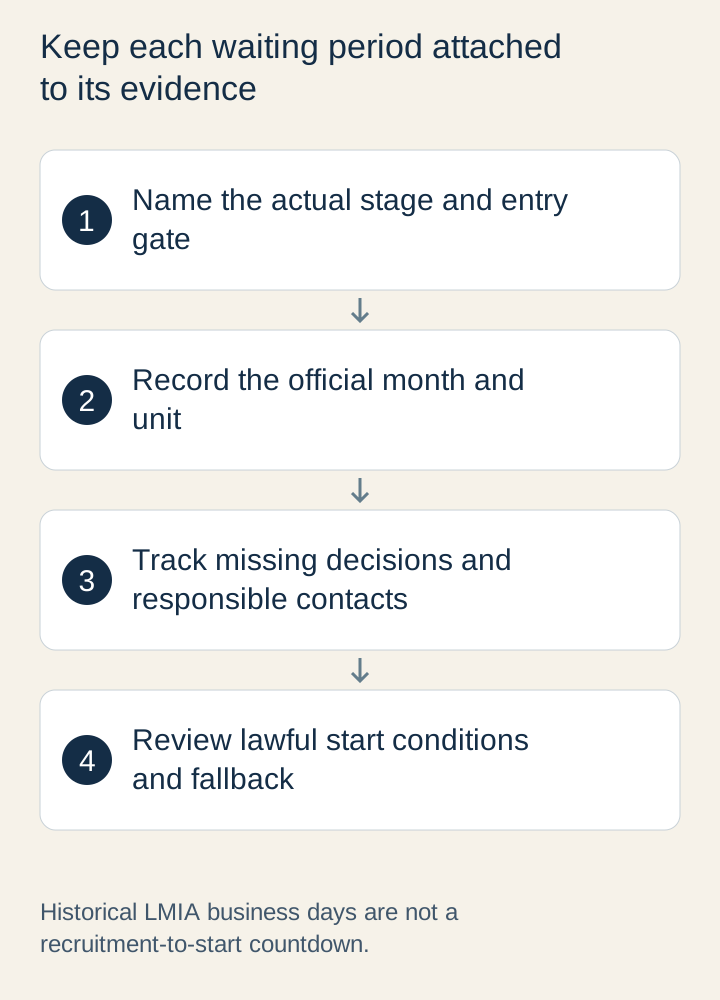
Keep a compact index of the vacancy and employer contact, current offer version, unresolved employment terms, relevant employer-side documents when provided, your personal application record and requests requiring an answer. Distinguish documents actually received from documents expected later. A folder named “approved” is not evidence of approval.
Use the same role and worksite descriptions consistently. If the offer changes while an assessment or application is being prepared, tell the relevant contact rather than treating the old document as current. The Canada offer-difference checklist can help you record the discrepancy. A corrected employment document and any necessary immigration response are separate tasks.
IRCC's employer-specific permit guidance explains that employer steps and supporting documents depend on the appropriate route, and that actual permit conditions matter. Do not infer that every job requires the same employer filing or that an LMIA-exempt job uses the LMIA timeline. If an exception or an expiring existing permit may affect your sequence, obtain an individual assessment rather than copying an overseas example.
For overseas applications, IRCC's decision-stage guidance describes possible requests for further information, an interview or a medical examination as applicable. It does not mean every candidate receives the same requests in the same order. Read the actual instruction and deadline you receive; do not book an unnecessary step simply because someone else's timeline included it.
6. Agree on a lawful start condition and a practical fallback
A printed start date is an employment planning target until the relevant conditions have been resolved. Ask what happens if permission, documents or the employer's operational arrangements are not ready. Who confirms that the job and site remain available? Who records the revised date? Which commitments should be reconsidered before money or notice to an existing employer is involved?
Keep preparation proportionate. Reviewing a resume, organizing a document index and discussing interview availability can often be done without promising an arrival date. A non-refundable move or an unconditional statement that you will start on a certain day is a different commitment. The right choice depends on actual conditions and your circumstances; the record helps expose those conditions without promising a risk-free decision.
The overseas approval letter of introduction is not the work permit itself, as IRCC's decision page explains. Entry and permit issuance still involve the border officer's decision. Do not describe an approval message as a permit already issued or use it to promise a particular first shift. This is also not an instruction that every applicant can apply at a port of entry.
Prepare a plain update: “I remain interested in the role. My next confirmed step is [fact]. [condition] remains unresolved. Could we review the proposed start arrangement when [relevant evidence or decision] is available?” Use genuine facts. If the delay changes the employer's needs, ask for the revised role and conditions in writing rather than assuming the original offer remains indefinitely available. Immigration questions can be referred for individual assessment through PremierVisa Group's Canada information.
7. Questions about waiting and starting work
Can I add the LMIA average to an IRCC estimate and promise a date?
No. The measures may use different units, starting conditions and application contexts, and practical preparation may overlap or depend on missing decisions. A record can show separate planning assumptions, but a sum does not become an official end-to-end deadline or a guaranteed start date.
Has the LMIA clock started when an employer says they are applying?
That statement does not establish a complete application. Ask which stage the employer can confirm and what evidence is available. The official assessment measure has a completeness boundary; it is different from recruitment, document preparation and advertising.
Does the faster stream mean I should ask to use it?
The correct stream depends on the job and applicable requirements, not the shortest figure in a table. Ask the employer to identify the actual category and its basis. An average cannot establish eligibility or an employer's ability to hire you.
What if the work-permit tool is unavailable?
Record the lookup date and the missing result, keep the field unverified and check again through the official tool. Do not replace it with another country's number or call it zero. Continue preparation that does not depend on knowing the decision date.
Can I begin while the paperwork is being completed?
A hiring promise does not establish permission. Check your actual authorization and conditions; any applicable exception needs its own assessment and evidence. Neither an LMIA, a pending application nor a visitor entry automatically permits you to start the proposed job.
Submit your job-search background to HKJobHunt to discuss your experience, resume, interviews and practical employer directions. Track employment, employer support, work authorization and permanent residence as separate outcomes.