
Compare an EB-3 job offer by separating the applicable wage requirement, the employer’s actual pay terms and the money your household may have available. A prevailing wage determination is not a take-home-pay estimate or a promise that a city is affordable. Put each offer on the same pay-period basis, exclude unconfirmed overtime from your basic budget and check deductions against the real contract. This guide provides an offer comparison record without inventing local salary or living-cost figures.
- 1. Identify the wage attached to the actual job
- 2. Compare the same unit and dependable hours
- 3. Separate gross pay, withholding and deductions
- 4. Build a budget around the actual shift and location
- 5. Use the six-field offer comparison record
- 6. Ask for clarification before accepting the comparison
- 7. Questions about comparing EB-3 pay
1. Identify the wage attached to the actual job
There is no useful single “EB-3 salary” that fits every occupation and place. Ask which job, duties, location and wage determination the employer is discussing. Under 20 CFR 656.40, the employer requests a prevailing wage determination for labor certification purposes through the designated process. A general online salary search does not replace that determination for the actual opportunity.
Record whether the determination has been obtained or is still pending, its stated wage unit and the relevant job context. If a recruiter sends a number without identifying the role or worksite, keep it marked as unconfirmed. A nearby city, a similar title or a different level of responsibility can make a comparison misleading. Do not select the lowest number from unrelated advertisements and treat it as the applicable standard.
The employer attestations in 20 CFR 656.10(c) address the offered and applicable prevailing wage, guaranteed pay where incentives are involved, and lawful employment conditions. Ask the responsible employer contact how the written offer reflects those obligations. This article does not certify an individual wage determination, resolve every state or local pay rule, or tell an employer which occupation to choose.
2. Compare the same unit and dependable hours
An hourly offer cannot be compared directly with an annual salary until you understand the hours and payment arrangement. Ask whether the quoted hours are an actual commitment, a usual schedule or merely an estimate. Identify paid and unpaid time, the pay cycle, variable shifts and any conditions affecting pay. “Up to” hours or earnings should not quietly become the guaranteed amount in your household budget.
Use a clearly labelled arithmetic exercise to see why this matters. These are invented teaching amounts, not U.S. market wages or real offers. Suppose offer A pays USD20 per hour for an assumed 35 paid hours each week; offer B pays USD22 per hour for an assumed 30 paid hours. Assuming 52 paid weeks, with no unpaid absence and no additional pay, their average monthly gross amounts would be approximately USD3,033.33 and USD2,860 respectively. The higher hourly figure produces the lower assumed monthly total.
The calculation is hourly rate multiplied by assumed paid weekly hours, multiplied by 52, then divided by 12. This is an annualised monthly average, not a promise of the cash received in every calendar month. Actual pay dates, unpaid periods and schedule changes can produce different cash flow. Do not use the calculation until you have labelled the assumptions; replace the invented inputs with employer-confirmed terms before relying on a comparison.
| Comparison item | Record for both offers | Why it matters |
|---|---|---|
| Pay unit and currency | Hourly, weekly or annual; USD amount and source | Prevents comparing unlike figures |
| Dependable paid hours | Confirmed terms versus usual or maximum hours | Separates a budget base from a possibility |
| Variable earnings | Overtime, shift premiums, incentives and conditions | Avoids relying on unconfirmed extra pay |
| Deductions and benefits | Payroll items, coverage, waiting conditions and costs | Gross pay is not spendable income |
| Actual location | Worksite, shift and feasible housing area | City averages may miss the real commute |
3. Separate gross pay, withholding and deductions
Gross wages and the amount deposited into your account are different. Ask payroll to explain each proposed deduction and its basis, including the employee share of any benefit. Keep tax withholding separate from housing, meals, equipment or service charges. A single “net salary” estimate with no assumptions cannot show whether family circumstances, tax treatment or optional benefits have been considered.
The IRS Tax Withholding Estimator is a tool for relevant federal withholding situations, not a universal take-home calculator. Its page says people with nonresident status for U.S. tax purposes cannot use it and directs them to the appropriate supplemental instructions. Do not infer your tax residence from your immigration label, nationality or days you hope to work. Use appropriate tax guidance for your actual circumstances rather than a flat percentage copied from another worker.
For employer-benefit expenses, DOL Fact Sheet 16 explains FLSA limits on certain deductions and reimbursements affecting required minimum wages and overtime. That is not permission for every deduction above a single threshold, or a complete analysis of state, local and immigration rules. Request the actual item, amount, frequency and written basis. A worker’s signature does not, by itself, answer whether an arrangement is permissible.
PERM-related cost shifting is a separate issue from ordinary household budgeting. If a deduction is described as repayment of employer recruitment or labor certification costs, preserve the explanation and obtain appropriate review. Use the invoice responsibility guide to organise that question. Do not include a questionable deduction in the budget and assume that doing the arithmetic makes it lawful.
4. Build a budget around the actual shift and location
Identify a realistic housing area for the worksite and shift. Check several current listings with comparable room arrangements and lease terms, recording their dates and what utilities are included. A state average or a rent quoted by another worker may not describe the accommodation you can actually obtain. If an employer proposes housing, ask about occupancy, family access, deposits, deductions, transport and what happens if the employment or housing arrangement changes.
Test the commute at the proposed working hours. A bus route shown on a daytime map may not operate when an early or late shift starts. Record the actual timetable source and the alternative cost if public transport is unavailable. If driving appears necessary, include the relevant vehicle, insurance, parking and operating costs rather than treating fuel as the entire transport budget. These are questions for a real local check, not a claim that every U.S. job requires a car.
Separate recurring household expenses from arrival cash needs. Rent and regular food spending belong in the ongoing budget; a deposit, initial accommodation, essential setup and travel may arise before the first paycheck. Note when money is needed, not only the annual total. Do not count an unconfirmed spouse’s wage, a promised raise or overtime that the employer has not committed to as the amount that makes the basic plan affordable.
If you want help turning the employment terms into clear questions for the employer, submit your background to HKJobHunt. The discussion can cover your job-search direction and preparation. Personal tax advice, a verified housing quotation or a legal opinion on payroll deductions is not automatically included; the appropriate support scope should be agreed.
5. Use the six-field offer comparison record
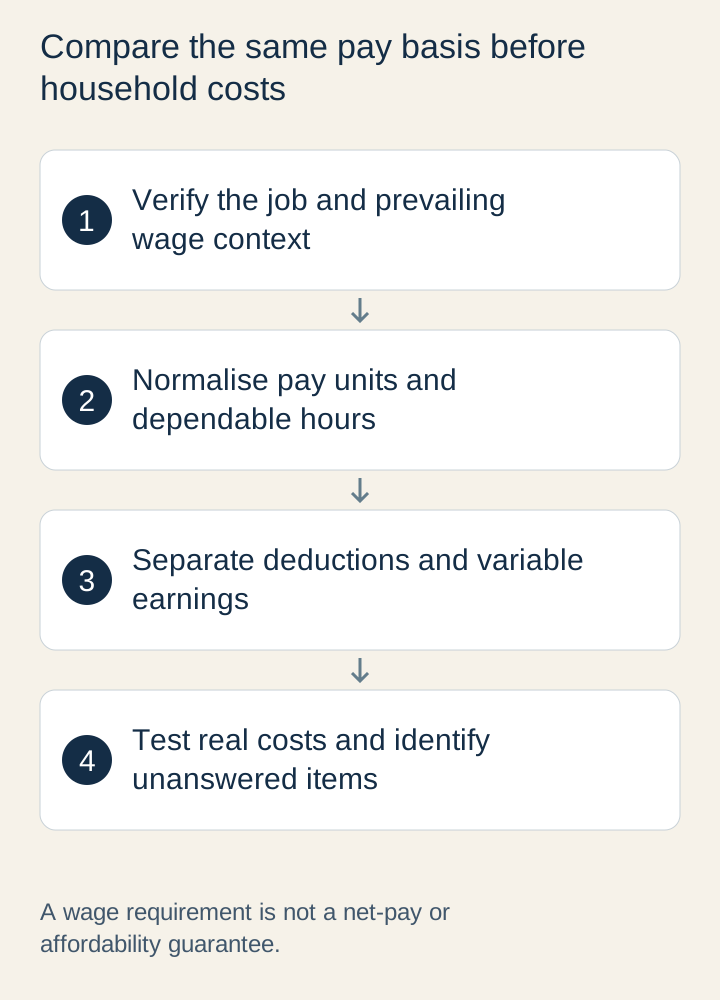
Keep one record for each offer version. Link every important input to its source and mark it employer-confirmed, externally checked, hypothetical or unresolved. This is a decision aid, not a government wage determination or an offer acceptance. Where you do not know a number, write “not obtained”; do not enter zero to make the totals balance.
| Field | Evidence or calculation to keep |
|---|---|
| Job and wage context | Employer, duties, worksite, determination position and wage unit |
| Base pay and paid time | Written rate, currency, dependable hours and actual pay cycle |
| Variable compensation | Conditions for overtime, premiums and bonuses; excluded from base if unconfirmed |
| Deductions and benefits | Each proposed item, basis, employee cost and unresolved review |
| Household and arrival costs | Actual local sources, recurring budget and timing of setup cash |
| Gap and next owner | Missing input, downside scenario, responsible contact and next question |
Use the offer comparison worksheet to keep those six fields together. For two possible roles, compare a normal scenario with a cautious scenario: no unconfirmed extras, a realistic commute and the actual household composition. The purpose is to show which unknown changes the decision, not to generate a convincing-looking disposable-income number from weak inputs.
Suppose a hypothetical higher-rate offer includes optional shared housing but the written terms do not say whether a spouse may live there. That is a decision gap, even before you know the rent. Record who must answer the occupancy question and what alternative would be needed. Do not present the shared-room price as a family housing budget, or turn a recruiter’s reassuring phrase into a confirmed benefit.
6. Ask for clarification before accepting the comparison
A useful written request is: “Please confirm the base rate and pay unit, paid hours, payment cycle, location and shift. Which additional earnings are guaranteed, and under what conditions? Please itemise proposed deductions and employee benefit costs, and explain the wage determination position for this role.” Adapt the request to the actual offer. You are asking for verifiable employment terms, not demanding a prediction of future tax or government approval.
Keep the reply with the corresponding offer version. If a verbal promise differs from the document, ask for the intended terms to be reconciled before you rely on them. Pay special attention to a move between locations or a different shift, as that can change both the employment comparison and household costs. Refer material changes to the responsible employer and appropriate professional adviser; do not decide that every change is automatically harmless or fatal.
A viable budget does not establish immigration eligibility or immediate work authorization. The Department of State employment-based visa overview explains later processing and availability separately from employer interest. Avoid making irreversible relocation decisions on a wage calculation alone. For wider immigration context, use PremierVisa Group’s U.S. overview; actual eligibility and services require individual assessment.
Once your comparison shows the genuine terms and remaining gaps, submit your job-search background to discuss resume, interview and employer-contact preparation. No salary, affordable housing, employer match, visa outcome or fixed arrival date is guaranteed. Keep the worksheet as your own record so you can revisit the decision when verified information changes.
7. Questions about comparing EB-3 pay
Is the prevailing wage the amount I take home?
No. It concerns the applicable wage framework for the job, not your personal net deposit or living budget. Compare the employer’s written pay terms separately from withholding, lawful deductions and household expenses. Do not describe a gross figure as disposable income.
Can I budget on regular overtime?
Only after understanding the actual commitment and applicable pay rules; do not assume extra work or earnings. Keep unconfirmed overtime outside the basic affordability scenario. Ask how hours, authorisation and pay are handled for the specific role rather than copying another worker’s schedule.
Does employer housing replace the need to check wages?
No. Record the wage and housing arrangement separately and have the actual treatment reviewed. Understand occupancy, cost, conditions and alternatives. A photograph of accommodation or a promise of “support” is not a complete benefit specification or proof of wage compliance.
Should I use the same tax percentage as another applicant?
No. Their circumstances may differ. Obtain an appropriately qualified estimate and confirm whether an official tool is suitable for your U.S. tax status. The IRS estimator expressly excludes nonresident tax situations; an EB-3 conversation does not determine that status.
What if the budget works only with an unknown benefit?
Keep that input unresolved and identify the person who can confirm it. Test the comparison without the benefit and consider the actual alternative. Missing information is not zero cost or guaranteed support; resolve the gap before treating the offer as financially workable.