
Before paying an EB-3-related invoice, match each line to the actual service, responsible payer, recipient and evidence of delivery. Employer PERM costs cannot simply be passed to a worker under a different label. Other personal, government and professional charges require their own checks. This guide helps candidates reconcile an invoice with a contract and receipt, including unresolved items after a payment. It does not certify a provider’s charges as lawful or quote a universal EB-3 package price.
- 1. Make one record for each charge
- 2. Identify the PERM responsibility boundary
- 3. Separate later-stage and personal charges
- 4. Complete the six-field reconciliation record
- 5. Resolve a mismatch without rewriting history
- 6. Review payment triggers and retain a usable file
- 7. Questions about invoices and receipts
1. Make one record for each charge
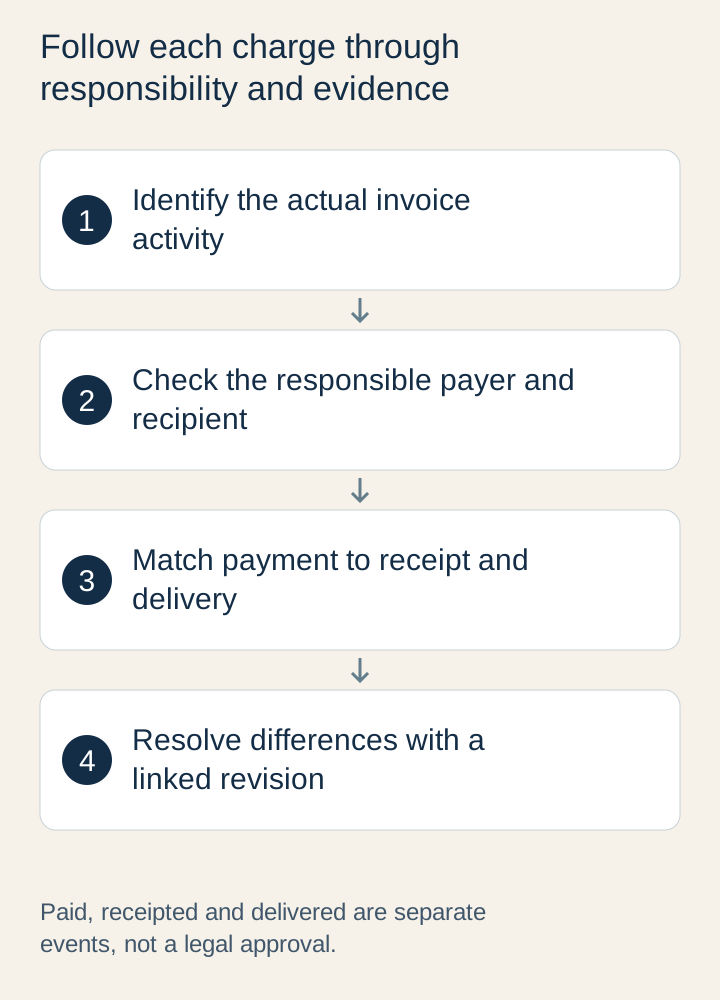
A single package total cannot show which work is being purchased. Start with the actual invoice and give each charge a reference you can reuse in correspondence. Link it to the relevant contract clause, quotation version and service stage. If several activities appear on one line, request an allocation before deciding who should pay. An attractive total or a familiar provider name does not answer the responsibility question.
Use precise descriptions. “Document translation for the candidate’s civil documents” is more informative than “processing.” “Employer’s permanent labor certification legal work” raises a different responsibility issue. These are illustrative descriptions, not findings that a particular service is necessary or chargeable to you. If the supplier cannot describe an activity without using the package name, the record is still incomplete.
Keep the original documents even when a revised bill arrives. Give the revision a new version and note which line it replaces. Do not overwrite a record of a payment just because somebody changes its description afterwards. Your objective is a traceable chain from request to decision to actual payment and receipt. That chain can help an appropriate professional understand a dispute without relying on fragments of a chat.
2. Identify the PERM responsibility boundary
The current 20 CFR 656.12 treats permanent labor certification applications and approved certifications as non-tradeable. It restricts an employer seeking or receiving payment for activities related to obtaining that certification, including its attorney’s fees. The provision also distinguishes a worker’s own costs and separate representation; where the same attorney represents employer and worker, the relevant costs fall on the employer. Read the actual relationship, not just the invoice heading.
The payment concept reaches beyond an upfront transfer: wage or benefit concessions, in-kind arrangements and free labor can matter. There is a limited exception involving an established business relationship and work benefiting the paying party. Do not treat that exception as permission to route a candidate’s money through an intermediary. Whether a particular arrangement falls within a rule or exception needs qualified review of the facts.
For an invoice line, ask: what activity happened, whose matter was it, who provided the service and who is legally responsible? If the explanation says the employer originally paid but the candidate must repay after arrival, preserve that explanation. A reimbursement can still raise the same substantive question. Calling it training, placement support or a refundable deposit does not itself change what the money funds.
| Item appearing in the record | Immediate check | What to avoid concluding |
|---|---|---|
| Employer PERM activity or related employer legal cost | Identify the activity and apply the PERM payment restriction | “It becomes payable because the worker signed” |
| Candidate’s separate legal representation | Confirm client, scope and whether counsel also represents the employer | “Every lawyer invoice can be charged to the worker” |
| Government visa-processing charge | Match official service, payment instruction and actual stage | “A private receipt proves the government received it” |
| Translation, medical or document expense | Identify need, provider, included work and actual evidence | “Every personal-looking charge is automatically permissible” |
3. Separate later-stage and personal charges
PERM is not the whole employment-based immigration process. The Department of State overview identifies later petition and visa-processing costs as well as medical, document and other possible expenses. Use the actual stage to locate the appropriate official instructions. Do not use the PERM rule to pronounce every EB-3-related expense employer-paid, or assume that anything outside a PERM line may automatically be charged to a worker.
For Department of State services, check the current Fees for Visa Services page when the payment becomes relevant. Record the named service, currency, applicable unit and the date checked in your private reconciliation file. This article intentionally does not turn a government fee table into a package quotation. Different services, family members and routes can involve different obligations, and official charges can change.
Keep a service provider’s handling charge separate from the amount described as an official fee. If the provider collects a third-party payment, ask for its authority to collect, how the amount is determined and what evidence will show onward payment. A bank transfer proves that money moved to the named recipient; it does not establish that a petition was filed, an official fee was accepted or a visa was granted.
For consular processing, follow the official payment instructions for the actual case. The Department of State warns against paying the NVC or interviewing post unless requested and explains that applicants receive instructions on where and when to pay. A message from a private contact saying “government deadline today” should therefore be checked against the actual notice and responsible channel, rather than treated as an official demand.
4. Complete the six-field reconciliation record
Use one row for one charge, not one row for an entire family’s package. The fields below are designed for operational follow-through. Keep any personal identifiers in a secure private file and share only the extracts a verified adviser needs. Do not put bank details, passport numbers or receipts in a public blog comment or an analytics link.
| Field | Entry to make |
|---|---|
| Charge and stage | Invoice line reference, real activity and relevant contract version |
| Provider and representation | Who performs the work, who receives funds and whose interests are represented |
| Responsibility and basis | Stated payer, supporting explanation and any unresolved legal question |
| Amount and coverage | Actual currency, amount, included services, conversion method and exclusions |
| Payment and receipt chain | Agreed trigger, actual payment reference, receipt and third-party evidence |
| Exception and next owner | Mismatch, requested correction, responsible person and next action |
Mark the row “unresolved” if evidence is missing. “Paid” is a financial event, not a compliance approval. “Receipt obtained” is another event, and “service delivered” is another. Keep them separate even if a provider’s portal displays a single green tick. A record is useful precisely because it reveals the missing connection.
The invoice and receipt worksheet provides these fields without requiring a form submission. If you want help organising employment-related questions, submit your job-search background. HKJobHunt can discuss the appropriate scope of support; a billing-law opinion, recovery action or immigration representation is not implied by sending an enquiry.
5. Resolve a mismatch without rewriting history
Consider an invented teaching example with no fee amount. A candidate’s invoice says “personal document support,” but an attachment says the payment reimburses the employer’s PERM recruitment activity. The candidate also has a transfer receipt naming the service company. Those documents conflict in purpose; the existence of a receipt does not resolve the responsibility issue. Keep the row open and request the underlying allocation and an appropriate review.
An itemisation request can be short: “For invoice line A, please identify the work performed, provider, client represented, payment recipient and basis for charging me. Please explain the difference between the invoice and its attachment, and identify any correction needed. I am retaining both versions pending clarification.” Use your actual line reference and facts. Do not accuse a named party of misconduct based only on an ambiguous description.
If the provider confirms an error, ask for a corrected invoice or credit record that refers to the original, explains the adjustment and shows the remaining balance. Check that related contract attachments and any future deduction schedule are consistent. A new heading alone is not a correction of the underlying service or payer. Record what changed and who confirmed it, rather than deleting the old evidence.
For a payment already made, retain the bank record, original request and receipt, and seek suitable advice on the actual issue and available next steps. Do not assume a refund entitlement, recovery deadline or enforcement outcome from this article. A private provider’s refund terms and the government’s treatment of official fees are separate questions. A promise to “return everything” should identify the specific funds, recipient and conditions before you rely on it.
6. Review payment triggers and retain a usable file
Ask what event makes the next amount due and what evidence identifies that event. An employer interview, a signed employment offer, a labor certification decision, a petition decision and a visa decision are different milestones. Tie the record to the actual notice or agreed deliverable. Do not accept an undefined “approval” as a sufficiently clear billing trigger, and do not interpret any one milestone as permission to work immediately.
Read every connected document for later obligations: payroll deductions, benefit reductions, deposits, cancellation provisions and repayment clauses may sit outside the fee schedule. Ask an appropriate reviewer to assess the substance and applicable law. A worker’s signature does not automatically make an otherwise prohibited PERM payment lawful. Equally, this guide does not decide every independent contract or wage-law issue from one sentence.
Before a transfer, verify the recipient through a trusted channel and compare it with the contracting and collection arrangement. A newly substituted account or unexplained personal recipient warrants clarification. Keep the eventual payment reference matched to the right invoice line and currency. If an exchange rate or bank fee is involved, record the agreed method so a payment is not mistaken for an unexplained shortfall. No hypothetical amount here represents market pricing.
At handover, keep an index of invoices, revisions, contracts, payment records, receipts, official instructions and unanswered requests. Give the next adviser a concise list of discrepancies rather than an unsorted chat export. Separate verified facts from another party’s explanation. For broader employer checks use the employer verification guide; for immigration context see PremierVisa Group’s U.S. overview. This guide’s added tool is the transaction-level reconciliation record, rather than another provider-price comparison.
If a fee discussion is preventing a sensible job-search decision, submit your background and the questions you need to resolve. Agree any document-review scope and secure sharing method before sending sensitive files. No payment purchases a guaranteed employer, job, visa or permanent residence, and HKJobHunt does not validate a particular invoice simply by receiving an enquiry.
7. Questions about invoices and receipts
Does every EB-3 cost have to be paid by the employer?
No universal conclusion follows from the programme name. Identify the actual activity and stage. The PERM payment restriction is particularly important, while personal representation and later government or document charges require separate checks. Ask for an itemised explanation instead of accepting either blanket answer.
Can a PERM cost be collected after I start work?
Delaying collection does not itself remove the issue. Preserve any deduction or repayment clause and have the actual arrangement reviewed against the applicable rules. Check both the initial contract and later employment documents so an obligation is not overlooked because it is absent from the first invoice.
Is an invoice plus a bank receipt enough evidence?
It may show a payment request and transfer, but not the recipient’s authority, lawful responsibility or delivery. Match the service and payer first, then obtain the relevant receipt and evidence of onward government or third-party payment where applicable. Do not describe a private receipt as a government filing notice.
Can I pay my own lawyer separately?
The regulation distinguishes the worker’s own representation and addresses a lawyer representing both parties. Confirm the actual client and engagement scope rather than relying on a separate invoice number. Let an appropriate professional assess the relationship and responsibility before you treat a fee as payable by you.
What if I have already paid a disputed line?
Retain the original and revised documents, payment reference and written explanations. Mark the unresolved question and seek appropriate advice on correction or recovery options for your circumstances. Do not alter evidence or assume that another customer’s refund outcome establishes your rights or a guaranteed recovery.