
Plan an EB-3 family move around each person’s verified immigration position, the principal applicant’s real job and the household’s practical needs. An approved employer petition does not automatically give every family member permanent residence, work permission or the same travel date. Build a family dependency record linking documents, income, school, care and housing to the conditions that must be confirmed first. This helps you prepare useful questions without assuming a guaranteed visa, spouse’s salary or school placement.
- 1. Give every family member a separate case line
- 2. Check the spouse’s work position before counting income
- 3. Prepare school and care questions for the actual district
- 4. Build the six-field family dependency record
- 5. Test both a together-move and a delayed-step scenario
- 6. Keep documents, responsibilities and changes visible
- 7. Questions families often ask
1. Give every family member a separate case line
Start with the principal applicant, spouse and each child on separate lines. Record the relationship evidence, present location, actual application position and outstanding questions. Avoid a single statement that “the family is approved” when only one employer petition has been decided. One person’s notice may be relevant to others, but it is not evidence that every individual has completed the necessary steps.
The USCIS EB-3 family section says a spouse and unmarried children under 21 may be eligible to apply with or after the principal applicant for admission as permanent residents based on an approved I-140. “May be eligible” and “apply” are important conditions. Identify the actual family relationship and process rather than treating a recruitment advertisement as confirmation that all relatives are included.
For a child whose age may be an issue, seek an individual CSPA assessment using current USCIS guidance. CSPA can protect some children through an immigration-age calculation, but it does not simply freeze everyone’s birthday or remove the unmarried requirement. Petition dates, visa availability, the applicable rules and required actions matter. Do not wait until a school term or planned flight to raise a possible age-related deadline.
The Department of State employment-based overview also explains that family applicants have their own forms, civil documents, fees and medical requirements where applicable. Keep a person-by-person evidence index and obtain the actual instructions. This guide does not decide derivative eligibility, calculate a child’s age, determine a later-joining process or promise simultaneous appointments.
2. Check the spouse’s work position before counting income
Separate the spouse’s desired career from the present permission to work. An employer’s support for the principal applicant does not itself authorise the spouse to begin a U.S. job. Ask what status or authorization the spouse actually holds or would obtain, when it becomes relevant and what evidence supports it. If the spouse is already in the United States under another arrangement, review that arrangement rather than assuming the EB-3 process replaces it immediately.
8 CFR 274a.12 distinguishes employment incident to permanent resident status from other authorization categories, including those requiring an application. Becoming a permanent resident is different from having a petition approved or an adjustment application pending. A family member’s work position should therefore be recorded separately from the principal applicant’s recruiting progress. Do not infer immediate work permission from a shared case number or travel plan.
Build a cautious household budget with only income that has a reasonable, evidenced basis. If the spouse has no confirmed job or cannot yet confirm permission for it, keep that earnings line unconfirmed instead of entering an expected salary. They can still prepare a truthful resume and investigate occupational requirements. For any regulated profession, actual local practice permission remains a separate question from immigration work authorization.
Discuss care responsibilities alongside work. An early shift, late shift or long commute can affect school pickup and whether a second job is practical. Childcare availability and an informal promise of help should not be treated as the same arrangement. For the principal’s pay, use the separate pay and cost comparison guide; this family plan focuses on who can perform each task and what must happen first.
3. Prepare school and care questions for the actual district
Identify the likely residential area and the school district responsible for it, then ask about the actual registration process, grade placement and required records. A recruiter’s statement that “schools are included” is not a school assignment. Nor does a convenient property advertisement establish that a child can attend a particular campus. Keep school confirmation separate from a proposed lease and the immigration case.
As a local example, Seattle Public Schools’ enrolment page describes registration for each student and documents concerning the guardian, address and immunization, with age evidence for specified entry situations. It also directs families needing document assistance to the relevant admissions process and describes special circumstances. Use it to see the type of question to ask, not as a nationwide checklist or a claim that every family must present an identical set of documents.
Prepare school reports, relevant learning-support records and contact details for the current school where appropriate. Ask the receiving school what it needs, whether translation is required and how records should be submitted securely. Do not publish a child’s report, health information or full identity documents in a housing group to obtain advice. Share the minimum relevant material with a verified recipient through the agreed channel.
Check the care gap between arriving, registering and the child’s actual attendance or care arrangement. School hours may not cover the principal applicant’s full working day. Ask who handles transport, unexpected closure and an appointment during work. For older children, ask the receiving school about subject or credit placement rather than promising that an existing grade will transfer unchanged. The family should know which questions remain open before committing to a rigid move date.
4. Build the six-field family dependency record
Use one row per person or practical task. Link the task to a condition, an owner and a source of evidence. This prevents a principal applicant’s possible start date from becoming the assumed date for the spouse’s job, a child’s school and an entire household move. Mark “not confirmed” where necessary; a blank does not mean there is no cost or no permission requirement.
| Field | What to record |
|---|---|
| Person or task | Principal, spouse, each child, school, housing or care responsibility |
| Verified position | Actual notice, employment term, district answer or other reliable evidence |
| Prerequisite | Permission, document, address, care arrangement or decision needed first |
| Owner and recipient | Who will obtain the answer and the verified contact who needs the record |
| Timing and cash need | Real deadline or conditional target, recurring or arrival expense |
| Alternative and update trigger | Backup if the condition is not met and what change requires reassessment |
For an invented example, a family has a proposed principal-applicant shift, no confirmed spouse’s job and a school enquiry awaiting an address. The next actions are different: clarify the real employment conditions, assess the spouse’s permission and contact the district about registration evidence. Calling the household “ready” because the principal has an offer would conceal those dependencies.
Use the family dependency worksheet without a form gate. If you need help linking your job-search background to employer questions, submit your background to HKJobHunt. State which family arrangements affect availability. Do not send children’s full files or financial records through an ordinary first enquiry; agree any necessary document scope and secure sharing method separately.
5. Test both a together-move and a delayed-step scenario
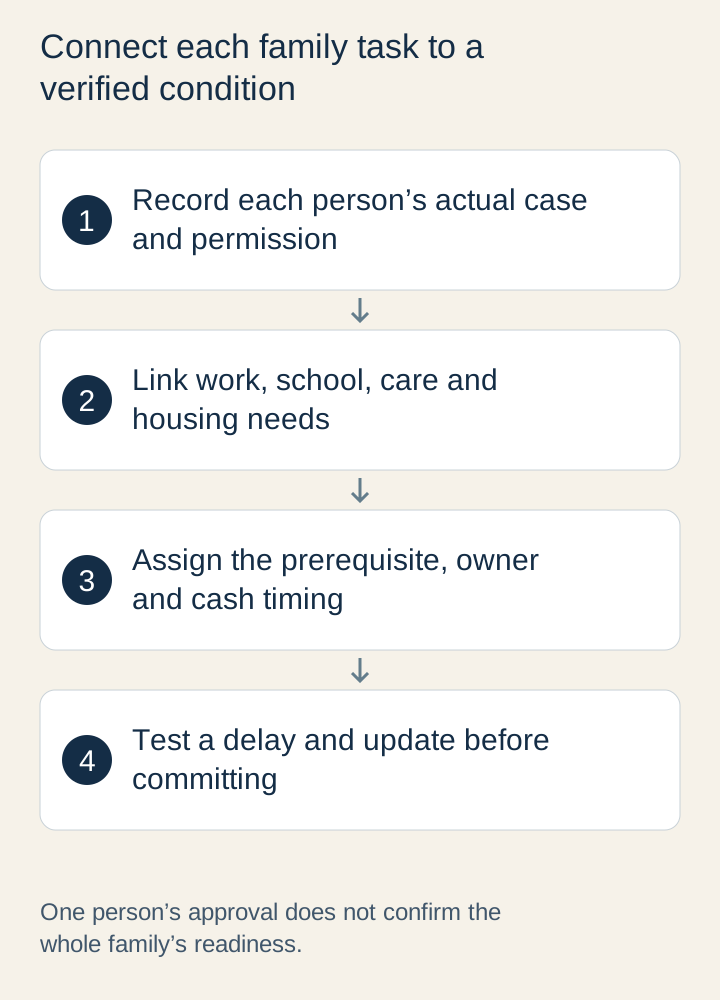
Compare practical scenarios while leaving immigration eligibility to the appropriate assessment. One scenario may explore moving together if each person’s conditions and documents are confirmed. Another may ask what happens if one person’s appointment, work readiness or school arrangement is delayed. These are planning exercises, not recommendations to separate a family or assurances that later travel is legally available in every case.
In each scenario, list which home remains occupied, who cares for the children, what income can be relied on and which expenses arise before a paycheck. Include temporary housing, deposits, transport, essential setup and any period of overlapping household costs where actually relevant. Obtain current quotations for the real location; do not present an invented “standard family relocation budget” as an official or local estimate.
If housing is linked to employment, ask whether it permits the actual family composition, how charges work and what happens when the arrangement changes. A shared room intended for one worker may not solve family accommodation. Check the commute and care logistics from that address. A lower rent can still be impractical if the shift requires transport or supervision that the family cannot arrange.
Ask the relevant benefits or insurance contact about coverage for each person, the start conditions, employee costs and any gap before coverage applies. Immigration medical requirements are not the same as ongoing household health coverage. This article does not recommend a policy, determine eligibility for public support or give medical advice; the record simply makes the unresolved coverage question visible before the move.
6. Keep documents, responsibilities and changes visible
Maintain a secure index rather than repeatedly circulating one large family file. Separate immigration relationship records, each person’s official notices, school documents and employer information. Record which is an original, certified copy or translation and what the actual receiving authority requests. Keep spelling differences or relationship changes explained; do not silently edit civil records to match an advertisement or another family member’s document.
Use a short employer question: “Which work location and shift are confirmed, what start conditions remain, and what does any proposed housing or benefit cover for my household?” Use a different district question: “For this actual address and student’s circumstances, what is the registration process and what should we prepare?” Different recipients can answer different parts of the plan; an employer cannot approve a school place or a family visa.
Review the record when the employer, duties, location, immigration decision, family relationship or care arrangement changes. A hoped-for arrival month, an official appointment and a work-authorized start are not the same event. Before resigning, withdrawing a child from school or accepting an irreversible commitment, identify which conditions have actually been confirmed and obtain appropriate assessment of the remaining issues.
For immigration background, see PremierVisa Group’s U.S. overview. Submit your job-search background to discuss resume, interview and employer-contact preparation that fits your real availability. Individual immigration and family issues need the appropriate scope of assessment. No whole-family approval, spouse’s job, school placement, housing availability or relocation date is guaranteed.
7. Questions families often ask
Does the principal’s I-140 approval approve the whole family?
No. Eligible relatives may apply under the applicable conditions, but each person’s requirements and actual process still matter. Keep separate notices and outstanding actions rather than describing an employer petition as all family members having permanent residence.
Can the spouse work while the case is pending?
Do not assume permission from the EB-3 process alone. Identify the spouse’s actual status or authorization, its conditions and whether it covers the proposed work. Permanent resident work rights and a pending application are different positions.
Is a child automatically protected from aging out?
No. CSPA may help some children, subject to the applicable calculation and conditions, including remaining unmarried. Obtain an individual assessment using the actual dates and required actions. Do not simply deduct every year spent waiting or assume a birthday was frozen.
Can we confirm a school before choosing an address?
Ask the actual district how residence and assignment are handled for your circumstances. A proposed neighbourhood or an agent’s promise is not an enrolment decision. The Seattle example illustrates local document questions, not a guarantee of a particular school or a universal requirement.
Should we move together or at different times?
Compare actual eligibility, documents, care responsibilities, work conditions and costs, then obtain appropriate individual advice. Neither arrangement suits every family. Keep an alternative plan for a delayed condition rather than assuming every appointment and start date will coincide.