
An EB-3 advertisement saying “no English needed” does not prove that an employer will hire you or that you can perform the job. Separate immigration eligibility, the actual role’s communication requirements and the employer’s responsibility to provide understandable safety training. Ask what you must understand, explain and confirm in the real workplace, then practise those tasks honestly. This guide provides a communication readiness record and clarification examples; completing them is not a language certificate, occupational qualification or hiring guarantee.
- 1. Turn the advertising claim into a specific question
- 2. Check occupational requirements as well as immigration facts
- 3. Identify the messages the job actually requires
- 4. Use the six-field communication readiness record
- 5. Practise clarification and accurate reporting
- 6. Ask how understandable workplace training is provided
- 7. Questions about “no English” advertising
1. Turn the advertising claim into a specific question
Ask what “no English” actually refers to. Does the provider mean it does not require a particular examination for its own initial enquiry? Is it describing one employer’s interview arrangements? Or is it claiming that no language-related requirement can apply to any EB-3 job? Those statements are different. A provider’s screening process cannot establish every employer’s requirements or override an occupational rule.
The USCIS EB-3 page describes different subgroups and the need to meet the job’s applicable requirements. A programme label does not establish that a specific candidate can do a specific job. Ask the employer for the actual duties and requirements, including how the interview and workplace communication are handled. Do not accept “other worker” as meaning that there are no real conditions.
Request an explanation tied to the position: who gives instructions, what language is used, what must be read, whether customers or officials are involved, and what happens when a message is unclear. Record the answer as confirmed, still being checked or merely a recruiter’s statement. A promise of a Chinese-speaking colleague should identify the actual arrangement and its limits, rather than being treated as guaranteed support on every shift.
2. Check occupational requirements as well as immigration facts
Some work has specific language rules. The current USCIS EB-3 page includes an alert about English proficiency for jobs operating commercial motor vehicles and the relevant labor-certification requirements. 49 CFR 391.11, within its applicable scope and exceptions, addresses reading and speaking English sufficiently for specified driving-related communication. Do not apply an advertisement’s blanket waiver to a driving role without checking the actual requirements.
This example does not create a universal English test for every EB-3 occupation. It shows why you must identify the actual duties and regulatory scope. A commercial-driving rule should not be copied into a kitchen or office checklist as if all jobs were regulated identically. Conversely, one employer’s bilingual team cannot erase a requirement imposed on a particular activity.
For a regulated occupation, ask the relevant authority or appropriate reviewer about the requirements for the real location and task. Keep any language evidence separate from the licence, qualification and immigration evidence it may support. A practice worksheet, course attendance or a consultant’s opinion does not automatically constitute accepted proof. This article does not determine a particular driver’s, nurse’s or other professional’s eligibility.
| Statement or evidence | What to check | What it does not prove |
|---|---|---|
| Provider does not ask for a named test | Scope of its own initial screening | Every job has no language requirement |
| Employer arranges interpretation for an interview | Actual arrangement and purpose | All workplace tasks can be done through interpretation |
| Candidate practises useful phrases | Whether the meaning is understood and used accurately | Accepted regulatory evidence or certified competence |
| Role has a specific language rule | Current official requirement and accepted evidence | The same rule applies to every EB-3 occupation |
3. Identify the messages the job actually requires
Build a small inventory with the employer. Include receiving a schedule, confirming a task, reading an authorised work instruction, reporting an error and asking for help. Add customer, telephone, written-record or team-handover communication only where the role actually involves it. The question is what you must be able to communicate, through which channel and with what support, rather than whether you can deliver a memorised introduction.
Describe your level using observable facts. “I can explain my previous routine duties slowly, but I need clarification when instructions are rapid” is more useful than “fluent” when that label is untrue. If you can read a message but struggle on a call, record both. A translated resume does not show that you can understand the same material in conversation, and a confident accent does not establish accurate comprehension.
Use an invented scheduling example for practice: a supervisor changes a meeting from an earlier time to a later time and names a different room. The candidate repeats the new time, location and person to contact. Missing one item reveals a specific practice need. This is a fictional low-risk communication exercise, not an employer’s shift notice or an assessment of safe equipment operation.
Ask whether an interview exercise resembles the real role and how it will be assessed. State when you need a question repeated. Do not let another person answer in your place while presenting the result as your own ability. If a recruiter proposes hiding a communication difficulty until arrival, record the unresolved requirement and seek clarification before making a commitment.
4. Use the six-field communication readiness record
Create one row per message or situation. Link it to the actual role and the employer’s explanation, then record what you can demonstrate and what still needs practice. This is a preparation record, not an English grade or an employment selection decision. A completed row should mean the question was investigated, not that the candidate has been certified for a task.
| Field | What to record |
|---|---|
| Actual situation | Schedule, task confirmation, report, handover or other genuine communication need |
| Channel and language | Spoken, telephone or written; employer-confirmed language and support |
| Requirement source | Employer contact, actual role instruction or applicable official rule |
| Demonstrated understanding | What you correctly heard, read and explained back; limitations noted |
| Clarification and support | Phrase or approved channel for checking meaning and the responsible person |
| Next practice and review | Specific gap, permitted practice material, next owner and update condition |
Use the communication readiness worksheet to keep the evidence and practice plan together. If you need help describing your experience and preparing for a real employer discussion, submit your background to HKJobHunt. Agree the actual support scope. A first enquiry does not certify English, arrange a job or appoint someone to assess regulated occupational competence.
For example, the record might show that a candidate understands a short written schedule but cannot yet confirm a changed time during a phone conversation. The next practice can focus on listening, repeating the critical details and asking for clarification. It should not become a broad claim that the candidate is incapable of every job, or that a few rehearsed sentences remove every communication requirement.
5. Practise clarification and accurate reporting
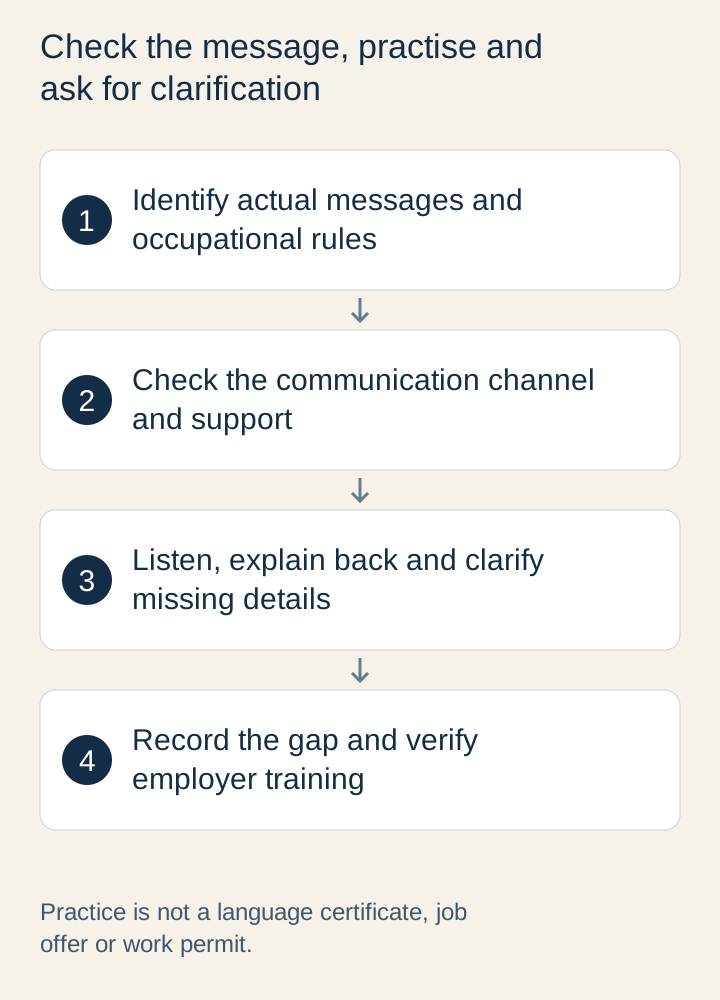
Start with a short invented message in a quiet practice setting. Listen, say what you understood, ask about the missing detail and check the final meaning with the practice partner. Use permitted sample materials and keep a note of the specific difficulty. Repeating the same script from memory may show familiarity with the script; varying the time, place or responsible person helps reveal whether you understood the message.
Three useful original examples are: “Could you repeat the last part more slowly?”; “Let me confirm the time and place”; and “I did not understand that instruction. Who should I ask?” Practise their meaning and when they are appropriate, rather than presenting them as mandatory government wording. They help identify uncertainty; they are not a substitute for the employer’s actual instruction, training or reporting procedure.
For reporting, distinguish a fact from a guess. In a fictional office exercise, “I received the new schedule but cannot confirm the room” is clearer than pretending the room was understood. For a work problem, describe what you know and ask the authorised supervisor how to proceed under the actual workplace procedure. A language exercise should not teach readers to improvise a technical repair, operate equipment or handle an emergency beyond their training.
Keep practice relevant and truthful in an interview. Explain a real previous task, the communication involved and what support you actually used. An invented success story or a translation presented as your own unscripted explanation can create misleading expectations. The separate interview guide covers broader interview preparation; this exercise focuses on understanding and clarification.
6. Ask how understandable workplace training is provided
OSHA’s training policy statement explains that training required by its standards must be delivered in a manner, language and vocabulary employees can understand. It also distinguishes actual comprehension from merely having a training record. This employer obligation matters; limited English should not be used as an excuse to provide incomprehensible required safety instruction.
Ask how the relevant employer checks understanding, provides a channel for questions and covers the actual shifts. Confirm the role of any interpreter or bilingual trainer and whether that arrangement is real. A colleague occasionally helping is not necessarily a complete training system. Equally, understandable training does not mean every job must waive its lawful communication or occupational requirements. Keep the employer’s training responsibilities and the candidate’s actual job readiness visible together.
Safety training belongs with the authorised workplace trainer and applicable procedures. Practice using fictional schedules and general clarification messages can prepare you to ask questions, but it cannot establish competence for live machinery, clinical work, driving or other regulated activity. If you do not understand an instruction, use the employer’s trained clarification and safety process; do not pretend comprehension to avoid embarrassment.
Immigration work permission remains another question. 8 CFR 274a.12 distinguishes authorization categories; a successful conversation or language exercise does not create that permission. For immigration background see PremierVisa Group’s U.S. overview. Submit your job-search background to discuss resume, interview and realistic employer-contact preparation without a guaranteed job or visa outcome.
7. Questions about “no English” advertising
Does “no named English test” mean an employer must hire me?
No. Identify what the provider’s statement covers, then check the real employer’s requirements and any occupational rules. An initial screening statement does not establish your ability, an available job or an obligation to employ you.
Should I memorise answers and hide that I need clarification?
No. Practise explaining real experience and asking when a message is unclear. A memorised answer can conceal a gap that matters at work. State your current level truthfully so the actual requirements and support can be assessed.
Can a translation app handle all workplace communication?
Do not assume that. Ask whether a tool is permitted and suitable for the actual task, confidentiality and timing. An app is not proof of accurate comprehension, accepted occupational evidence or an employer’s complete training arrangement.
Must required safety training always be in English?
OSHA’s statement focuses on training that employees can understand, including language and vocabulary. Ask how the employer meets the actual training requirement. That principle is distinct from a job’s lawful communication criteria or a specific regulated occupation’s language rules.
Does the commercial-driving example apply to every EB-3 role?
No. Check its actual regulatory scope and the duties involved. It demonstrates why a blanket exemption claim can be misleading, rather than creating one test for every occupation. Obtain appropriate assessment of the specific role and evidence.