
Nurses trained outside Hong Kong should identify the actual nursing role, check the relevant Nursing Council registration or enrolment pathway, and clarify employer selection and work permission separately. An overseas licence or a conditional offer does not establish authority to practise in Hong Kong. This guide helps candidates prepare an employer enquiry and a document-owner board for general nursing. It explains the differences between full, limited and special routes without assessing an individual's eligibility or promising an available position.
- 1. Identify the nursing role before approaching an employer
- 2. Compare the Council pathways without assuming automatic recognition
- 3. Build a document-owner board, not a pile of certificates
- 4. Prepare clinical experience and language evidence for recruitment
- 5. Ask the employer about the role, process and conditional offer
- 6. Keep nursing recognition and immigration as separate workstreams
- 7. Questions overseas-trained nurses ask before applying
1. Identify the nursing role before approaching an employer
Begin with the role's exact professional category and duties. Registered nursing, enrolled nursing and a care-worker position should not be treated as interchangeable labels. A care-related advertisement does not necessarily describe the nursing role you are trained for. Record the employing institution, service setting, professional title and the registration category it is asking candidates to hold or obtain.
Ask the hiring contact whether the role requires an existing Hong Kong registration or whether it is considering candidates through an identified non-local pathway. The answer should concern that actual role and institution. A general statement that Hong Kong needs nurses does not tell you whether a particular employer can support the pathway or whether your training fits its requirements.
The Government's 29 September 2026 nursing-workforce statement describes continuing service needs while maintaining priority for locally trained personnel in public recruitment. That context is not a personal hiring probability. This guide does not convert workforce figures or public recruitment activity into a promise that an overseas candidate will receive an offer.
Save the vacancy source and version before preparing documents. If a recruiter gives a different professional title or employer name from the advertisement, ask for clarification. Your early enquiry should establish what is actually being considered, rather than asking only whether someone can arrange a visa. Nursing recognition, employer selection and immigration involve different decisions and evidence.
2. Compare the Council pathways without assuming automatic recognition
Use the Nursing Council's non-locally trained nurses index to locate the relevant category. The comparison below concerns general nursing only and is a starting point for document preparation, not a complete eligibility checklist. Other practice categories need their own guidance.
| Route to investigate | What to clarify first | Who must contribute evidence | What it does not establish |
|---|---|---|---|
| Full registration or enrolment | Relevant application and licensing-examination assessment | Candidate, training institution and original registration authority | Automatic recognition of an overseas licence |
| Limited registration or enrolment | Selection for full-time employment in a designated institution and applicable conditions | Candidate, employing institution, school and regulator | Freedom to practise through any employer |
| Special registration or enrolment | Selection in a specified institution and applicable training and experience conditions | Candidate, employing institution, school and regulator | That limited and special routes are identical |
The full general-nursing guidance explains individual assessment and the licensing-examination process. It explicitly says the Council does not operate reciprocal registration or enrolment. Do not rename an overseas qualification as Hong Kong recognition before an actual decision.
The limited and special pages have different conditions, including employment context, training and clinical experience. Use the complete current page with the institution considering your application. A person saying “no examination route” has not answered whether the relevant criteria or institutional arrangements are satisfied.
Do not infer that every private clinic, hospital or residential facility can offer the same pathway. Ask the institution to identify the applicable category and its role in the process. If that point is unresolved, keep it as a gap; do not substitute a care-worker scheme or a medical-practitioner registration route because the names sound related.
3. Build a document-owner board, not a pile of certificates
The accompanying nursing evidence and responsibility board has six fields: role and institution; proposed registration category and question; qualification and current practice evidence; training and original-registration verification owners; clinical experience and language evidence; and the next action, permission dependency and responsible person. Complete one board for the actual enquiry rather than sending the same unexplained archive to every contact.
Begin by checking the name and dates across your graduation, registration and employment records. Record discrepancies honestly and ask what clarification is required. Do not edit an official document to make it match another one. If you have used different names, follow the applicable Council instructions rather than inventing a supporting explanation that the issuing body cannot confirm.
The Council's pathway pages distinguish material supplied by the applicant from verification sent by the training institution or original registration authority. Identify the appropriate school and regulator contact, ask about their process and record what has actually been requested. Your own scanned copy and an institution's required direct verification are different items; one should not be marked complete because the other exists.
For experience, prepare an accurate account of your role, setting, employment dates and duties. Distinguish post-qualification clinical experience from student placement, non-clinical work or a differently structured appointment. Ask the relevant institution how it needs the evidence documented. Do not inflate a title or combine unrelated periods into a confident eligibility claim.
The current full-route page contains an additional verification step for applications submitted on or after 1 June 2026, following a pass in the licensing examination. The limited and special pages require the March 2026 employer-certification annex for applications submitted on or after 16 March 2026. Apply each instruction to its own pathway and stage; do not treat one downloaded old form as suitable for all three routes.
Keep document progress factual: identified, requested, sent by the responsible body, or receipt confirmed. A courier receipt or an employer acknowledgement is not a Council decision. No fixed processing promise is made here, and a school or regulator's response is outside the candidate's sole control. Plan follow-ups around actual missing items rather than an assumed guaranteed start date.
4. Prepare clinical experience and language evidence for recruitment
A recruitment conversation should explain what you have actually done within your professional role. Prepare a non-identifying example of coordinating a handover, recognising that a concern needed escalation or maintaining accurate documentation. This is an interview preparation approach, not clinical advice or an invitation to disclose a patient's history.
An original experience sentence could be: “Worked within the ward's handover process, documented assigned observations and escalated concerns through the responsible clinical team.” Use it only if it accurately describes your work. Add the real setting and responsibility where appropriate, but do not claim independent authority, specialist competence or outcomes you cannot support.
Separate language tasks rather than writing a vague bilingual label. Ask about patient communication, team handover, documentation and the interview or assessment format. Your ability to read professional English does not automatically establish readiness for unscripted Cantonese communication. Equally, this guide does not impose a universal language threshold on every nursing role or registration pathway.
For an international candidate, state your actual working languages and limits. A Mainland candidate should distinguish Mandarin capability from Cantonese and written requirements. A Taiwan-trained candidate should explain the training and professional title accurately without assuming that a familiar Chinese title proves Hong Kong registration. The employer and Council still need the appropriate evidence.
If you need help organising the job-search account, share your background with HKJobHunt. Bring a role description and a non-confidential experience summary. A CV or interview discussion does not replace a regulator's assessment, institutional selection or appropriately engaged immigration advice.
5. Ask the employer about the role, process and conditional offer
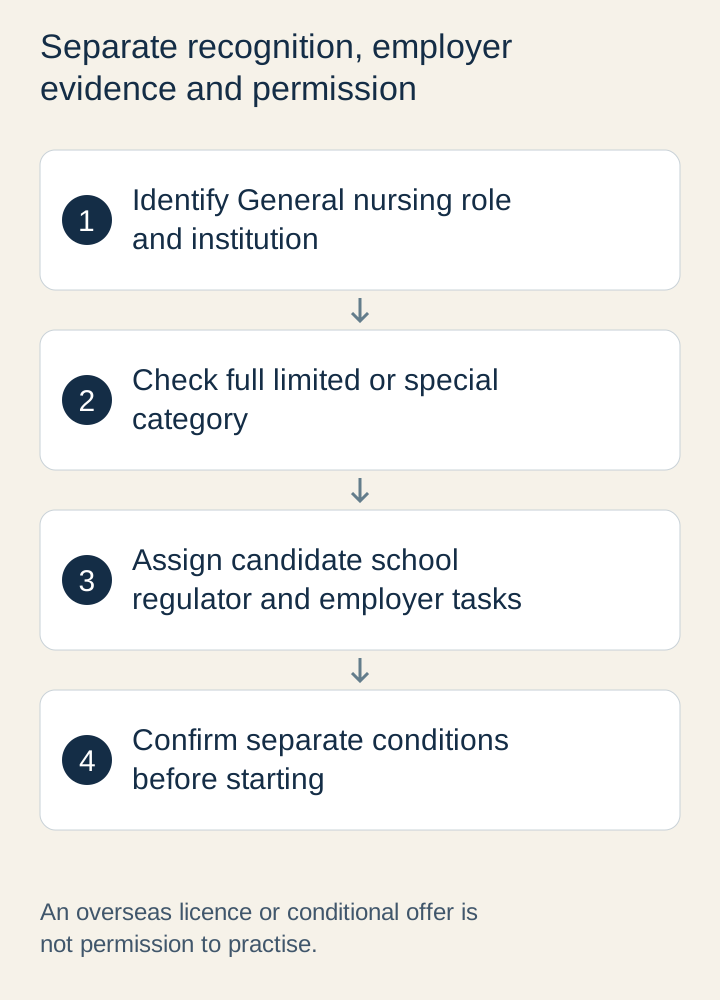
Use a verified employer-controlled recruitment channel or confirm the intermediary's relationship to the role. Ask for the actual employing institution and the relevant recruitment contact. A copied advertisement, a message using a hospital logo or an attractive title is not enough to establish the relationship. Do not send a full identity and qualification archive to an unverified recipient.
An original first enquiry might say: “I trained outside Hong Kong and can provide accurate details of my qualification, current nursing registration and clinical work. Does this general-nursing role require existing Hong Kong registration, or is your institution considering an identified non-local pathway? Which evidence should I prepare first, and who handles the institutional part?” Adapt it to your actual background and the role.
If invited to interview, clarify the professional category, clinical setting, duties, reporting arrangement and assessment format. Ask which conditions must be satisfied before the employment can begin. These questions help identify the next action without treating a positive interview as a registration decision. Keep the original wording of a conditional offer and identify what remains conditional.
Review the written role alongside the recruitment conversation. A different location, professional category or employing institution may change the preparation question. Ask who will resolve that difference and when, rather than assuming that an earlier discussion covers the revised arrangement. General offer-comparison questions are available in the Hong Kong duties and offer guide.
Before resigning or arranging travel, confirm the separate status of employer selection, professional permission and immigration. Do not rename “documents requested” as “registration approved” or “entry approved”. If a commercial intermediary claims guaranteed recognition or a reserved place, ask for the precise official basis and institutional confirmation; this article supplies neither a partner list nor a guaranteed job.
6. Keep nursing recognition and immigration as separate workstreams
The General Employment Policy and ASMTP have different applicant scopes and professional-employment requirements. The job and individual background require assessment under the actual applicable arrangement. A nursing qualification, an English interview or a Chinese-language CV does not choose the immigration route.
Do not copy a Mainland colleague's ASMTP label for a Taiwan applicant or assume every candidate living overseas falls under GEP. Existing permission, qualifying graduate circumstances and any separately applicable stream also need examination. State the real facts and the remaining question, rather than using a convenient label to make the employer enquiry sound complete.
The official visitor guidance prohibits visitors from paid or unpaid employment. Do not begin nursing work because an employer is preparing documents, a registration application is pending or a visit has been arranged. A change in immigration status does not by itself resolve professional authority to practise either.
For background, see the Hong Kong route guide and PremierVisa Group's professional-employment information. Keep individual service responsibility and the intended route clear. Recruitment, nursing registration, permission to work and any later residence question should not be collapsed into one “approved” label.
7. Questions overseas-trained nurses ask before applying
Does my overseas nursing licence automatically transfer?
No reciprocal recognition should be assumed. The Nursing Council describes individual assessment of non-local applications. Identify the relevant category and obtain the required training and original-registration verification rather than presenting an overseas licence as an existing Hong Kong entitlement.
Are limited and special registration the same route?
No. Their conditions and institutional context differ. Ask the institution which category is actually under consideration and check the corresponding Council page. A general description of an alternative pathway does not establish that the role or candidate meets it.
Can I forward my own transcript instead of school verification?
Follow the instructions for the particular application. The Council distinguishes applicant documents from verification required directly from institutions or registration authorities. A personal copy can help you check your records, but it should not be recorded as satisfying a direct-submission requirement without the required evidence.
Should I send patient case records as experience evidence?
Do not disclose identifiable patient or restricted employer material in an initial job enquiry. Prepare an appropriate non-confidential account of your own role and ask what formal evidence is needed through a verified channel. Clinical experience can be explained without turning a portfolio into a patient-data archive.
Is a conditional offer enough to start nursing work?
No automatic conclusion follows. Check what conditions remain, the professional permission required and the actual immigration position before beginning. An offer, an application and a decision are separate stages with separate evidence.
Submit your job-search background to discuss your CV, interviews and practical employer-contact directions. Bring the document-owner board and a clear question about the next recruitment step; professional recognition and immigration assessments remain separate.