Hong Kong employers onboarding overseas professionals should confirm the person's actual permission for the job, settle employment terms and statutory administration, and prepare a supervised first assignment before treating arrival as readiness to work. This guide is for managers receiving a new international hire, including teams coordinating with Taiwan or Mainland China. Its handover card connects permission, payroll, insurance, practical support and probation feedback. A flight booking, accepted offer or welcome email does not resolve those separate responsibilities.
- 1. Decide who can release the first assignment
- 2. Make the contract usable by both HR and payroll
- 3. Assign insurance and MPF tasks before they disappear
- 4. Prepare a first task the employee can actually complete
- 5. Use the permission-to-first-task handover card
- 6. Settle practical needs and probation expectations
- 7. Questions employers ask before the first day
1. Decide who can release the first assignment
Give the onboarding handover a named manager and an HR contact. One coordinates the work itself; the other confirms which employment and permission checks remain open. In a small company these may be the same person, but record both responsibilities. A recruiter saying that the candidate is ready is not evidence that the receiving supervisor has checked the current situation.
Begin with the proposed employing entity, actual role, normal location and reporting line. Compare those details with the agreed offer and the permission being relied upon. An employee moving within a group may be joining a different legal employer even when the brand and office look unchanged. Flag a mismatch before allocating duties; do not assume an internal transfer or payroll arrangement settles immigration conditions.
The Immigration Department's GEP conditions distinguish professionals on employment conditions, whose employment changes require prior approval, from qualifying top-tier professionals on time limitation only, who follow notification arrangements. Check the individual's current conditions rather than applying one rule to everybody. Mainland professional entry has its own ASMTP guidance; a Taiwan hire should not simply inherit the Mainland employee's travel checklist.
Keep a dated check record with a secure reference to the relevant evidence, the reviewer and any unresolved question. A shared welcome spreadsheet needs a status and an owner, not unrestricted copies of identity or travel documents. Where the evidence does not establish that the proposed work is permitted, resolve that question before assigning it. Do not present this practical record as a substitute for the employer's applicable document-checking duties or individual advice.
Visitors cannot take paid or unpaid employment under ImmD's visitor rules. Calling productive work an unpaid induction, trial shift or training period does not create permission. This is not a blanket classification of every interview or orientation activity: assess the actual activity and seek clarification where needed.
2. Make the contract usable by both HR and payroll
An onboarding pack should let the employee and payroll team find the same current terms. Keep the employing entity, job title, work location, agreed wages, allowances, wage period, notice provisions and any agreed probation arrangements together. Make clear which document controls when an earlier offer email and a later contract differ. Record agreed changes through the proper process rather than silently replacing the file.
The Labour Department's employment-contract guidance sets out information to give before employment begins and requires a copy for the employee when the contract is written. Use that official guidance to check completeness. Do not interpret a signature as allowing a term to remove statutory protection. This article's checklist is an original administrative aid, not a replacement employment contract.
Ask payroll to confirm receipt of the final terms, the real commencement information and the contact for corrections. A manager should not write “salary arranged” merely because a bank-details request was sent. Separate information requested, information received, payroll setup checked and actual payment. Avoid asking the employee to share banking credentials or to post account documents in a team chat.
For an international hire, explain that the contract's HKD amounts are Hong Kong dollars. If the person budgets in another currency, a conversion for personal planning does not amend the contractual wage or promise an exchange rate. Separate fixed pay, conditional payments, reimbursement and benefits. A housing-information sheet is not a housing allowance unless that allowance has actually been agreed.
Use a simple correction request: “Please confirm which version contains the agreed allowance, who will update payroll, and when I will receive the corrected copy.” The useful outcome is a consistent record, not another acknowledgement that leaves conflicting versions in circulation. For an earlier offer review, use the separate offer checklist; the onboarding pack itself should retain the actual agreed documents.
3. Assign insurance and MPF tasks before they disappear
Insurance, retirement administration and optional employee benefits need separate owners. The Labour Department explains that employees' compensation insurance must cover the employer's relevant liabilities for employees, including full-time and part-time staff. Confirm effective cover and the actual duties and locations with the responsible person before employment starts. Do not treat a private medical benefit or a pension arrangement as evidence of that cover.
For MPF, first establish coverage and any applicable exemption using the employee's actual circumstances. Overseas origin is not, by itself, a complete exemption assessment. Use the current MPFA enrolment guidance, assign the applicable deadline and retain the enrolment outcome. Regular and construction or catering casual employees have different arrangements; do not copy one team's deadline across every worker category.
Probation does not justify postponing otherwise applicable MPF duties, as MPFA's probation explanation makes clear. A good internal record therefore distinguishes an enrolment request from an accepted account and a payroll deduction from a remitted contribution. If an item has failed, record the real problem and obtain the appropriate correction steps instead of changing the original start date.
Use three administrative states: evidence received, action completed and outcome checked. Record who can access the supporting material and who covers the task during absence. The supervisor does not need to choose the employee's investment fund or collect their medical history to know whether an administrative follow-up is open. Ask the relevant provider or authority about an uncertain case rather than inventing a blanket exemption.
If the receiving team needs help turning a job description into practical recruitment and interview arrangements, submit the employer's requirements. HKJobHunt can discuss the scope of assistance; employer compliance decisions and provider confirmations still need their actual responsible owners.
4. Prepare a first task the employee can actually complete
Prepare one bounded assignment with an output, a supervisor and a review point. “Learn our systems” is too vague to reveal whether the equipment works or whether the employee understands the job. A better first assignment might be to prepare a draft handover note from an authorised training example, identify missing information, and explain the next action to the supervisor. This is a fictional teaching example, not a vacancy or client case.
Check the workstation, necessary software, access permissions and approved source material. Provide individual accounts through the company's normal process; do not circulate another employee's password to save time. Decide which actions require approval and who can answer a question when the main supervisor is unavailable. Start with the minimum access needed for the task, then adjust through the established approval process.
Explain how to report an error, an unsafe situation or an absence. Show the employee where relevant workplace and emergency instructions are kept, and who provides role-specific training. A welcome tour and signed attendance sheet do not demonstrate that the person can safely perform every duty. If a role involves regulated activity, have the relevant authorisation and supervision requirements checked separately before assigning that activity.
For multilingual teams, name the language needed for each real activity. A person might discuss a workflow in English but need help reading a local internal form. Provide an explanation or agreed support and check understanding through a practical example. Avoid treating unfamiliar office shorthand or an accent as proof of poor performance. Distinguish a training gap from a system that has never been explained.
At the review, ask the employee to describe what they did, what remains uncertain and which decision needs approval. Record the actual observation and any support given. If the system was unavailable, do not score the missing output as though the employee had a fair opportunity to produce it. Carry unresolved operational items forward with owners.
5. Use the permission-to-first-task handover card
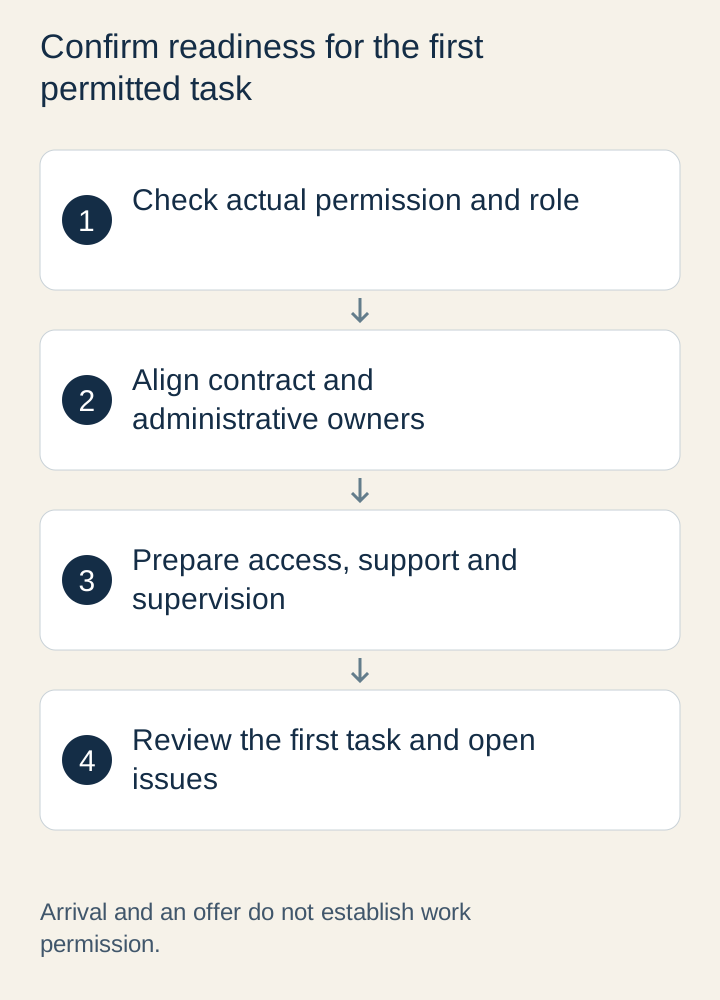
This original card joins the receiving team's responsibilities without recreating the whole recruitment timetable. Keep one card per hire, with version date and restricted supporting references. The following fields describe what to record; they are not a statutory form or a certificate that the company has met every duty.
| Card field | Useful entry | What leaves an unresolved risk |
|---|---|---|
| Person and actual role | Entity, role, location and supervisor agreed | Brand name only |
| Permission check | Reviewer, current evidence reference and open question | “Visa underway” |
| Contract and payroll | Current terms version, employee copy and payroll owner | Old offer forwarded |
| Insurance and MPF | Separate applicability, action, outcome and deadline owners | “Benefits handled” |
| First task | Permitted activity, access, output and reviewer | “Help the team” |
| Support and review | Practical request, responsible contact and next review | Welcome message only |
For example, an invented operations coordinator is ready for a supervised internal task, but the software account cannot open the training folder. Record the access owner and the revised assignment; do not hand over a colleague's account. Separately record any permission question without assuming that an IT fix resolves it. “Ready” should always name the activity for which readiness has been established.
Use an end-of-handover question: “Which unresolved item could stop this person completing the first approved task, who owns it, and what evidence will close it?” This exposes gaps hidden by a general green status. Keep the detailed onboarding conversation accessible to the people doing the work while restricting sensitive documents to the appropriate administrative channel.
6. Settle practical needs and probation expectations
Offer practical information about reaching the workplace, the contact if arrival is delayed, building access and the agreed first reporting point. Ask whether temporary accommodation information would help, but distinguish an information list from a booking, company-funded benefit or regulated property service. Confirm payer, cancellation terms and reimbursement approval before anyone commits money. Do not promise a suitable flat, school place or bank account.
The employee can maintain a private relocation budget while the employer records only agreed company commitments. Family arrangements should be discussed only to the extent needed for a requested support decision. A manager does not need the family's full travel, medical or financial history to confirm a flexible meeting time. Use optional, proportionate questions and the normal confidential channel.
Explain the agreed probation objectives and review method at the start. Define observable work outputs, the training offered and how concerns will be raised. Probation is not an automatic exemption from employment obligations, nor does passing it change the individual's immigration conditions. A review should distinguish the employee's actions from delayed access, unclear instructions or missing supervision.
If the role or employing entity changes, revisit the contract, operational arrangements and actual permission requirements before the new activity. For case-specific immigration questions, consult the PremierVisa Group professional-employment guide. The guide provides further context; neither an onboarding checklist nor a recruitment discussion guarantees a visa, continuing work permission or permanent residence.
7. Questions employers ask before the first day
Can we begin because the employee has arrived in Hong Kong?
Arrival alone does not establish permission for the intended work. Check the person's current conditions, the proposed entity and duties, and any outstanding entry or employment-change step. If unclear, resolve it before assigning the activity. An offer or travel receipt cannot fill that gap.
Can MPF wait until the employee passes probation?
Do not use probation as the reason to delay an applicable duty. Check coverage, exemptions and the correct employee category under current MPFA guidance, then allocate the actual enrolment and contribution tasks. Retain outcome evidence rather than marking a request email as completion.
Does our medical plan settle the insurance check?
No. Verify employees' compensation cover separately with the responsible person and insurer, using the actual employment and work details. Optional medical benefits answer a different question. Keep the evidence reference and renewal follow-up within the appropriate administrative record.
What if the employee cannot complete the first assignment?
Check whether instructions, access, supervision and role-specific training were available before judging performance. Record the specific gap, corrective owner and another opportunity to demonstrate the task. A system failure should not become a fictional observation about ability.
What should we send a recruitment consultant?
Start with the actual role, required outputs, location, proposed support and unresolved recruitment questions. Avoid sending identity documents or confidential employee records through a public enquiry. Submit your hiring requirements to discuss talent search, screening and interview arrangements with HKJobHunt, part of the PremierVisa Group service network. Any further scope and terms must be agreed for the case.