
Chefs approaching Hong Kong employers should match their real kitchen experience to the specific duties, identify the employing company and clarify the applicable work-permission arrangement before committing. A restaurant advertisement or a promise of sponsorship does not establish approval. This guide provides a kitchen-role and contract comparison sheet, practical evidence examples and employer questions. It distinguishes professional-employment discussions from the Enhanced Supplementary Labour Scheme, whose catering requirements and contract versions need current checks rather than assumptions based on an old advertisement.
- 1. Read the kitchen responsibilities behind the title
- 2. Prepare experience evidence you can honestly explain
- 3. Clarify the employment arrangement before choosing a route
- 4. Check the current catering rules and the contract version
- 5. Use the six-field kitchen-role and contract sheet
- 6. Verify the recruitment channel and keep starting conditional
- 7. Questions overseas chefs should ask before committing
1. Read the kitchen responsibilities behind the title
A title such as chef, cook, section chef or kitchen supervisor is a starting point for questions. Ask what the person actually prepares, which station they cover, who supervises the work and whether they manage staff, ordering or service coordination. Do not assume that a familiar title from your home market has the same authority or scope in the Hong Kong role.
Save the original vacancy and date. Record the cuisine, production setting, work location and employing entity. A hotel, restaurant group, central kitchen and client-site operation may describe different working arrangements. These are categories to investigate, not a statement that every business in one category hires overseas or supports a particular entry route.
For a fictional pastry position, your relevant evidence might explain preparation planning and maintaining consistency across service. For a role involving a hot-kitchen station, a different example may be more useful. The point is to connect the real duty to your own work instead of assuming that attractive food photographs demonstrate every aspect of kitchen responsibility.
If the advertisement and recruiter describe different duties, write the discrepancy down. A proposed position that changes from section work to general duties needs clarification before you select evidence or compare the contract. Do not agree to a more impressive title on paper while being told privately that the actual work will be something else.
2. Prepare experience evidence you can honestly explain
Build a concise record of employers, employment dates, actual position and duties. Add relevant qualifications and training without renaming them as Hong Kong recognition. Ask previous employers for appropriate experience confirmation where needed. If a document is unavailable, record the gap rather than replacing it with an invented reference or an unsupported statement of seniority.
An original CV rewrite could change “Responsible for kitchen work” to “Prepared the assigned station's service plan, coordinated ingredient preparation and checked the handover of outstanding tasks with the kitchen team.” Use this only if it describes your contribution. Do not add a volume, cost reduction or supervisory role simply because it sounds more competitive.
Photographs can support a discussion of work you are entitled to show, but they need context. Explain what you personally prepared, whether the image represents a practice exercise or commercial service, and what the example does not demonstrate. Do not claim a restaurant award, another chef's dish or a team menu as your sole achievement.
Choose non-confidential evidence. A self-created practice menu or a permitted description of workflow can be useful without revealing an employer's restricted recipes, supplier prices or customer information. If you share a team example, identify your own part. Your ability to discuss a preparation decision should survive a follow-up question without relying on private material you have no authority to disclose.
Prepare a short account of a service challenge and how you handled your assigned responsibility. Keep it about your experience rather than offering unverified food-safety instructions. Ask what the prospective employer expects for communication, supervision and training. This guide helps with recruitment preparation; it does not certify professional competence or replace the employer's assessment.
3. Clarify the employment arrangement before choosing a route
The General Employment Policy and ASMTP consider professional employment within their respective scopes. A chef title does not automatically satisfy those conditions. The actual duties, relevant background and applicant circumstances matter, and Mainland, Taiwan and other overseas candidates should not copy each other's route labels without assessment.
The Immigration Department's ESLS guidance describes a different employer-led labour-importation arrangement. It separates Labour Department approval-in-principle from the worker's visa or entry-permit application. An employer saying it has applied is not evidence that the relevant approval is valid, covers the proposed position or establishes the individual's permission to work.
Use the following original comparison to organise questions. It is not a finding that any particular chef role qualifies.
| Issue | Professional-employment discussion | ESLS discussion |
|---|---|---|
| Actual job | Clarify duties and relevant professional background | Compare the job with the approved position and contract |
| Employer evidence | Identify the employing entity and applicable assessment | Ask about the employer's actual approval and responsible contact |
| Candidate evidence | Show accurate qualifications and experience | Show suitability for the specified job and applicable application |
| Written terms | Compare duties, remuneration and start conditions | Check the required Standard Employment Contract and applicable version |
| Outcome | Recruitment does not establish immigration approval | Approval-in-principle does not replace the worker's entry decision |
Any separately proposed stream needs its own current criteria; do not treat Technical Professionals Stream terminology as a synonym for every skilled kitchen job or for ESLS. Ask the employer which arrangement it is actually considering and why. A clear unanswered question is better than a confident route label that the documents do not support.
4. Check the current catering rules and the contract version
The Government's 15 June 2026 announcement describes catering-related ESLS changes implemented from 16 June 2026. For the relevant production and table-service posts, it specifies a 3:1 ratio of local full-time employees to imported workers calculated across the section, a six-week local recruitment period and employer participation in recruitment fairs every two weeks during that period. These are employer-side requirements, not a candidate's promised processing time.
Do not reuse an old statement that all catering applications follow a four-week recruitment exercise. Ask the employer to confirm the category, relevant requirements and actual stage of its case. The announcement also discusses other changes, so a short summary here should not be treated as a complete employer compliance checklist or as approval of a particular establishment.
The Labour Department ESLS page lists September 2026 revised application forms and distinguishes several Standard Employment Contract versions by the case's preliminary-screening and approval circumstances. Check the version required by the relevant approval notification. The newest file name alone is not enough to decide which version applies to an older case.
Compare the proposed duties, employer and approved workplaces with the actual documents. Do not assume a verbal instruction to move between branches is covered. Equally, do not reduce the current arrangements to a blanket claim that every approved worker has only one workplace; the relevant approved scope needs to be read. Record any discrepancy and the responsible person who will resolve it before commencement.
Check wages and proposed deductions against the applicable current requirements and contract. This guide does not supply a market salary, a deduction percentage or a net-pay estimate. Keep base pay, variable items, accommodation arrangements and any proposed deductions separate, and ask for the basis of anything unclear. An agency's all-in figure is not a substitute for the written terms.
If you need help organising these questions, share your job-search background with HKJobHunt. Bring the actual role and a non-confidential comparison of the terms. A preparation discussion does not confirm employer approval, a contractual entitlement or a guaranteed work-permission result.
5. Use the six-field kitchen-role and contract sheet
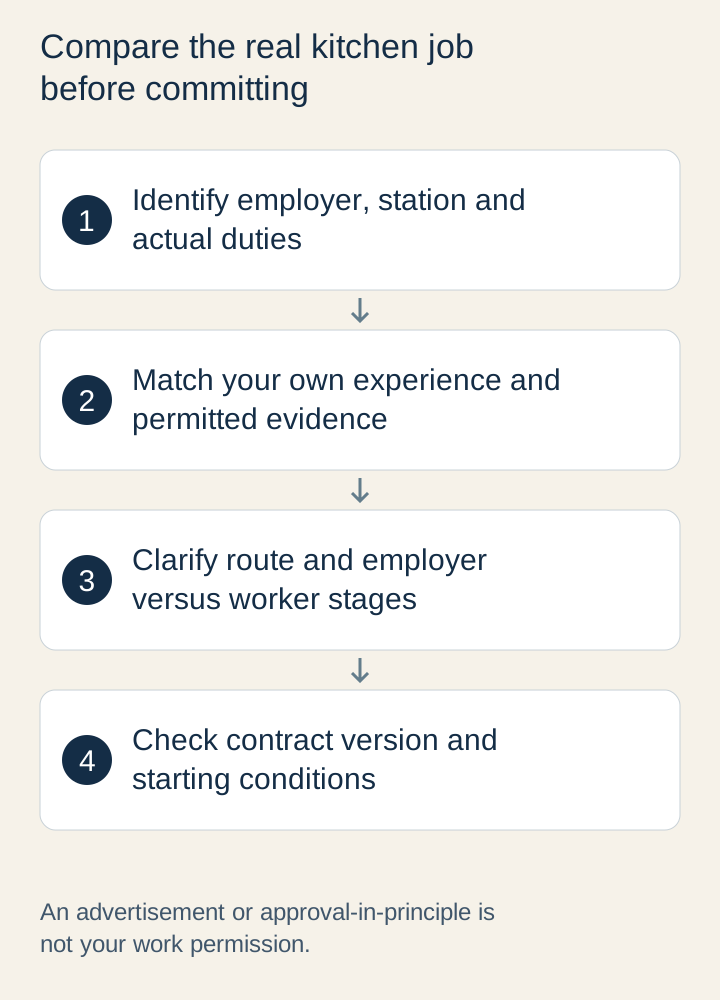
The accompanying kitchen-role comparison worksheet connects the recruitment conversation to the written arrangement. Use one sheet per genuine opportunity. It is an original preparation tool, not an official form, a job offer or a list of employers with available sponsorship places.
Field one records the original role, employing entity, source and date. Field two describes the station, actual duties and supervision. Field three records your own relevant experience and permitted evidence. Field four captures the proposed route, employer-side stage and unresolved question. Field five compares written remuneration, hours, location and contract version. Field six records the discrepancy, responsible contact and condition that must be resolved before starting.
For example, imagine the advertisement says pastry preparation at one establishment, while the interview mentions general kitchen work at several branches. Do not mark the sheet as a match simply because the company name is unchanged. Ask which duties and workplaces the written offer and any relevant approval actually cover, then record the answer and the supporting document.
A useful clarification might be: “Could you confirm the employing company, the station and duties, the approved workplaces where relevant, and the contract version required for this case? I also need to understand which conditions remain before I can begin.” Adapt it to the actual arrangement. The purpose is to obtain an answer that can be compared with documents, not to demand confidential company information through an informal channel.
Use the Hong Kong offer and duties guide for broader written-offer comparisons and the CV guide for truthful experience wording. This article adds the kitchen-role, route and contract-version questions rather than repeating a general visa application overview.
6. Verify the recruitment channel and keep starting conditional
Use an employer-controlled application channel where available or verify an intermediary's relationship to the actual role. A copied photograph of a kitchen, a restaurant logo or a promise that a place can be purchased is not evidence of an available lawful job. This guide supplies no partner roster, guaranteed appointment or paid sponsorship offer.
For Mainland recruitment under ESLS, the official immigration guidance describes employer submission and recruitment through appropriately approved Mainland labour service enterprises. Do not assume that any individual advertising an introduction meets that requirement. A Taiwan applicant should not copy Mainland-specific recruitment paperwork merely because the role is similar; confirm the applicable documents for the actual background.
Agree the scope of any interview demonstration in advance. Ask where it takes place, whether it is a demonstration or productive work, and what arrangements are required. The visitor rules prohibit paid or unpaid employment by visitors. Do not begin a trial shift because an employer says the paperwork will follow. This guide does not decide the legal character of every individual assessment.
ESLS also has distinct residence and family implications. The Immigration Department states that imported workers under the scheme cannot bring dependants under that arrangement and that their stay as imported contract workers is not treated as ordinary residence for acquiring right of abode. Do not market this job-search route as an automatic permanent-residence programme or borrow family arrangements from GEP.
For professional-employment background, PremierVisa Group's Hong Kong information is a separate reference, not an ESLS approval page. Confirm the intended route and service responsibility for any individual advice. A recruitment discussion, a contract, entry permission and later residence questions remain separate decisions.
7. Questions overseas chefs should ask before committing
Does a chef title automatically qualify for GEP or ASMTP?
No. The actual professional role, relevant experience and applicant background need assessment under the applicable criteria. Do not upgrade a title on paper to make a different job appear eligible. Ask the employer what arrangement it is genuinely considering.
Is Labour Department approval-in-principle my work visa?
No. ESLS separates the employer's approval-in-principle from the worker's immigration application and decision. Check what the actual approval covers and which individual steps remain. An application in progress or verbal statement should not be recorded as an entry approval.
Should I use the latest contract for every ESLS case?
Check the version required for the particular preliminary-screening and approval circumstances. The Labour Department lists distinct versions and explains their scope. Use the relevant notification and current guidance rather than choosing only by file date or colour.
Can I work at another branch if the manager asks?
Do not assume that an informal request establishes permission. Compare the actual approved workplaces and written arrangement, and clarify any proposed change before acting. The answer depends on the applicable documents and conditions, not simply on whether both branches share a brand.
Will the job guarantee permanent residence or family entry?
No such guarantee is made. ESLS has specific restrictions and is distinct from professional-employment arrangements. Confirm the actual route before planning family relocation or residence expectations; a job title and a long-term intention do not change those conditions.
Submit your job-search background to discuss CV preparation, interviews and practical employer-contact directions. Bring the kitchen-role sheet and the unresolved contract question so the next step is based on the real job, not a promise of a purchased place or guaranteed approval.