
If you are looking for work in Canada without Canadian experience, start by checking whether each application makes your relevant skills, work authorization and practical availability clear. Silence alone cannot show why an employer did not respond. This guide helps newcomers already in Canada and applicants overseas diagnose the gap, present truthful overseas achievements, prepare references and practise an interview. Requirements for regulated occupations and permission to work need their own checks; a stronger resume cannot replace either.
- 1. Diagnose where the application stops before changing your whole career story
- 2. Translate the work, not just the job title
- 3. Explain your actual permission and location without making a sponsorship promise
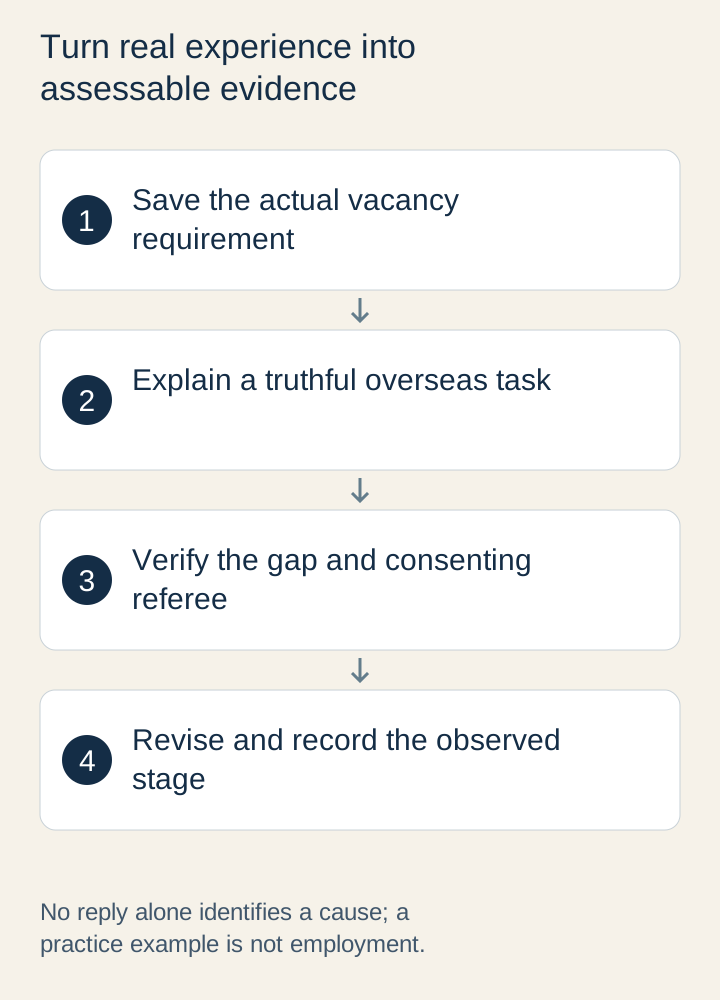
- 4. Use a six-field evidence record to revise one application
- 5. Prepare references and practise the answer to the missing-experience question
- 6. Understand the limits of Canadian-experience guidance and unpaid practice
- 7. Questions to resolve before the next application
1. Diagnose where the application stops before changing your whole career story
An unanswered application is an observation, not a diagnosis. The role may have closed, attracted many applicants or required a licence you have not obtained. Your resume may also leave the relevant work buried under an unfamiliar job title. None of these possibilities can be established from silence alone. Start with the vacancy you actually applied for and your saved application, rather than trying to explain the entire Canadian labour market.
Separate the stages. Did you submit through the requested channel? Did the system acknowledge receipt? Did a recruiter ask a question? Did you reach an interview or a reference check? If there was no receipt, check submission instructions and file readability first. If interviews repeatedly reach the same unanswered technical question, a new resume design will not resolve that question. A small application record helps you find a recurring gap without turning a few outcomes into a claim about every employer.
Choose a role you can actually perform. Save its requirements, location, shift pattern and closing information with the date observed. Mark requirements you can demonstrate, those that need clarification and those you do not currently meet. A preference and a legal requirement are different. Do not quietly delete an inconvenient licence requirement or assume an overseas credential automatically permits regulated practice.
The Alberta government's resume checklists provide practical guidance on relevant content and presentation. Use them to review your own evidence; the original worksheet below is a separate teaching tool, not a reproduced government template or a recruiter scoring formula.
2. Translate the work, not just the job title
An overseas title may describe a seniority level that a Canadian reader cannot interpret. Keep the real employer, country and title, then explain the work in plain terms. Describe what you handled, what decisions you made, who relied on the work and how you checked the result. If you add an English explanation of a title, make clear that it is a description rather than a different position you held.
Consider this fictional operations example. A weak line says, “Responsible for orders and customer service.” A more useful version says, “Coordinated order changes between sales and warehouse staff; checked item codes against the dispatch record and escalated unresolved differences before release.” This gives the reader a task, interfaces and a control point. It does not need an invented percentage to sound credible. Only use that wording if it accurately describes your own responsibilities.
If you have a documented result, explain its unit and period: which transactions, which team and what you personally contributed. Do not turn a team result into your individual achievement. If the underlying records are confidential or unavailable, describe the process and your contribution without manufacturing a number. An employer may ask follow-up questions about how you know the outcome.
A local gap also needs a precise description. “No Canadian experience” could hide a specific unfamiliarity with a product, customer setting, terminology or software. Ask which task is affected. Learning the relevant task may be useful; paying for an unrelated certificate simply to decorate the resume may not address it. For a regulated occupation, check the regulator rather than substituting a course provider's advertising for authorization.
3. Explain your actual permission and location without making a sponsorship promise
Being able to do the work and being permitted to start it are separate matters. State your current location, realistic availability and relevant authorization accurately. Do not describe a visitor's ability to attend a discussion as permission to perform the job. Applicants overseas should not imply that they already live locally or can begin work immediately.
An open work permit is not job-specific, but its validity and any restrictions still matter. IRCC's open work permit page explains the category. Where work is covered by a valid open permit, the employer does not need an LMIA for that work. This does not promise a future permit, permanent residence or authorization after the current permission ends. If you hold an employer-specific permit, do not replace its actual terms with the general phrase “authorized to work anywhere.”
A useful initial statement is factual and brief: “I am currently based in [place]. My current work authorization is [accurate description], subject to its conditions. My availability for this role is [truthful information]. I can provide the relevant evidence through your normal secure hiring process.” The brackets are prompts for the reader, not a suggested false identity or a guarantee that this statement fits every case.
Keep passport scans and unnecessary personal identifiers out of a broadly distributed resume. A legitimate employer may need to inspect evidence at the appropriate stage; confirm who is requesting it and how it will be handled. For the distinction between an offer, an LMIA and a permit, read the Canada hiring and work-permit guide. Immigration route assessment is a separate question from improving an application.
4. Use a six-field evidence record to revise one application
Make one row for each important vacancy requirement. This prevents a generic resume rewrite from becoming a collection of claims you cannot support. The record is for your own preparation; share only an appropriate summary with a hiring team.
| Field | What to record | A useful check |
|---|---|---|
| Vacancy requirement | The actual task or condition, with its source | Is it essential, preferred or unclear? |
| Overseas contribution | Your real task, decision or responsibility | Can you explain your part separately from the team's? |
| Evidence or example | A lawful, shareable example or a clear explanation | Does it disclose confidential information? |
| Local gap | The specific knowledge, licence or process to verify | Who is qualified to confirm it? |
| Reference | A consenting person and what they directly observed | Are their role and contact details accurate? |
| Next revision and result | The change made and the next observed stage | Is the result an observation rather than a causal claim? |
For the fictional operations role, a vacancy might ask for accurate dispatch coordination. The candidate can describe checking changed orders and escalating mismatches. A permitted evidence example could be a newly created practice log using invented products, labelled “practice example; not company data.” It demonstrates reasoning, not proof that an employer employed you or approved the sample. A former supervisor can separately confirm duties they actually observed, with consent.
The next revision might move that truthful example into the first relevant experience section and remove an unrelated paragraph. Record the next application's outcome. One reply does not prove the edit caused the response; one rejection does not prove your overseas experience has no value. Use the record to make the next discussion more specific.
If you need help identifying which experience to explain, submit your job-search background to discuss your resume, interview preparation and realistic employer directions with HKJobHunt. You can use the worksheet and examples without submitting a form.
5. Prepare references and practise the answer to the missing-experience question
A reference is a person who can speak about real work, not a purchased local contact. Ask permission before naming someone. Explain the type of role you are pursuing, confirm their preferred contact method and discuss which responsibilities they personally observed. An overseas referee may need a convenient time zone arrangement. Do not assume a recruiter can contact them during Canadian office hours.
Prepare a separate reference record rather than publishing everyone's details across job boards. Keep the employment relationship, period and scope accurate. If a company has closed or a supervisor has moved, explain that fact honestly. Ask the prospective employer which alternative evidence they would consider; do not invent an email address or label a friend as your manager.
The Alberta government's newcomers' guide to working in Alberta discusses preparation for work, including explaining skills and experience. The following interview answer is an original fictional practice example: “I have not worked in Canada yet. In my previous role, I coordinated changed orders with sales and warehouse colleagues and checked discrepancies before dispatch. I would need to learn your local systems and procedures. Could you tell me which part of the role requires knowledge I should demonstrate in the next interview?”
That answer acknowledges a gap, explains relevant work and asks a concrete question. Adapt it to your actual duties. Practise explaining a mistake, the action you took and what you learned as well as a successful task. Avoid memorizing a polished story that falls apart when the interviewer asks what you personally did.
6. Understand the limits of Canadian-experience guidance and unpaid practice
The Ontario Human Rights Commission's Canadian-experience fact sheet addresses assessing relevant competence rather than using blanket local experience as a proxy. Its stated scope matters: it describes protection for people already living in Canada and legally entitled to work. It explicitly says the policy does not apply to people living abroad seeking temporary foreign worker employment. Do not turn it into a nationwide rule or an individual finding of discrimination.
If an Ontario employer asks for Canadian experience, you can ask which job-related competence they need demonstrated and offer relevant overseas evidence. Save the wording and context if you need individual advice about the situation. A missing reply does not establish what the employer considered. Other provinces and particular legal questions need their own applicable sources. This recruitment issue is also different from the Canadian Experience Class immigration program.
Practical experience must be lawful and truthful. The Immigration and Refugee Protection Regulations, section 2 include activities that directly compete in the Canadian labour market within the definition of work. Calling a shift an unpaid trial does not by itself settle whether authorization is required. The cited consolidation is current to September 30, 2026; it is not represented here as a later consolidation.
Independent practice with invented data can help you explain a skill. It should be labelled as practice and must not be presented as employment. This is different from doing productive work for a business. Neither every volunteer activity nor every learning exercise has the same legal position. Before agreeing to a trial or placement, clarify the actual duties, who benefits, employment terms and the permission needed. PremierVisa Group's Canada overview offers further immigration information; individual work-right questions need a separate assessment.
7. Questions to resolve before the next application
Should I remove my overseas jobs because they are not Canadian?
Keep relevant truthful experience. Explain unfamiliar titles and duties so the reader can assess the work. Remove irrelevant detail if it obscures the role's requirements, but do not erase the location or invent a Canadian employer. A concise explanation is more useful than a misleading employment history.
Must my referee live in Canada?
Do not assume a universal rule. Ask what the particular employer needs to verify. A consenting overseas supervisor may provide relevant information about work they directly observed. If the hiring team needs another form of evidence, clarify the reason and acceptable alternatives rather than buying a local reference.
Does no response mean the employer rejected my immigration status?
It does not establish that. Review the vacancy, your actual submission and the stage reached. Clarify authorization accurately when relevant, but do not guess a reason and circulate it as fact. Record known outcomes and unresolved questions separately.
Can an unpaid trial solve the experience gap?
Not automatically. An unpaid label does not settle immigration authorization or employment obligations. Clarify the actual activity and conditions before agreeing. A fictional practice sample should be identified as such; it cannot be passed off as a completed job or local employment.
Can a consultant guarantee a reply after rewriting my resume?
No credible preparation process can promise an employer's decision. Useful support can help you select relevant evidence, explain your responsibilities and practise answers. Measure the quality of those changes and the actual stages observed without claiming a guaranteed response or job.
Submit your job-search background to HKJobHunt to discuss your experience, resume, interviews and realistic employer directions. A job offer, work authorization and immigration approval remain separate decisions.