
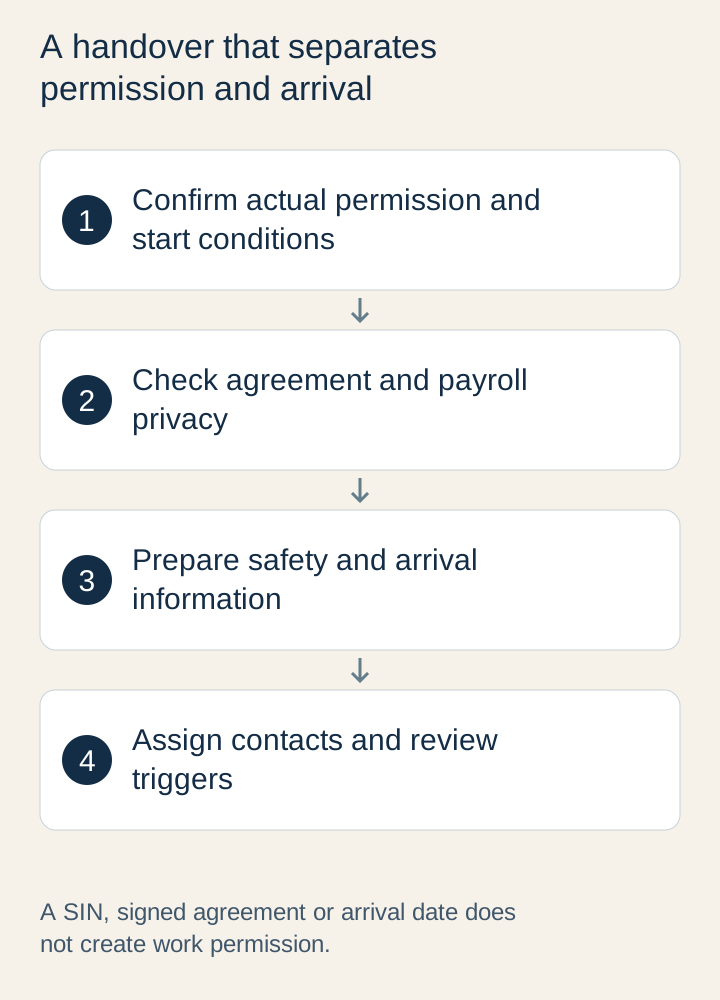
Before an overseas employee starts work in Canada, confirm the permission covering the actual job, reconcile employment terms and assign payroll, safety and arrival contacts. A signed offer, a flight booking or a Social Insurance Number is not a substitute for work authorization. This guide helps employers organise an individual onboarding handover, including housing information and follow-up. It distinguishes an original coordination checklist from the legal requirements that depend on the worker’s program, worksite and circumstances.
- 1. Make the first-work decision using actual permission
- 2. Reconcile the agreement, wages and first-day information
- 3. Keep SIN and payroll handling separate from immigration permission
- 4. Build a six-field arrival handover with clear owners
- 5. Explain safety, health-care access and how to raise a problem
- 6. Offer useful arrival information without inventing housing promises
- 7. Employer questions about an overseas employee’s arrival
1. Make the first-work decision using actual permission
Identify the employing entity, duties, worksite and proposed start arrangements. Ask the responsible HR person to compare these facts with the worker’s actual permission and conditions. Keep expected approvals and issued documents in different entries. A travel plan or someone saying “the application is in progress” does not answer whether the proposed work may begin.
The official IRCC employer-obligations guidance says employers must check work permits and ensure workers follow their conditions and time limits. Do not rely on an agency’s verbal assurance without the relevant evidence. If the worksite or duties have changed since recruitment, raise that change before using an earlier assessment to authorise the roster.
Appoint the person who will confirm the start condition and tell the supervisor what has actually been established. A calendar invitation for induction should not quietly turn a conditional start into an unconditional instruction to work. If permission remains uncertain, obtain an appropriate assessment rather than describing productive work as an unpaid trial to avoid the question.
For route selection, see our LMIA and exemption checklist. This article begins once a real hire is being coordinated; it does not replace the individual assessment or reopen every immigration category. Keep permanent residence plans separate from the permission for this employment.
2. Reconcile the agreement, wages and first-day information
Compare the final job terms with the offer and applicable employer documents: employing name, occupation, location, wage basis, hours and working conditions. Resolve differences through the responsible person and preserve the corrected version. A new employee should not discover at the workstation that the role or location differs from the agreed arrangement.
The ESDC temporary foreign worker rights guide applies to the Temporary Foreign Worker Program and describes a signed employment agreement and rights information on or before the first day of work. The agreement must be in the worker’s chosen Canadian official language, English or French, and align with the approved LMIA terms. Use the appropriate instructions for another program rather than silently extending every TFW Program detail to it.
Explain how hours are recorded, who approves a correction, the wage basis and where the employee can ask about a payslip. Gross contractual pay is not a guaranteed take-home amount. Check applicable payroll and employment requirements without inventing a universal Canadian tax rate or assuming the same overtime rules apply everywhere.
List any proposed housing or other charges separately from wages. Do not assume that a signature makes every deduction lawful. Confirm the applicable program, employment rules and actual agreement before making a deduction or promising a net-pay figure. If a charge is unresolved, record it as unresolved rather than hiding it in an arrival-cost estimate.
Give the employee a practical way to ask questions privately. A signature confirming receipt does not prove understanding. Ask them to explain in their own words where they will report, which tasks are planned and whom they should contact if the documents or first shift differ.
3. Keep SIN and payroll handling separate from immigration permission
Service Canada’s SIN Code of Practice explains the employer’s collection and protection responsibilities. Employers must request a new employee’s SIN no more than three days after employment begins. If an eligible worker does not yet have one, the worker must apply within the first three days of employment and provide it within three days of receiving the confirmation.
The guidance allows an individual who is eligible to work and applies as required to begin work while awaiting the SIN. This is not permission for someone who lacks the immigration authorization for the job. Check the basis for work separately, and follow Service Canada’s instructions about evidence of application and subsequent confirmation.
Assign a restricted payroll channel and a named internal owner. Do not put the SIN in a shared arrival spreadsheet, a recruitment enquiry URL, a public worksheet or an ordinary team chat. The official code advises against asking for it on a job application or during an interview, and against using it as the company employee-identification number.
The code also says a SIN confirmation is not an identity document. Complete the appropriate identity and payroll checks through the proper process. Store necessary records securely, and tell the employee what information is needed, why and who will receive it. Our handover tool should record that a check is complete or pending, not the number itself.
4. Build a six-field arrival handover with clear owners
The original six fields are: permission evidence and the first-work condition; final agreement and pay communication; restricted SIN and payroll follow-up; safety and rights orientation; practical arrival and housing information; and the contact, review trigger and unresolved action. Use a document reference instead of copying sensitive records into the table.
| Area | Evidence or action to confirm | What the entry does not establish |
|---|---|---|
| Work permission | Actual document, conditions and responsible review | An offer or travel booking authorises work |
| Employment terms | Correct agreement and explanation of pay and hours | A signature resolves every legal issue |
| SIN and payroll | Appropriate request, application evidence or restricted record | The SIN grants immigration permission |
| Safety and rights | Role-specific introduction and questions understood | A welcome email is completed safety training |
| Housing information | Actual arrangement, costs, contacts and applicable obligations | Every employee has employer-provided free housing |
An invented example: an employee is expected at a particular worksite, but the team preparing the welcome email has a different address. The coordinator checks the final job and permission evidence before issuing the meeting instructions. The unresolved address stays visible until corrected. This is an original teaching situation, not a client success story or a verified employer arrangement.
An internal handover question can be: “Which evidence confirms this part, who has checked it, what can the supervisor tell the employee, and what still needs an answer?” Give each unresolved item a real owner. An internal reminder is a planning device, not a government deadline or approval promise.
Employers needing support with talent search, screening and interview coordination can submit their hiring requirements. Agree the actual service and contract scope; this enquiry does not submit a permit application or guarantee that every relocation or onboarding task is included.
5. Explain safety, health-care access and how to raise a problem
Prepare an orientation suited to the actual job and worksite. The TFW Program rights guide describes safe-work training, applicable provincial or territorial safety laws and access to help. A general office tour is not evidence that someone has been trained to operate equipment. Identify what the employee may do, what requires instruction and who supervises it.
Explain how to report an unsafe task, illness, injury or a difference from the agreed job. Make the appropriate contact available and check the employee understands the process. Do not discourage questions by implying that reporting a problem allows a supervisor to cancel immigration status. The guide expressly distinguishes employer powers from government immigration decisions.
Confirm the applicable health-insurance arrangements before arrival. For the TFW Program, the guide describes employer-paid private emergency medical coverage during a gap before eligible public coverage, with stated exceptions. Check the actual program and province or territory; do not assume public coverage begins immediately or promise that every medical expense is covered.
Give the employee the relevant rights resource and a way to keep their own documents. The guide prohibits taking away personal documents such as passports and permits. Necessary HR checks are not a reason to retain control of the worker’s originals. Use secure, proportionate document handling and keep ordinary onboarding help separate from pressure or recruitment-fee recovery.
6. Offer useful arrival information without inventing housing promises
Provide factual information about the worksite address, first meeting point, transport options and the contact for a delayed arrival. Check that the information corresponds to the actual shift and location. An office accessible in daytime may require different travel planning for another schedule; do not assume an unverified route will work.
Distinguish information from an arrangement the company has actually promised. If housing is provided or a program imposes housing duties, confirm the applicable requirements, address, occupancy, costs, responsible contact and any relevant agreement. The ESDC guide has separate housing provisions for different agricultural arrangements; it does not justify telling every overseas employee that the employer owes identical free accommodation.
If the employee arranges their own accommodation, share appropriate local information and explain which questions the employer can answer. Do not place unverified property listings in a compulsory onboarding pack, guarantee a landlord or send the employee’s SIN to a rental contact. The SIN Code of Practice says it is not needed to rent a property or negotiate a lease.
Use an original pre-arrival message such as: “Please confirm the worksite and first meeting arrangements, the person handling work-permission checks, the secure payroll process and which housing or transport arrangements are actually agreed. Tell us which item remains uncertain before we finalise the plan.” This is a communication example, not a statutory form or a promise that every item is employer-funded.
After the first working period, arrange an internal check of the actual duties, hours, pay explanation and unresolved arrival issues. Choose a review point appropriate to the job rather than inventing a universal legal interval. Record and refer material changes to the responsible people. For immigration background, use PremierVisa Group’s Canada information and agree individual assessment separately.
7. Employer questions about an overseas employee’s arrival
Does the employee’s SIN prove they may start this job?
No. SIN handling and immigration work permission are separate checks. Read the actual authorization and conditions. Service Canada’s waiting-for-SIN guidance applies to someone already eligible to work and following the relevant application requirements.
Must work always wait until the SIN confirmation arrives?
The official code allows eligible workers who apply as required to work while awaiting it. Follow the application-evidence and later-notification instructions. This does not override a missing permit or restrictions affecting the proposed job.
Can the welcome pack replace the employment agreement?
No. Reconcile the actual terms and provide the applicable agreement and rights information. A welcome email can explain logistics, but is not a substitute for the required employment documentation or role-specific instruction.
Must every overseas hire receive free housing?
Do not assume one nationwide rule for every program. Check the actual category, relevant requirements and agreement. Distinguish verified employer arrangements from general housing information, and clarify costs before the employee relies on a promise.
Should we keep the employee’s passport for safekeeping?
The TFW Program rights guide prohibits taking away personal documents. Complete necessary checks without controlling the originals. Identify a secure process for the records the employer legitimately needs and let the employee keep their own documents.
Use the six-field record to resolve the next concrete handover question. Submit your hiring requirements to discuss search, screening and interviews within an agreed scope. Hiring, work permission, practical arrival help and permanent residence remain separate matters.