
Before accepting a Canadian truck-driving offer, match the actual vehicle and province to the required licence, document your driving experience and clarify the route, pay and employing entity. An overseas heavy-vehicle licence or an LMIA label does not by itself establish permission to drive or work. This guide provides an original driver-readiness record and employer questions. It supports recruitment preparation without certifying licence exchange, assessing a carrier's safety or promising a job, work permit or permanent residence.
- 1. Define the vehicle and province before comparing licences
- 2. Prepare a driving history that a recruiter can understand
- 3. Use a driver-readiness record to expose the real gaps
- 4. Ask what the route and schedule mean in practice
- 5. Check the legal employer and the contract behind the advertisement
- 6. Confirm both driving readiness and permission to work
- 7. Frequently asked questions
1. Define the vehicle and province before comparing licences
Ask where the job is based, which vehicle combination you would operate and whether the work involves local deliveries, highway routes or other duties. Licence classes and conditions are jurisdiction-specific. Do not convert a familiar overseas category into a Canadian class merely because both are described as heavy trucks. A general recruitment title cannot answer a trailer, transmission or air-brake question.
For a concrete provincial example, Ontario's truck-licence guide distinguishes full Class A, restricted Class A and Class D arrangements, with vehicle configuration and air brakes affecting what is needed. It describes training and testing, and transmission-related restrictions. Use the actual page for the proposed vehicle rather than assuming any truck licence covers every combination.
As checked on 25 October 2026, the same Ontario page says commercial-licence applications from 11 May 2026 require documentation of primary Ontario residence, legal presence and work eligibility. It also announces a Class A road-test licence-holding change from 1 January 2027. That later change is not already in force on this draft's date. Confirm the rules applicable to the actual application and test date.
Ask the appropriate licensing authority about your own documents, previous experience and any recognition route. This guide does not determine exchange eligibility or guarantee that overseas training removes local requirements. Keep the regulator's answer, the employer's vehicle requirements and the training provider's proposal separate. Paying for a course is not proof that a licence will be issued or a job will follow.
2. Prepare a driving history that a recruiter can understand
Build a factual timeline of employers, dates, vehicle types, duties and operating environments. Distinguish driving from dispatch, loading or warehouse work. Explain your own responsibilities without inflating distances, accident history or years in a vehicle class. If records are incomplete, identify the gap rather than replacing it with an unsupported claim of a clean history.
ICBC's driving-record guidance distinguishes a basic driving abstract, insurance and claims information, and a commercial National Safety Code abstract for employment purposes in British Columbia. This illustrates why “send your driving record” is an incomplete request. Ask which document, issuing authority and coverage the employer actually needs. A British Columbia record is not a document every overseas applicant already has.
Prepare lawful evidence references: licence details, an appropriate official record, relevant employment confirmation and any genuine training evidence. Do not email every identifier to an unverified recruiter. Ask how documents will be received and used, and provide only what is appropriate through a secure process. This article has not retrieved a private driving record or checked an individual's insurability.
When you cannot obtain a particular historical document, explain the reason and ask what alternative evidence is acceptable to the actual decision-maker. A recruiter agreeing to review a substitute does not mean the licensing authority or insurer has accepted it. Keep those outcomes distinct. Clear documentation helps the conversation; it cannot erase an offence, create experience or guarantee acceptance.
3. Use a driver-readiness record to expose the real gaps
The original six-field record contains: proposed vehicle, province and route; current licence and restrictions; experience and dated evidence; remaining licensing or training question; written job and pay question; and responsible contact with the next decision. Keep it privately with the source documents. It is a teaching worksheet, not a government licensing checklist, carrier approval or an employer partnership list.
In a fictional example, an applicant has substantial experience with one vehicle type, while the offer refers to a different tractor-trailer configuration. The record preserves that difference and asks what qualification and training are required. The applicant does not rename the existing licence to match the advertisement. This is a preparation scenario, not a successful placement or an assessment that the applicant can drive the new vehicle.
An original first question might be: “Please confirm the vehicle combination, home terminal and licence conditions required for this role. Which licensing questions should I resolve before you can consider a start?” Follow with the evidence you actually hold. Avoid saying that obtaining the local licence will be easy or promising a date before the relevant authority has answered.
| Question | Evidence or clarification | Do not substitute |
|---|---|---|
| Which vehicle may I operate? | Actual provincial licence requirements and conditions | Overseas title translated into a Canadian class |
| What experience can I show? | Accurate timeline and appropriate records | Unsupported mileage or clean-history claims |
| What is the job arrangement? | Legal employer, route, duties and written pay terms | A brand name or headline rate |
| When may I start? | Required driving and work authorization checks | A course booking, interview or LMIA label |
If you need help presenting your experience and organizing employer questions, submit your candidate background. Discuss resume and interview preparation and practical employer-contact directions. A consultation does not issue a licence or certify a carrier, and it does not guarantee a vacancy.
4. Ask what the route and schedule mean in practice
Clarify the home terminal, expected routes, time away, loading or unloading duties, dispatch contact and arrangements for unfamiliar equipment. If cross-border work is proposed, ask which additional permissions and documents are actually required. A Canadian work permit is not a blanket answer to entry or work questions in another country. Do not accept a route description that leaves essential authorization assumptions unexplained.
Ask how the employer records driving, other work, waiting, breaks and any overnight arrangements. Do not assume that a distance-based rate describes all paid time. Request the written pay basis and ask who explains a sample calculation. This article does not invent a market rate, decide a deduction dispute or calculate a driver's actual earnings from an incomplete advertisement.
The federal labour hours page contains special trucking provisions and distinguishes classes of operators. It is not correct to copy a general office-work overtime rule onto every driver. Determine whether the workplace is federally or provincially regulated and identify the relevant employment and safety rules. This guide quotes no universal maximum-driving or overtime number.
Prepare a practical communication example from your own work: how you reported a vehicle concern, a route change or a scheduling problem to the responsible person. Explain the sequence and your role without giving improvised mechanical or road-safety instructions. Overseas experience can support an interview, but unfamiliar local equipment and conditions still require appropriate training and supervision.
5. Check the legal employer and the contract behind the advertisement
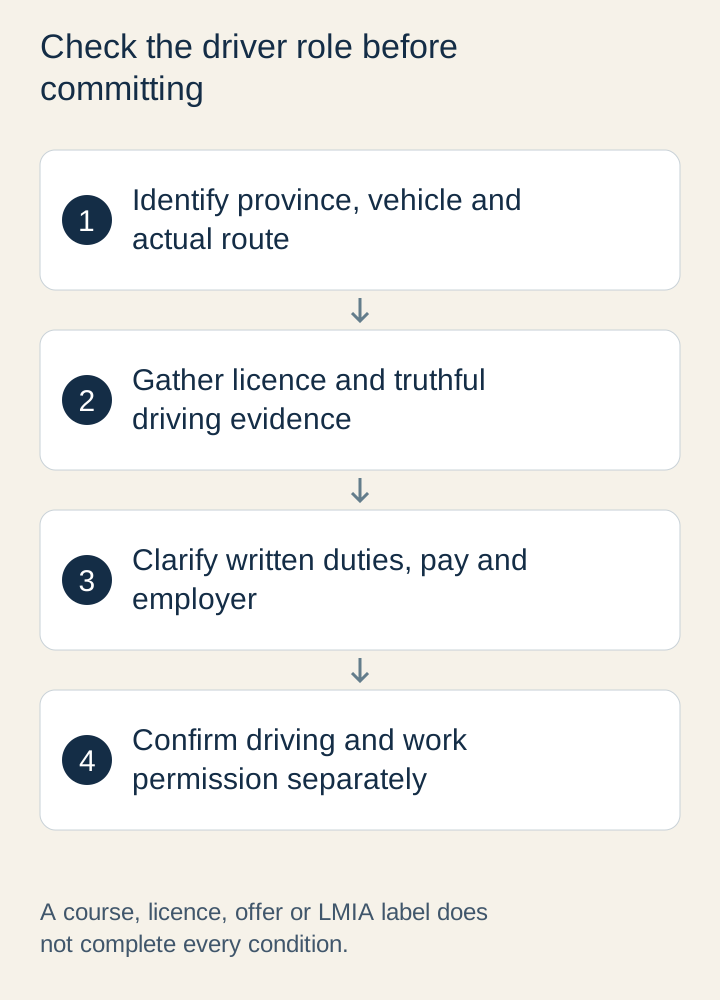
Identify who employs you, pays wages, assigns the work and signs the agreement. A recruiter, dispatch brand and carrier may have different roles. If the written arrangement changes from employee to an incorporated contractor, stop and seek clarification of the actual relationship and program requirements. A new label does not settle employment rights, immigration compliance or responsibility for expenses.
ESDC's business-legitimacy guidance says trucking LMIA applications require current carrier-profile, National Safety Code certificate and fleet-insurance documents, with names varying by jurisdiction. These are employer-side application requirements. An applicant does not certify a company by collecting a screenshot of one document, and document submission is not an approval decision.
Ask who is confirming the employer process and whether the actual position, duties and worksite match the proposed application. Request proportionate explanations, not unrelated confidential business files. The advertisement-reading guide helps distinguish audience and LMIA-stage wording. No public listing in this article has been checked as a currently available job for you.
Read the guaranteed pay, paid-time basis, deductions, training arrangements and any repayment clauses as separate questions. The wage-offer guide explains why stream thresholds and a package headline are different. Do not treat a large training or recruitment payment as proof of sponsorship. Unclear fees or obligations need their own lawful basis and appropriate review before a commitment.
6. Confirm both driving readiness and permission to work
IRCC's employer-specific work-permit guidance separates employer steps from the applicant's permit conditions. An LMIA, offer or course certificate does not replace personal authorization. If a permit is required and you do not have it, do not claim current legal authorization to work or begin a shift because a manager says the paperwork will catch up.
Use separate readiness states: evidence requested, licensing question answered, job terms clarified and start basis confirmed. A local licence may resolve driving eligibility while a work-permit question remains; a work permit may exist while the vehicle licence or restrictions still need checking. The purpose of the record is to show this unfinished work, not make every line look complete on the same day.
Before relocation or resignation, ask what happens if testing, training or the relevant decision is delayed. Identify who updates the proposed start and which commitments are conditional. Do not use a booked flight or roster as evidence that the outstanding requirements have been met. Keep dated versions so later recruitment changes can be reviewed against what you originally understood.
The offer and work-permit handover guide provides the next document stage. Immigration background is available through PremierVisa Group's Canada information under an appropriate individual engagement. This article does not promise provincial nomination, calculate permanent-residence eligibility or use future immigration changes as current rules. A driving career and an immigration outcome remain distinct decisions.
7. Frequently asked questions
Does my overseas heavy-vehicle licence automatically qualify me?
Do not assume that. Confirm the actual province, vehicle, licence conditions and any recognition or testing route with the appropriate authority. A translated category name is not a decision.
Does an approved LMIA replace a commercial driving licence?
No. Employer immigration steps, personal work authorization and the permission needed to operate the vehicle are separate. Confirm all relevant bases before driving for the job.
Is every Canadian truck driver subject to the same overtime rule?
No blanket rule is supplied here. Identify the employment jurisdiction and operator classification, then use the applicable official provisions. Pay and safety-hour questions should not be collapsed into one number.
Can a fleet-insurance screenshot prove that a vacancy is genuine?
Not by itself. ESDC's employer assessment considers the business and offer; a single document does not certify a job, LMIA or your suitability. Ask what remains unverified.
Can I promise a start as soon as I book training?
A booking establishes only that step. Licensing, job terms and work authorization may still be unresolved. Give an accurate conditional update rather than an unsupported start guarantee.
Submit your candidate background to discuss your driving history, resume and interview questions, and practical employer-contact direction. Begin with relevant experience and the proposed vehicle or route, without complete private records in a general enquiry. No licence, job, LMIA or immigration result is guaranteed.