
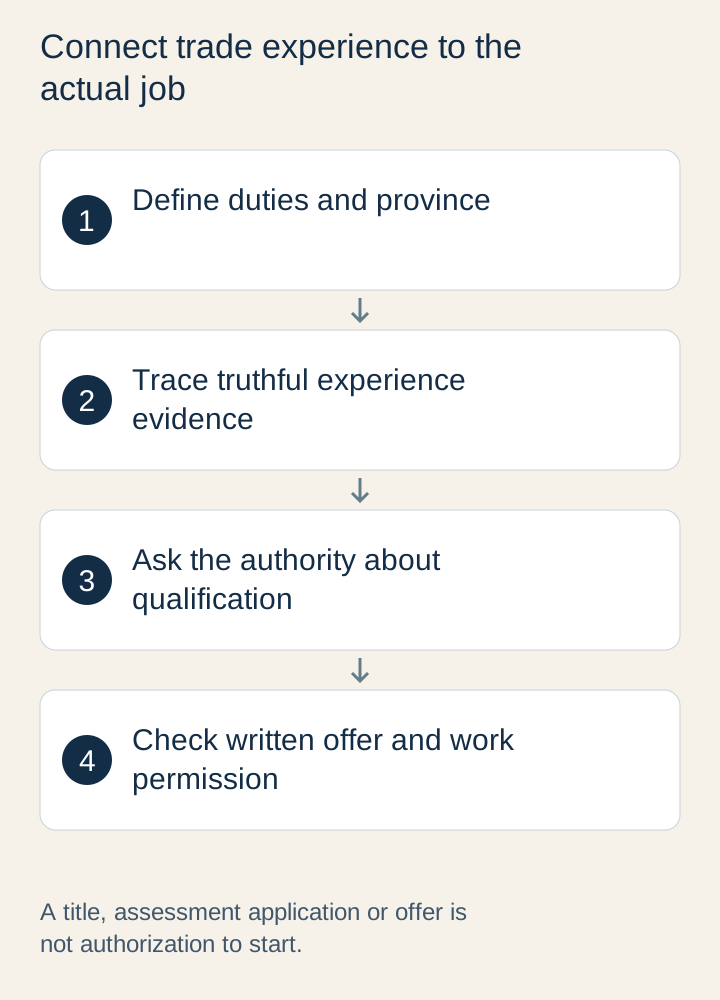
To pursue a Canadian skilled-trade job involving LMIA support, identify the actual trade, duties and province before presenting your overseas experience as a local qualification. Then connect your work evidence to the relevant authority’s requirements and ask the employer what must be resolved before hiring or starting. This guide provides a trade-task evidence record and original interview questions. It helps experienced applicants prepare a credible discussion without certifying their trade, assessing site safety or promising employment, a work permit or permanent residence.
- 1. Describe the work before choosing a Canadian trade name
- 2. Identify the province’s authorization requirements
- 3. Build evidence of your own tasks and training
- 4. Use a trade-task record to guide employer questions
- 5. Explain Red Seal and your interview evidence accurately
- 6. Keep the offer, costs and work-permit decision separate
- 7. Frequently asked questions
1. Describe the work before choosing a Canadian trade name
Start with a short account of the tasks you actually perform. Include the equipment or materials, work environment, your own responsibilities and the supervision under which you worked. Separate installation, maintenance, inspection, coordination and assisting duties. A broad overseas title such as technician or tradesperson can conceal differences that matter to a Canadian employer and provincial authority. Translating the title is the beginning of the conversation, rather than its conclusion.
Ask for the vacancy’s location and full duties. A company can operate in several provinces, while the specific job is based at one site. Record the proposed legal employer, the trade name used in the description and whether the employer is recruiting a qualified journeyperson, an apprentice or another role. Do not rename a qualified position as an assistant job merely to make an unresolved credential question disappear.
An original preparation example is an applicant who has maintained equipment but is considering a position that includes a different installation scope. The useful application explains what the applicant has done and asks about the additional scope. It does not convert maintenance experience into evidence of every installation task. This is a fictional teaching example, not a vacancy or a determination that a person may perform regulated work.
Create a small shortlist of roles that genuinely connect to your experience. Save the original description and date, then highlight the duties you can support and those that need clarification. Avoid treating every advertisement containing “LMIA” as an equally suitable trade opportunity. The Canada employer-search guide covers the broader search; this article concentrates on the trade and evidence behind the match.
2. Identify the province’s authorization requirements
Trade requirements must be checked in the actual jurisdiction. For an Ontario example, Skilled Trades Ontario’s compulsory-trades page describes valid Certificates of Qualification, Provisional Certificates of Qualification and Registered Training Agreements as relevant bases for working in compulsory trades. It also identifies specific exemptions. Do not rewrite this into a rule that every person needs the same certificate, or decide that an apprentice can work merely because an employer uses that label.
Ask which trade and authorization basis apply to the proposed duties. If someone relies on an exemption or a training arrangement, request the actual basis and its limits from the appropriate authority. The employer’s interest in your experience cannot create an exemption. Equally, an incomplete understanding of a public register should not be used to accuse a person of being unauthorized: the official page explains that some exempt groups may not appear there.
The distinction between a compulsory and non-compulsory trade does not answer every hiring question. An employer may still require particular evidence, and the work may involve other applicable conditions. Keep the questions separate: what the law requires for the actual scope, what the employer requires for this role and what evidence you currently possess. Record an unresolved point as unresolved, rather than guessing that a familiar occupation must be unrestricted everywhere.
Use the relevant provincial or territorial authority when considering another location. An Ontario example is not a national clearance. Do not assume that a training provider, recruiter or colleague can settle your case simply by showing a certificate held by someone else. Before committing to training, ask the authority which process is appropriate for your own background and proposed trade.
3. Build evidence of your own tasks and training
Prepare an accurate timeline of employers, dates, duties and training. Distinguish paid trade work, apprenticeship activity, classroom learning and other tasks without inventing a total that looks more attractive. Identify who can confirm each period and what the supporting document actually says. A resume is useful for recruitment, but it is not automatically sufficient for a regulator’s assessment of experience.
Skilled Trades Ontario’s Trade Equivalency Assessment information explains a route for experienced workers who have not completed an Ontario apprenticeship, including experience obtained outside Canada. The assessment concerns whether the applicant can challenge a certifying examination and requires sufficient, verifiable evidence against the relevant training standard. It is available for trades with certifying exams. Applying for the assessment is not passing an exam or receiving a certificate.
Make a document list with the issuer, relevant period, purpose and receiving organization. Appropriate employment confirmation might establish dates and described responsibilities; training evidence may establish a different part of the history. Ask what the actual authority requires before paying to obtain translations or commissioning documents. Do not change a former supervisor’s statement, manufacture hours or present a course attendance record as proof of duties you never performed.
Protect other people’s information and former employers’ confidential material. An initial job application does not require a bundle of every identifier, internal drawing or customer record you possess. Begin with relevant summaries and lawful evidence references. If a source document is unavailable, explain the gap and ask the actual decision-maker what alternatives may be considered. A recruiter agreeing to read a substitute does not establish that the regulator accepts it.
4. Use a trade-task record to guide employer questions
The original record for this topic has six fields: proposed trade and duties; province, authority and authorization question; your task evidence and dates; training or scope limitation; question requiring the authority’s answer; and employer contact with the next action. Keep it privately with the dated job description. It is a preparation tool, not a government application, a safety certificate or a list of approved employers.
Use one row for a meaningful duty or unresolved requirement, rather than giving your whole career a single readiness score. A row can show good evidence of a past task while still showing that the local authorization question is unanswered. This is more useful to the next person handling the enquiry than a percentage that hides the condition preventing a lawful start.
| Item in the conversation | What it may establish | What it does not establish by itself |
|---|---|---|
| Employer’s duty description | The proposed work and expectations | Your authorization to perform it |
| Employment or training evidence | Facts within the document’s scope | Automatic provincial equivalence |
| Assessment or exam-stage confirmation | The particular stage reached | Completion of every qualification requirement |
| Red Seal endorsement | Relevant national-standard examination evidence | Every provincial practice condition or work right |
| Offer or LMIA progress | A recruitment or employer-process stage | Personal permission to begin work |
An original employer question is: “Which duties require provincial authorization in this position, and what status must I hold before you can consider a start?” Follow with the evidence you actually have. Ask who answers the regulatory question and who confirms the company’s conditions, so a helpful recruitment reply is not mistaken for an authority’s decision.
If you need help presenting your background, submit your candidate details to discuss resume preparation, interviews and practical employer-contact directions. The actual service scope and contractual arrangements are confirmed separately. A consultation cannot issue a trade certificate or promise that an employer will hire you.
5. Explain Red Seal and your interview evidence accurately
The official Red Seal Program explanation describes the endorsement on a provincial or territorial trade certificate and the national standard it represents. Certification and endorsement verification remain matters for the issuing provincial or territorial authority. Do not describe the endorsement as a universal federal licence that independently permits every trade activity in every province. The actual certificate, jurisdiction and work scope still need to be checked.
In a resume, use the qualification you genuinely hold and identify the issuing body. An assessment application, booked exam or planned training is a different status. If you do not hold an endorsement, do not add the acronym to make your profile appear equivalent. You can explain relevant overseas tasks without presenting a Canadian credential you have not received.
Prepare a short account of one real task: the context, your responsibility, how the work was supervised or checked, and your own contribution. Use materials you have permission to share. A personal teaching sketch or anonymized explanation can help a discussion, provided it is labelled accurately; it must not be passed off as an approved project drawing or a customer’s completed work.
Ask the interviewer about supervision, site induction, equipment familiarity and how role-specific requirements are confirmed. Discuss safety communication at the level of your experience and reporting responsibilities. Do not improvise electrical, lifting or other hazardous procedures to impress a recruiter, and do not treat an informal demonstration as authorization to undertake productive work. The employer and appropriate authority need to clarify the actual activity and its conditions.
6. Keep the offer, costs and work-permit decision separate
Establish which entity would employ and pay you, where you would work and what duties appear in the written terms. A recruitment brand and a site operator may have different roles. If the arrangement changes, keep both versions and resolve the difference before committing. Clarify pay components, hours and any training or repayment terms without assuming a package headline is the guaranteed amount. The offer-wage comparison guide addresses those separate questions.
IRCC’s employer-specific work-permit guidance separates employer LMIA or applicable exemption steps from the individual’s permission and conditions. A trade qualification does not settle every immigration requirement; an offer or LMIA does not create a provincial credential. If you require a work permit and do not yet have one, do not claim existing authorization to work or start because someone expects approval.
Before resignation or relocation, identify which conditions remain, who provides the next update and whether the proposed date is conditional. A booked course, travel plan or roster does not resolve an outstanding decision. Unknown fees, timelines and responsibilities stay unconfirmed until the applicable source and arrangement are established. This article quotes no certification charge, market salary, processing promise or permanent-residence threshold.
The offer and work-permit handover guide supports the next document discussion. For separate immigration background, consult PremierVisa Group’s Canada information under an appropriate individual engagement. Employment suitability, trade authorization, work permission and a possible long-term immigration plan remain distinct decisions; progress on one should not be reported as completion of all four.
7. Frequently asked questions
Does overseas trade experience automatically become a Canadian qualification?
No. Describe the actual work and ask the relevant authority which process applies. Experience evidence can support assessment, but a translated title or employer’s opinion does not establish provincial equivalence.
Does every Ontario compulsory-trade worker need the same certificate?
Do not assume that. The official page identifies different valid authorization bases and particular exemptions. Confirm the basis applicable to the person and duties instead of treating one certificate or an apprentice label as the universal answer.
Does submitting a Trade Equivalency Assessment mean I can start?
Submission establishes an application stage. The assessment, examination, certification and actual right to perform the work are separate questions. Check the authority’s confirmation and the employer’s genuine start conditions.
Can I describe Red Seal as permission to work anywhere in Canada?
That is too broad. Verify the endorsement and actual trade certificate with the issuing authority, then check the receiving jurisdiction and proposed work. Immigration permission remains an additional matter.
Should I send confidential site drawings to prove my skills?
Use only materials you are entitled to share. Start with accurate task descriptions and lawful evidence references, and ask what is needed through an appropriate process. A portfolio does not justify disclosing a former employer’s or customer’s confidential information.
Your next action is to define the trade and province, complete one evidence row and identify the question that prevents a clear employer discussion. Submit your candidate background if you need support with your resume, interviews and realistic employer-contact directions. No qualification, vacancy, LMIA, work permit or immigration outcome is guaranteed.