
To find a Canadian technology employer willing to consider an overseas applicant, connect your own demonstrable work to the advertised role and ask clearly about the employer’s actual hiring and work-authorization process. A software title, remote-work label or mention of the Global Talent Stream does not establish sponsorship or permission to start. This guide provides a six-field evidence record, original interview questions and a practical application sequence for applicants who need to discuss those conditions before accepting a role.
- 1. Build a shortlist around the work, not a sponsorship slogan
- 2. Prepare shareable evidence of your own contribution
- 3. Explain what GTS does without claiming personal eligibility
- 4. Use an evidence-to-interview record for each role
- 5. Prepare for a technical interview with clear ownership and limits
- 6. Check the employer relationship and written start conditions
- 7. Frequently asked questions
1. Build a shortlist around the work, not a sponsorship slogan
Read the responsibilities before sending a resume. Identify the product, technical problem, expected level of ownership, working location and team relationships described in the advertisement. Distinguish building a feature from operating a service, supporting users or managing a team. A technology label is too broad to establish that your experience matches the work, and an employer’s presence in Canada does not establish that this particular role is located there.
Save the original advertisement, URL and date. Record whether it asks for existing Canadian work authorization, considers international applicants or says nothing about that question. Silence is an unanswered condition. A company that once hired overseas staff is not automatically offering the same arrangement for every new position. Ask about the current role instead of copying a historical recruitment claim into your own assessment.
Make a small, defensible shortlist. For each role, choose a relevant project and describe your contribution in a few lines. If the position expects production ownership and your example is a personal demonstration, name that limitation openly. A well-explained learning project can support a conversation without being represented as a service used by real customers.
The Canada LMIA employer-search guide covers the broader search process. Here, the additional task is to show why the technical work fits and which hiring questions remain. This article does not verify any company’s vacancy, employer-program approval or willingness to provide immigration support.
2. Prepare shareable evidence of your own contribution
Choose work you have the right to discuss. A public repository, original demonstration, permitted case summary or carefully explained architecture decision may be useful, depending on the role. Check what is actually public and what belongs to a former employer or customer. Do not upload private code, credentials, customer records or internal diagrams merely to make an application look more substantial.
For each example, explain the problem, your responsibility, the approach you considered and the result you can substantiate. Separate team achievements from your own work. If you cannot establish a claimed performance improvement, describe the observed behavior and test conditions instead of inventing a percentage. A number is useful only when the reader can understand its basis and limits.
An original teaching example is a candidate presenting a personal issue-tracking prototype. The candidate can explain how duplicate submissions are handled, what was tested and what would need to change for production use. It would be inaccurate to call the prototype a deployed customer platform or to attach a fabricated user count. This example is not a client story, an approved technical solution or a real vacancy.
Create a short evidence index: project name, your contribution, lawful demonstration link, relevant role requirement and limitations. Test that links open without exposing private accounts. Keep a separate copy of the version submitted so that an interviewer and you can discuss the same material. Avoid promising access to a confidential system that you cannot lawfully provide later.
3. Explain what GTS does without claiming personal eligibility
The ESDC Global Talent Stream requirements describe an employer program with category-specific requirements. The categories have different bases, including referral requirements or a relevant occupation list as applicable. Having an IT title or working with a popular technology does not, by itself, establish that the employer and position qualify under the applicable category.
Ask whether the company is considering an employer-supported route for this actual job and who will confirm the applicable process. Some hiring situations may involve an LMIA; others require a separately established exemption or another lawful basis. Do not select a category for yourself because an advertisement uses the word talent, and do not present a recruiter’s preliminary interest as a decision by ESDC or IRCC.
The official GTS overview separates the employer process from the worker’s work-permit application. Employer documents and a positive LMIA, where applicable, are not a personal work permit. A published program service standard should not be converted into a guaranteed start date for your individual application. This guide quotes no processing duration, wage floor or application charge.
An employer’s Labour Market Benefits Plan obligations should not be turned into an invented certificate that applicants must buy. If someone offers a paid document supposedly proving that every technology candidate qualifies for GTS, ask which actual requirement and issuing authority it relates to. Keep personal suitability, employer eligibility and the individual immigration decision as separate questions.
4. Use an evidence-to-interview record for each role
This topic’s original asset has six fields: advertised task; your own contribution; lawful, shareable demonstration; limitations and testing evidence; the employer’s actual hiring or work-right question; and the next action with a contact. It is a private preparation tool, not a government form, an approved-employer directory or a prediction of interview success.
Use one row per important requirement. For a role involving service reliability, a row might identify the relevant personal demonstration, explain the limited test environment and ask what production responsibility the role actually carries. Do not mark the row “fully qualified” merely because the demonstration runs. The unresolved employment condition deserves its own entry, rather than being hidden behind a technical score.
| Information available | What it helps you understand | What remains separate |
|---|---|---|
| Technical job description | The proposed duties and expectations | Whether this employer considers overseas applicants |
| Portfolio or demonstration | Your stated contribution and reasoning | Employer-program or work-permit eligibility |
| Recruiter’s positive reply | Interest in continuing a discussion | A written offer or government decision |
| LMIA or employer-process progress | The relevant employer stage | Your personal work permission and conditions |
| Remote-work wording | A proposed working arrangement | Employer entity, location and lawful start conditions |
A concise first question is: “I am applying from overseas and would need the appropriate authorization for a Canadian role. Does your team consider that situation for this position, and who confirms the process?” Pair it with one relevant evidence link. You do not need to attach every personal document or send an immigration narrative before the company has answered whether it will consider the application.
If you need support explaining your experience, submit your candidate background to discuss resume preparation, interviews and practical employer-contact directions. The actual service scope and contractual arrangements are confirmed separately. A consultation does not create an employer relationship, a vacancy or government approval.
5. Prepare for a technical interview with clear ownership and limits
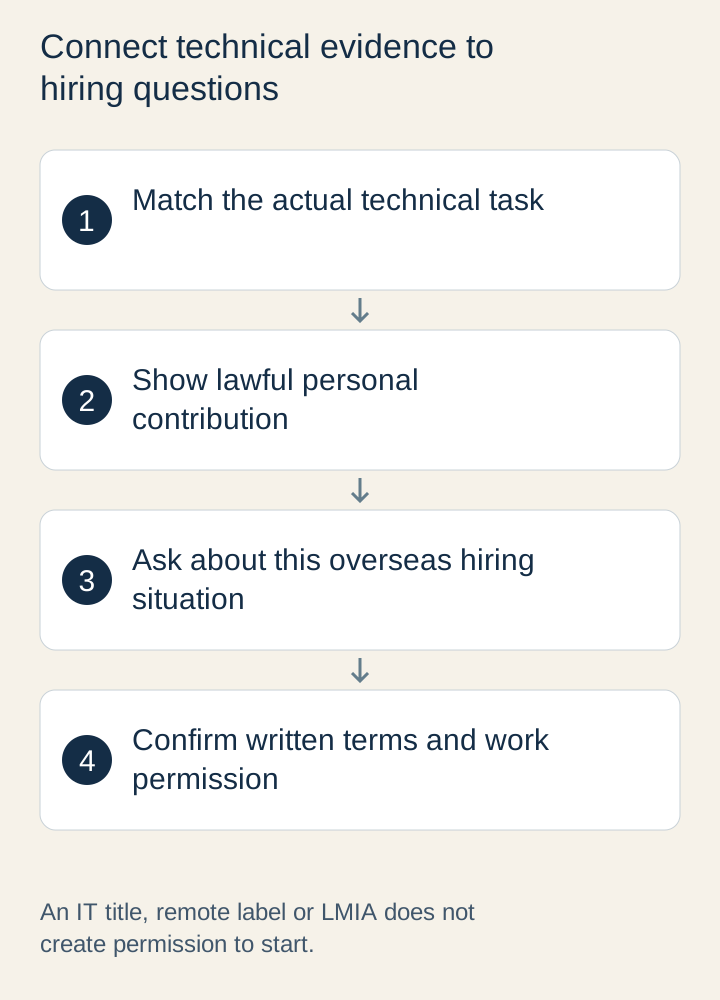
Select an example you can explain without relying on confidential material. Prepare the problem, assumptions, alternatives considered, implementation choices, checks and remaining limitations. For a team project, state which decisions you made and which belonged to colleagues. This helps an interviewer evaluate your contribution without treating the whole team’s output as your personal achievement.
Practice answering a change in requirements. For the fictional prototype, discuss what would need investigation if usage patterns changed or duplicate requests increased. Explain how you would test the assumption rather than claiming a production capacity that you have never measured. A thoughtful limitation can support a credible technical conversation; an invented benchmark creates a factual problem that more confident wording cannot fix.
Clarify the interview task before starting it. Ask about the expected deliverable, time arrangement, evaluation purpose, ownership and use of submitted work. Do not assume that every take-home exercise is improper, or that an invitation automatically resolves questions about productive work. If the task resembles delivery for a live business, clarify the actual activity and its terms before proceeding.
Keep technical evaluation separate from employment promises. Passing an interview or receiving encouraging feedback does not resolve the legal employer, written compensation, immigration process or start conditions. Keep the original instructions and your submitted version so that changes can be discussed accurately. Never share a former employer’s login or a customer dataset as an interview shortcut.
6. Check the employer relationship and written start conditions
Identify who would employ and pay you, where the work would be performed and whether the offer is employment or a different arrangement. A Canadian customer, recruitment agency and payroll entity may play different roles. Remote wording alone does not tell you which entity is making the offer or whether the role is a Canadian position requiring a particular authorization.
Within the TFWP, the GTS requirements address the actual employment relationship and worker misclassification. Do not use this to claim that every technology contract is unlawful. Instead, ask whether the proposed arrangement matches the employer program being discussed, and seek appropriate advice where the legal classification remains unclear.
Request written duties, location, compensation components, hours and conditions. Distinguish fixed pay from discretionary or conditional elements instead of treating a package headline as guaranteed cash. The same official requirements also address employer recruitment and LMIA cost responsibilities: those employer costs cannot simply be recovered from the worker. This does not mean every independently chosen personal service is free; clarify the exact item, provider, recipient and applicable rule rather than accepting an unexplained sponsorship fee.
IRCC’s employer-specific work-permit guidance explains the separate personal authorization stage and conditions. If you require a permit and do not yet hold one, do not claim existing Canadian work authorization or begin merely because approval is expected. A laptop shipment, planned onboarding session or agreed calendar date does not replace the applicable permission.
Before resigning or relocating, list unresolved conditions and the person providing the next update. The offer-to-work-permit guide supports that handover; written-offer wage checks address the compensation discussion. For separate immigration background, consult PremierVisa Group’s Canada information under an appropriate individual engagement. This article does not decide an individual’s immigration route or legal classification.
7. Frequently asked questions
Does a software-engineer title make me eligible for GTS?
No. The relevant employer, position and category requirements must be established. A familiar title or technology stack is not a program decision, and personal work permission remains a separate question.
Should I say I already have work authorization if the employer might support it?
No. Describe your actual status. If authorization is required and you do not hold it, say that clearly and ask whether the employer considers that situation for the current role.
Can I use a personal project instead of private production code?
You can explain an original project accurately, including its limitations and your contribution. It must not be represented as a real customer service or evidence of unmeasured production results. Do not disclose materials you lack permission to share.
Does remote work mean I can start immediately from any country?
The label alone does not answer that. Clarify employer entity, actual working location, arrangement and applicable conditions. If the role requires Canadian work permission, remote wording does not create it.
Does a positive LMIA guarantee a permit or a start date?
No. Employer progress and the individual application are distinct. Confirm the actual documents, remaining conditions and lawful start requirements rather than turning a service standard or recruiter’s forecast into a personal guarantee.
Your next step is to choose one genuine role, complete an evidence row and ask the unresolved overseas-hiring question. Submit your candidate background if you need help with your resume, interviews and practical employer-contact directions. No job, sponsorship, work permit or permanent-residence outcome is guaranteed.