
A Canadian nursing offer, professional registration and permission to work answer different questions. Choose the province and nursing category first, then coordinate the regulator's actual requirements with the employer's role and your immigration position. This guide provides an original three-track handover record, evidence checklist and employer questions. It helps internationally educated nurses organize a job search without certifying qualifications, providing clinical advice or promising that recruitment, an exam or an LMIA will lead to practice or permanent residence.
- 1. Choose the province and the full nursing category
- 2. Separate document validation from a regulator's registration decision
- 3. Build an evidence checklist with the correct sender and purpose
- 4. Ask what the employer can actually support
- 5. Use a three-track handover record before scheduling a start
- 6. Check lawful practice and immigration permission separately
- 7. Frequently asked questions
1. Choose the province and the full nursing category
Write down where you intend to work and the full category the employer is recruiting. Do not rely only on an acronym or translate an overseas title into a Canadian designation. Nursing categories and registration arrangements vary. A role description, educational background and permission to use a professional title need to be checked against the relevant regulator rather than inferred from a generic job advertisement.
The College of Nurses of Ontario's outside-Canada guide identifies which applicants its RN and RPN instructions cover and points other applicants to different guides. If you already hold registration elsewhere in Canada, or are considering another category, do not automatically use an internationally educated first-registration checklist. The appropriate starting point depends on your actual position.
BCCNM's internationally educated nurse guidance has its own instructions and distinguishes pathways by education or initial-registration background. This is why one province's document service or assessment route should not be advertised as the first step for every nurse in Canada. Confirm the current route before paying for a service, translation or course.
Use a narrow initial shortlist: province, category, practice setting and the experience you can support. Record whether the vacancy requires current registration or considers applicants at a stated stage. This article does not maintain a list of hospitals willing to hire an unregistered applicant. A shortage headline or an employer accepting overseas enquiries is not evidence that a particular job or authorization is available.
2. Separate document validation from a regulator's registration decision
Ontario's current outside-Canada guide describes education-credential validation by an approved assessment provider and direct transmission to CNO. Validation is not the same as satisfying all registration requirements. An assessment prepared for one purpose should not automatically be treated as accepted for nursing registration or as a complete immigration assessment. Follow the regulator's actual instructions and any request addressed to your application.
The guide also describes education, practice evidence, examination, transition-to-practice, language and other requirements. Do not reduce the process to passing one exam or obtaining a job offer. This article does not quote a universal language score, fee or registration timetable. Identify which requirements have actually been confirmed for you and which remain under review rather than declaring an expected result complete.
CNO says applicants must complete and submit their own applications and must not share login details or let others sign in, submit or verify information for them. Preparation support should respect that boundary. An employer or consultant can discuss appropriate information needs without taking over a private regulator account. This guide does not request credentials or submit an application on anyone's behalf.
In British Columbia, the relevant regulator describes its own assessment and remaining requirements, including possible education needs. Do not copy Ontario's steps into a BC application. If different sources appear inconsistent, first compare the jurisdiction, applicant category and date. Preserve the specific question and seek clarification from the responsible regulator rather than blending two procedures into an invented national checklist.
3. Build an evidence checklist with the correct sender and purpose
Prepare a private inventory of nursing education, registrations held, relevant employment and any required supporting information. Record the issuing institution, the intended recipient and what the document is meant to establish. A resume can summarize your experience for recruitment, while the regulator may require evidence from an official source. The same file does not necessarily serve both purposes in the same way.
CNO's guide explains that certain documents must come directly from schools, employers or regulatory bodies, with appropriate translation arrangements. Do not edit a reference to make its duties or dates more attractive, and do not assume an applicant-uploaded scan meets a direct-source requirement. Ask the institution and regulator how the actual document should be sent; a request made is not evidence received and accepted.
For the employer, describe your own setting, responsibilities and contribution accurately. Avoid patient names, identifiable case details or confidential records in a portfolio. You can explain a communication, teamwork or professional-development example without disclosing a person's care history. This article provides career preparation, not a clinical competency assessment or approval to perform a procedure.
| Evidence or event | What it can support | What it does not automatically prove |
|---|---|---|
| Credential validation | Document authenticity or assessment information | All registration requirements satisfied |
| Employer reference | Factual work history within its scope | Canadian registration or work permission |
| Exam result | The relevant examination outcome | Every other licensing requirement completed |
| Job offer | Proposed employment terms | Authorization to practise or begin work |
If you need help presenting your experience and preparing employer questions, submit your candidate background. Discuss resume and interview support and practical recruitment resources. Do not include patient information, regulator-account credentials or complete identity documents in a general enquiry.
4. Ask what the employer can actually support
Ask the hiring contact which role, category, location and registration stage the position requires. If an offer is conditional, request the exact condition and who will confirm it. “We support international nurses” is not a complete explanation of a particular vacancy. Separate recruitment interest, an orientation plan, any education opportunity and the actual conditions for employment.
An original question is: “Which registration or lawful practice basis must be confirmed for this role, and which team will check it before the start? What support is actually offered while an assessment remains outstanding?” This asks for operational detail without suggesting that the employer can waive a regulator's requirements. Keep the answer with the dated role description and offer.
If support includes a course, relocation contribution or other assistance, clarify eligibility, actual availability, conditions and any contractual obligation. Do not treat an advertised program or expected funding as already awarded to you. This guide does not certify a bursary, reimbursement, employer partnership or repayment clause. Read the real agreement before allowing an uncertain benefit to determine a major commitment.
Prepare an accurate interview explanation of your current stage. For example: “My application is at the evidence-review stage; I have not yet received confirmation of the permission required for this role.” Use that only if it describes your situation. Do not rename an application number as a licence, or an exam booking as a result, merely to make an employer form easier to complete.
5. Use a three-track handover record before scheduling a start
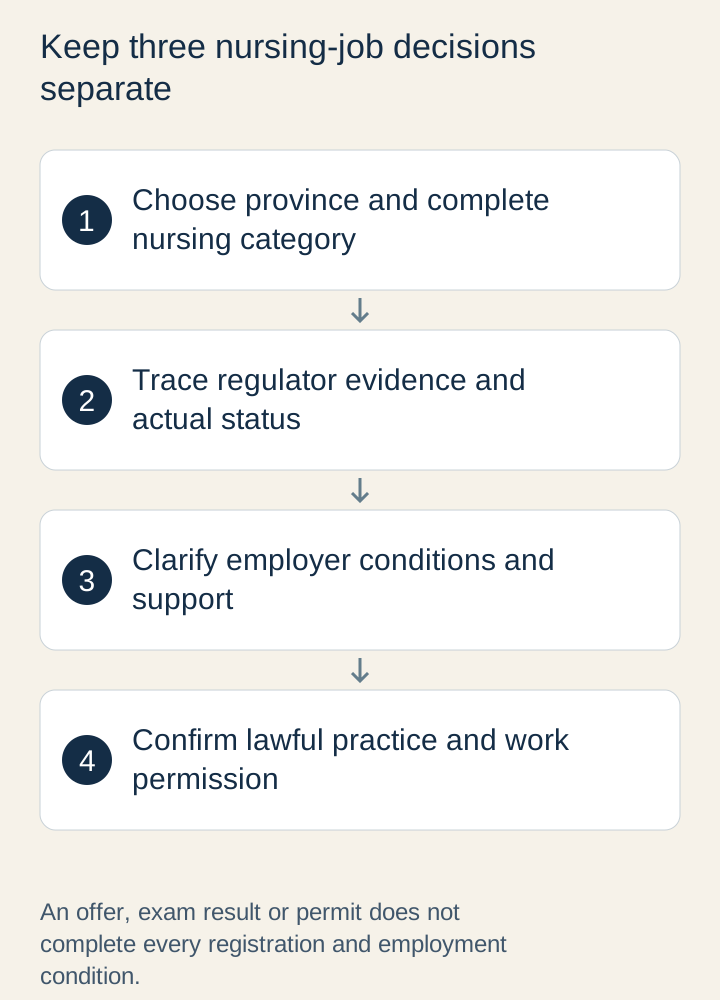
The original six-field record contains: proposed province and role; regulator requirement and actual evidence; employer condition and contact; work-permission condition and evidence; unresolved dependency; and next action with the responsible person. It tracks three connected processes without merging them into one approval. Keep it in a secure private copy; it is not an official form or a verified employer directory.
Use clear statuses such as requested, received, under review, confirmed and outstanding. A school sending a document may complete its own action while the regulator has not yet assessed it. An employer may clarify the role while the work-permit issue remains open. Record those facts separately instead of assigning a single percentage that hides the critical unresolved condition.
In a fictional scenario, a recruiter proposes a first shift after receiving an exam result, but the applicant still has an unresolved regulatory requirement. The record identifies that dependency and sends a precise question to the appropriate contact before a start is confirmed. It does not infer rejection or give permission to practise. The scenario is original teaching material, not a client story.
Keep an agreed communication point for changes in category, province, role or expected dates. A later offer revision may change which question needs answering. Preserve old and new versions rather than silently replacing them in a folder. A readable handover should allow the next responsible person to see both the evidence and the limits of what has been established.
6. Check lawful practice and immigration permission separately
BCCNM's IEN guidance describes provisional and practising arrangements and says applicants are not authorized to practise until listed in its online directory under the relevant process. An eligibility message or instruction to pay a fee is not interchangeable with the actual status required. Check the applicable registration and any conditions. Do not extend that specific instruction into an invented rule for every special pathway across Canada.
If a different lawful practice arrangement or conditional registration is proposed, obtain the actual provincial basis and conditions before relying on it. Ordinary recruitment interest cannot establish that basis. Likewise, an alternative support role is a separate job with its own duties and requirements; it is not permission to carry out a nursing role under another title. Do not assume such work automatically counts as registered nursing practice.
IRCC's employer-specific work-permit guidance keeps employer LMIA or applicable exemption steps separate from the person's permit conditions. Registration alone does not answer immigration work-right questions, and a work permit does not waive professional requirements. Do not describe every nursing vacancy as LMIA-based or every overseas nurse as exempt. Establish the actual arrangement.
Use the offer and permit handover guide and permit-condition comparison for that separate stage. Immigration background is available through PremierVisa Group's Canada information under an appropriate engagement. No permanent-residence outcome, processing time or future-policy benefit is guaranteed by a nursing offer or registration application.
7. Frequently asked questions
Does a Canadian nursing offer mean I can start practising?
No such assumption should be made. Confirm the role's lawful professional basis, employer conditions and your work permission separately. The offer establishes proposed employment, not all required authorizations.
Is the same credential-assessment service mandatory everywhere?
Do not assume that. Follow the current province and category instructions. Ontario and BC have their own pathways, and an assessment for another purpose is not automatically accepted as complete registration evidence.
Does passing the exam finish every registration requirement?
Not by itself. Check the actual regulator's remaining requirements and status. Education, practice, language or other conditions may still need confirmation; an employer cannot simply deem them satisfied.
Can a consultant log into my CNO account to submit for me?
CNO's outside-Canada guide expressly requires applicants to submit themselves and not share access or let others submit or verify on their behalf. Keep preparation support within that stated boundary.
Can I call a support job registered nursing experience while waiting?
Do not assume the title or experience is equivalent. Clarify the actual role and scope and ask the regulator what evidence meets its requirements. A support position does not independently authorize nursing practice.
Submit your candidate background to discuss your experience, resume, interview questions and practical employer-contact direction. Start with the intended province, full category and current stage, without patient information or private account access. No registration, job, work permit or immigration result is guaranteed.