
A Canadian resume for an LMIA-related vacancy should show why you can do the advertised work, with relevant experience, accurate qualifications and a truthful explanation of your present work-right position. Do not lead with a request to buy sponsorship or send the same file to every employer. Start with the actual posting, choose evidence for its main requirements and save a distinct application version. This guide provides an original vacancy-to-resume editing sheet and examples you can adapt without inventing achievements or Canadian experience.
- 1. Read the vacancy before opening your resume template
- 2. Choose a readable structure and remove unnecessary personal data
- 3. Turn duties into specific, supportable achievement statements
- 4. Explain work authorization without turning the resume into a visa promise
- 5. Use a vacancy-to-resume editing sheet for each application
- 6. Check the final file and the message that accompanies it
- 7. Frequently asked questions
1. Read the vacancy before opening your resume template
First establish whether the advertisement accepts someone in your situation. A well-written resume cannot overcome a posting restricted to applicants who already have the necessary authorization. Use the Job Bank vacancy-screening guide to check the recruitment audience, duties and employer-side stage before spending time on a complete rewrite.
Copy the posting's source link and reference into a private application record. Separate essential requirements from useful extras and practical arrangements such as shifts or worksite. Then mark each requirement as supported by your experience, needing clarification or not currently met. These are your editing labels, not official eligibility categories or a prediction of an interview.
Read beyond the title. A warehouse role centred on stock records may need different evidence from one centred on dispatch coordination. If you have worked on only one part of the process, describe that part. Do not borrow a more senior title simply because it appears in Canadian search results, and do not insert a licence you expect to obtain later as if you already hold it.
Make one master history containing your accurate employment dates, qualifications and examples. Keep it private and use it to assemble shorter vacancy-specific versions. This method reduces contradictory dates and prevents a last-minute edit for one job from silently changing the record used for another. It is an editorial workflow, not a requirement to purchase software or a resume service.
2. Choose a readable structure and remove unnecessary personal data
Job Bank's resume-writing guidance recommends concise, honest and tailored content. It advises against including a photograph or a Social Insurance Number and treats references as separate material. These are useful recruitment conventions; a resume is not an identity-document bundle or immigration application.
For an ordinary employment application, a simple structure can contain contact details, a short relevant summary, key skills, work experience and relevant education or training. Put the material most useful for this vacancy early. WorkBC's application guidance notes that ordering can depend on the strengths being presented and that resumes commonly run one or two pages. Follow genuine application instructions rather than treating a page count as law.
Use a clear name, an email you monitor and a reachable telephone number with the appropriate country code. State your real location. Do not invent a Canadian address to appear local. For the initial resume, consider what location detail is necessary and provide additional information through a verified channel if a genuine employer requires it. That privacy choice is not a claim that every employer uses the same form.
Remove age, marital status, passport numbers, banking details and unrelated family information. Explain relevant language skills through actual tasks rather than decorative ratings. “Handled customer enquiries in English” is useful only if it is true; it is not proof of a formal language result. If a posting requests French, do not mark yourself bilingual simply because a template has a bilingual heading.
3. Turn duties into specific, supportable achievement statements
A useful statement identifies your action, the work context and a result you can explain. An original teaching example changes “Responsible for inventory” into “Reconciled delivery notes with the stock record and flagged discrepancies to the shift supervisor before replenishment.” Use that wording only if it reflects what you actually did. It does not imply a particular performance improvement or Canadian credential.
Where you have reliable numbers, check the period, unit and your contribution before using them. A team outcome is not automatically your individual achievement. Where you do not have reliable measurements, describe the procedure and observable result without inventing a percentage. Clear scope is more valuable than a precise-looking figure that cannot survive an interview question.
Another original example is replacing “Good customer service” with “Recorded unresolved customer requests, checked the agreed response and handed outstanding cases to the next shift.” You would then explain the actual system, your level of responsibility and an anonymized situation at interview. Do not include a customer's name, account or confidential complaint to make the example look more credible.
For overseas experience, add a short explanation of an unfamiliar employer or internal job grade where it helps. Translate duties, not status. Keep the official employer and qualification names identifiable, with a plain-language explanation if needed. State a foreign qualification accurately; do not describe it as Canadian recognition or professional registration unless that status has actually been established.
4. Explain work authorization without turning the resume into a visa promise
IRCC's employer-specific work-permit information makes clear that employer steps and the applicant's permission are separate. A positive LMIA does not give an overseas candidate personal work authorization, and not every work situation follows the same LMIA route. Tailoring a resume cannot establish an exemption or a permit entitlement.
For a candidate outside Canada who genuinely requires authorization, an original wording option is: “Currently based outside Canada; appropriate work authorization would be required before starting.” Do not use it if it misstates your circumstances. If you hold a permit, describe the current position accurately and check any employer, occupation, location and other conditions rather than writing “unrestricted” automatically.
An application form may ask a more precise question than the resume. Read whether it asks about current authorization, future support or availability. Do not answer “yes” to current authorization simply because you are willing to apply or an employer has offered help. Where the wording is unclear, ask for clarification or obtain an individual assessment; do not guess the answer that seems most likely to pass a filter.
Keep relocation willingness, notice period and lawful start permission separate. You may be available for an online interview now while still unable to promise a Canadian start date. The offer, LMIA and work-permit comparison helps identify the documents involved. It is better to be clear at the beginning than to correct an inaccurate work-right assertion after an offer.
If you need support choosing evidence or preparing explanations, submit your candidate background to discuss resume and interview preparation. Service scope and any fee responsibilities must be confirmed under the applicable arrangements; a discussion is not a job, sponsorship or permit guarantee.
5. Use a vacancy-to-resume editing sheet for each application
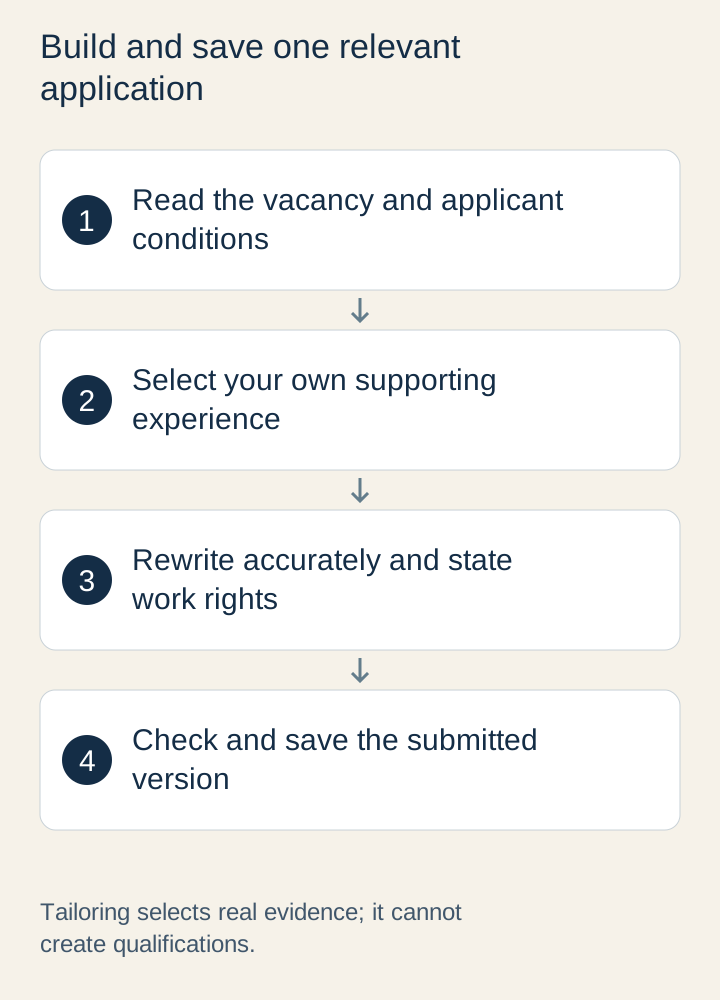
This original editing sheet connects a posting requirement to a decision about the submitted file. Keep the detailed evidence in your own secure records, not in the resume itself.
| Vacancy requirement | Evidence choice | Resume edit | Final check |
|---|---|---|---|
| Accurate stock records | Your actual reconciliation task | Prioritize the relevant work example | Can you explain the process and limits? |
| Shift communication | Your own handover responsibilities | Show the handover action, not “excellent teamwork” alone | Does the wording match your role? |
| Particular licence | Current verified licence, or a genuine gap | State exact status; do not imply local recognition | Is the jurisdiction and validity clear? |
| Existing authorization | Current individual position | Use truthful wording and form answers | Are permit conditions relevant to this employer? |
Add the employer, role reference, source date, file name and submission channel. Save a separate final copy for this application. If the next vacancy emphasizes dispatch rather than stock accuracy, change the examples and order where justified, but do not change employment facts. Tailoring means choosing relevant evidence, not creating a different person for each employer.
Run an interview test on every important line: What did I personally do? When? With what tools or process? What happened? What can I share without breaching confidentiality? If you cannot answer, narrow or remove the statement before sending it. The worksheet can also show a real gap that writing cannot solve, such as required registration or a skill you have not acquired.
Ask a reviewer to compare the resume with the posting, not simply whether it looks attractive. A useful comment identifies an unsupported claim, missing requirement or confusing sentence. Keep changes and versions so that you can bring the exact submitted resume to an interview. No worksheet score in this guide predicts an offer or immigration decision.
6. Check the final file and the message that accompanies it
Follow the employer's requested format. If a PDF is appropriate, check that text can be selected, headings remain readable and the file opens on another device. If an online system has separate fields, verify dates and job titles after copying them. A visually attractive document may still contain a blank page, a cut-off contact line or an old employer name in the accompanying message.
Use simple headings and test the reading order. This is a usability check, not a promise that a particular design defeats every applicant tracking system. Avoid hidden keywords, copied blocks of duties and unverifiable claims about “ATS scores”. Do not upload your full personal history or confidential evidence to an unfamiliar tool just to obtain a speculative score.
Write a short application message referring to the real vacancy, a relevant contribution and your accurate situation. For example: “Please find my resume for the advertised stock-control role. My experience includes checking delivery records and reporting discrepancies. I am available to discuss how that work matches your requirements.” Add work-right information where necessary and replace every example with facts about yourself.
Prepare references separately and obtain permission before sharing their details. WorkBC advises contacting referees first. Check the employer's requested information without sending a reference list to every unknown contact. For broader immigration-route questions, the PremierVisa Group Canada overview is separate reading, with individual requirements assessed separately from the resume.
7. Frequently asked questions
Is there a special official “LMIA resume” format?
This guide does not establish one. Write for the actual vacancy and follow genuine instructions. A resume presents your employment evidence; it is not a substitute for an employer's LMIA process or your own authorization.
Should I include a photograph because my home-market template has one?
Job Bank advises against photos in Canadian resumes. Review the destination's guidance instead of carrying every field from a home-market template. Keep attention on relevant work and avoid unnecessary personal information.
Must every achievement include a percentage?
No. Use reliable measurements only where you can explain the basis and period. Without them, describe the action, scope and observable result. Inventing numbers makes a weaker and less defensible application.
Can I write “Canadian equivalent” beside my qualification?
Only use recognition or equivalency wording that you can substantiate and that fits its purpose. An informal translation is not a credential assessment or licence. State what you actually hold and identify a recognition question separately.
Can I reuse the same resume for several jobs?
Reuse the accurate master history, then choose relevant evidence and check the final version for each vacancy. Save what you submitted so interview answers match. Changing only the company name does not address different job requirements.
Your next step is to choose one suitable vacancy, complete the editing sheet and revise one defensible version. For individual preparation support, submit your candidate background to discuss your resume, interview and realistic employer-search direction under confirmed service arrangements.
Prepared with AI assistance. General career information; no named professional review has been confirmed. AI cover illustration does not depict our staff, clients or partner employers.
Sources: Job Bank resume guidance; WorkBC Resume and Cover Letter; IRCC employer-specific permits. URLs and supported claims are recorded in sources.json.