
Pause if someone offers a Canadian LMIA job in exchange for a reservation payment, recruitment charge or supposedly guaranteed approval. Under the relevant Temporary Foreign Worker Program rules, employers and people recruiting for them must not recover prohibited recruitment or LMIA processing costs from workers. A different invoice label does not fix that problem. Check who is hiring, what work exists and what each payment is really for. This guide provides a payment-request evidence record and official reporting routes without assuming that every unclear message proves fraud.
- 1. Treat the promise as a claim to verify, not an available job
- 2. Separate prohibited worker charges from other costs requiring their own basis
- 3. Verify the people and employment before handing over sensitive documents
- 4. Keep a payment-request evidence record and ask a precise question
- 5. If you have paid or disclosed information, limit further loss and preserve the chronology
- 6. Choose the reporting route for your location and issue
- 7. Frequently asked questions
1. Treat the promise as a claim to verify, not an available job
A message saying “LMIA ready” can conceal several unresolved questions. Is there a real employer, a current vacancy, duties you can perform and an offer addressed to you? Is the sender authorized to recruit for that employer? What stage has actually been reached? A logo, company number or image of a letter does not answer all those questions.
The Canadian Anti-Fraud Centre's job-scam guidance recommends checking the company's genuine website and contacting it independently. Use a contact obtained separately from the suspicious message. Ask the business to confirm the recruiter, vacancy reference and application channel. Do not use only the telephone number on the document you are trying to verify.
Watch for pressure to decide immediately, unusually easy work with exceptional rewards, unsolicited offers without a meaningful assessment, requests to move money or demands to install unfamiliar software. These are reasons to pause and examine the situation. A free email address alone does not establish a crime, and a business-domain email alone does not establish legitimacy; use several independent checks.
Keep recruitment and immigration outcomes separate. A real employer can make an offer, but a recruiter cannot turn a private payment into a government decision. IRCC's employer-specific permit guidance distinguishes employer requirements from the worker's authorization. Do not travel as a visitor on an assurance that productive work can begin immediately, and do not accept a promise of permanent residence as proof of a job.
2. Separate prohibited worker charges from other costs requiring their own basis
ESDC's current high-wage program requirements prohibit recovering the LMIA processing fee and employer-side representative or recruitment costs from the temporary foreign worker. Its low-wage requirements also prohibit direct or indirect recruitment-fee recovery. Do not interpret an invoice or a refund clause as permission to charge a prohibited fee.
Use this original responsibility comparison to ask focused questions. It does not determine a particular bill's legality or quote current fee amounts.
| Payment described | What to check | Practical response |
|---|---|---|
| LMIA processing charge billed to the worker | Whether it is the employer's LMIA processing cost | Pause; do not accept recovery through a renamed package |
| Job reservation, placement or employer recruitment cost | The real purpose, recipient and connection to hiring | Check the prohibition on direct and indirect recruitment charges |
| Personal permit, medical or biometrics costs | Applicable individual requirement and genuine payment route | Verify the current official requirement; do not assume it buys employment |
| Personal professional advice or another service | Actual work, representative authorization where required, contract and applicable rules | Review separately; a service label cannot conceal prohibited recruitment costs |
The worker-rights guide explains that the employer cannot make you pay to get or keep the job or reimburse its recruitment fees. The guide addresses workers under the TFW Program. Other routes and provincial recruitment rules must be checked for the actual arrangement rather than assumed to have identical procedures.
If a package combines several items, request an itemized description of who performs each service and who is legally responsible for the cost. Calling a placement charge “CV preparation”, “training”, “document handling” or a deposit does not settle its substance. A legitimate independent service must not be used to disguise a charge for securing employment. Do not infer permission to charge simply because a contract uses the word “optional”.
3. Verify the people and employment before handing over sensitive documents
Ask for the employing entity, worksite, principal duties, hours, remuneration terms and named recruitment contact. Compare the answers with a genuine posting or direct employer communication. A business may exist while the sender has no connection to it. Public registration information cannot prove an individual vacancy or your permit prospects.
Ask the company through its independently located channel: “Does this person recruit for you, is this vacancy current, and is the payment request part of your authorized process?” The employer's confirmation is useful evidence, but a confirmation that a prohibited worker charge is intended does not make that charge permissible. Verify both identity and conduct.
For paid immigration advice, follow IRCC's authorized-representative checking guidance. Check the named person through the appropriate regulator and compare the contact details and current standing. A company brand, a copied licence image or a professional's name in a message is not evidence that the professional is actually handling your case. Recruiter requirements can also depend on province or territory.
Share documents proportionately through a verified channel after understanding the purpose. Do not send passport scans, banking credentials or unrelated family records just to reserve an interview. Never lend your identity to a false application or alter your experience to match a prewritten role. If someone asks you to receive and forward funds, stop: the CAFC describes employment schemes that use applicants as money mules.
4. Keep a payment-request evidence record and ask a precise question
Create one record for each request: date and channel, sender, exact claim, named employer and vacancy, requested amount and currency, recipient, stated purpose, supporting documents, independent verification and next action. Keep original messages and receipts in a secure location. Your working summary should redact unnecessary personal identifiers.
An original hypothetical example is: “Sender A requests a job-reservation deposit; employer connection not confirmed; invoice combines recruitment and documents; no payment made; independent employer enquiry pending.” This is a teaching example, not a report about any real company or a claim that all deposits have the same legal treatment. Do not change “unconfirmed” into “verified fraud” merely to fill a table.
Use a question such as: “Please identify the legal recipient, itemize the service and explain why this charge is payable by me rather than the employer. Please also confirm the employing entity and authorized contact. I will not proceed while the fee responsibility and recruitment connection remain unresolved.” This is original correspondence wording, not an official complaint form.
An adequate answer should address the actual concern. A second copy of the same logo or a voice message saying “everyone pays” is not an itemized explanation. If the response changes the recipient or fee name, record the change and review the substance again. Do not pay a small trial amount just to test whether the rest of the promise is real.
If you want help organizing your employment questions, submit your candidate background. Resume, interview and employer-search discussions require confirmed service scope and lawful fee arrangements. HKJobHunt does not replace an official reporting agency, certify an outside employer or guarantee recovery of money.
5. If you have paid or disclosed information, limit further loss and preserve the chronology
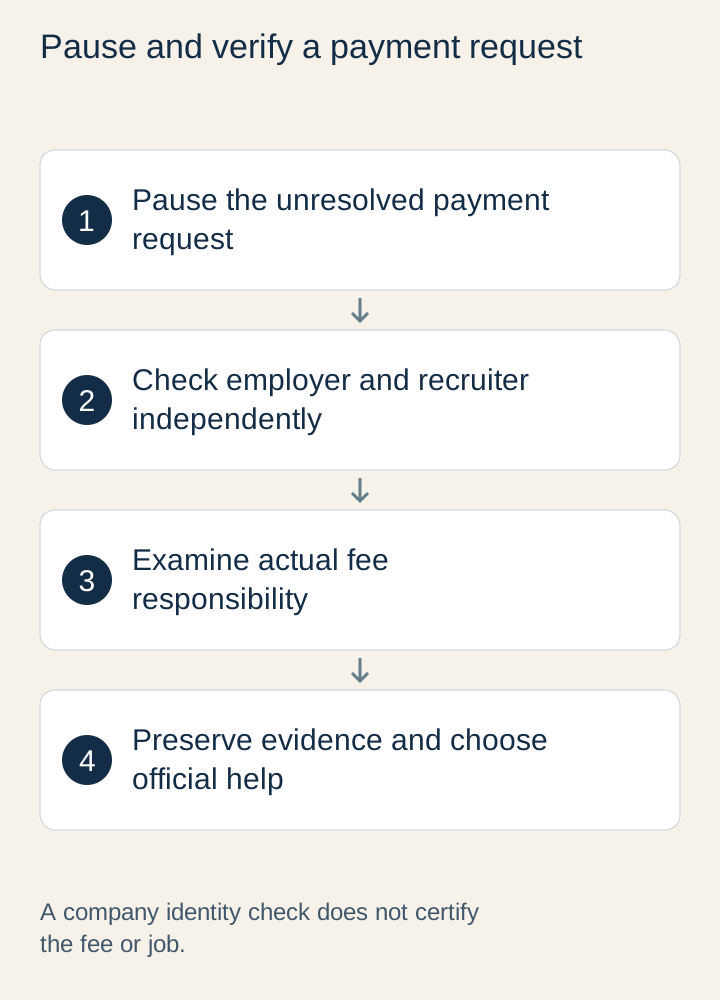
Stop sending additional money or documents while you assess the situation. Contact the relevant bank or payment provider promptly through its genuine channel, explain what occurred and ask what protective or transaction-review steps are available. This is a protective action, not a promise that a transfer can be reversed. Do not pay a new “release”, “refund tax” or recovery charge simply because the sender says it will unlock your original funds.
Save the original advertisement, messages, invoice, account or payment instructions, transaction receipts and documents received. Record dates, time zones, amounts and the exact claims. Separate what you personally observed from what someone told you. Keep evidence intact; do not edit the only copy or circulate unredacted documents publicly.
If account access may be compromised, use the affected service's official security process and obtain appropriate support. Avoid installing a remote-access app sent by the recruiter to “repair” the problem. Where identity or financial information was disclosed, explain that disclosure to the relevant institution and police or official reporting body; do not assume deleting a chat withdraws the information.
An employer threatening to keep your passport or change your immigration status is a separate serious concern. ESDC's rights guide says employers cannot take personal documents or deport you. Seek the applicable official help rather than negotiating solely with the person making the threat. If there is immediate danger, use local emergency assistance. Do not confront a suspected offender or try to conduct your own enforcement operation.
6. Choose the reporting route for your location and issue
IRCC's fraud-reporting page distinguishes online scams, immigration fraud, representative issues and situations inside or outside Canada. Start with the category that matches what happened. It links the CAFC, the Canada Border Services Agency and relevant professional complaint routes; a single generic inbox is not the answer to every problem.
For online job fraud, follow the CAFC's current reporting instructions and contact local police as appropriate. For suspected immigration-document fraud or a representative's conduct, follow IRCC's location-specific steps and any applicable regulator process. Workers facing employment abuse can use the help routes in the ESDC rights guide, including the relevant provincial or territorial employment authority for employment issues. Reporting is not a substitute for checking your current work authorization.
Prepare a factual summary stating where you are, what happened, who contacted you, what was requested or paid and which evidence you hold. Do not include speculation as established fact. Follow the receiving body's instructions for sensitive attachments. A report acknowledgement does not mean a finding of fraud, a refund or a corrected immigration record has been obtained.
For genuine applications, return to the Job Bank screening guide and offer/LMIA/permit comparison. Broader visa planning is separate: the PremierVisa Group Canada overview does not certify a fee or offer. Keep employment preparation, professional advice and government decisions distinct.
7. Frequently asked questions
Is every paid service connected with a Canadian application a scam?
No. The nature of the service, payer, provider and applicable rules matter. But prohibited recruitment and LMIA cost recovery cannot be made acceptable by calling it another service. Verify any independent professional service separately and do not assume a contract proves compliance.
Does a refund guarantee make a job-reservation charge safe?
No. A refund clause cannot legalize a prohibited charge or prove the employer connection. It also cannot guarantee that money will actually be recoverable. Check the underlying arrangement before payment.
Can an LMIA letter image prove the offer is genuine?
Not by itself. Verify the issuer, employer connection, role and applicable process. Another person's document or a reference number is not your authorization. Ask for appropriate evidence without spreading unrelated personal records.
Should I publicly name the company while I investigate?
Preserve evidence and use the appropriate official reporting channel. Avoid publishing personal information or presenting an unresolved suspicion as a legal finding. An impersonated company's name may have been used without its knowledge.
Can a consultant recover my payment or guarantee a new job?
No outcome should be assumed. Ask what specific service is offered, by whom and on what lawful terms. Use official reporting and payment-provider routes for the relevant problem; employment support is not a government decision or a recovery guarantee.
Your first action is to pause the unresolved payment and complete the evidence record. If you also need to rebuild a legitimate job-search plan, submit your background for a preparation discussion, with service scope and fee responsibilities confirmed before any commitment.
Prepared with AI assistance. General career information; no named professional review has been confirmed. AI cover illustration does not depict our staff, clients or partner employers.
Sources: ESDC high-/low-wage requirements and worker rights; IRCC employer-specific permits, representative checks and fraud reporting; Canadian Anti-Fraud Centre job scams. Full URLs and supported claims are in sources.json.