
No. An advertisement accepting international applicants describes who the employer is willing to consider; it does not by itself prove an LMIA application, a positive decision or your permission to work. Read the applicant section, current authorization wording and stated employer stage separately. This guide gives an original advertisement-statement record and questions for resolving contradictions before you apply or make commitments. It focuses on interpreting one posting, rather than promising an employer, a work permit or a permanent-residence pathway.
- 1. Identify the exact statement before interpreting the opportunity
- 2. Keep applicant audience separate from present work authorization
- 3. Distinguish LMIA silence, requested and approved
- 4. Use a statement-to-question record when the wording conflicts
- 5. Decide whether to apply, clarify or stop using the actual answer
- 6. Protect the boundary between recruitment, payment and permission
- 7. Frequently asked questions
1. Identify the exact statement before interpreting the opportunity
Open the original posting rather than relying on a screenshot, social-media summary or translated headline. Record the employer, role, location, posting reference and observation date. Then copy only the short phrase you need for your private comparison, keeping its context. A job-board filter, a recruiter's message and the full advertisement may describe different things. Treat differences as questions, not automatic proof that any one statement is authoritative.
Job Bank's foreign-applicant FAQ directs applicants to the intended-applicant information and the field explaining who can apply. It also describes a search filter for Canadian and international candidates. Those instructions help target applications. They do not certify that every employer will undertake the same immigration process for every overseas applicant or respond positively to every resume.
Read the duties, required experience, qualifications, worksite and application method alongside the audience statement. Being within the advertised applicant group does not mean you meet the job requirements. Conversely, having relevant experience does not create current authorization. The broader Job Bank search guide covers finding and tracking opportunities; here the task is to understand what this particular posting actually says.
2. Keep applicant audience separate from present work authorization
An employer can invite international applications while still asking candidates to describe their current work-permit position. “International” does not establish whether the person is outside Canada, already holds an eligible permit or needs new authorization. State your actual location and present position accurately, without assuming that nationality or residence alone answers the question. Do not say you have a permit that you merely hope to obtain.
IRCC's employer-specific permit guidance says that, if you need a work permit and do not yet have one, you cannot legally work or claim on an application that you are legally allowed to work. Follow the actual question being asked. A future willingness to obtain authorization is different from holding it now. This guide does not determine whether a particular exemption applies to you.
If a form asks whether you require employer support, answer according to the real situation and the wording, and seek clarification if the choices do not fit. Do not select an inaccurate option simply to pass an automated screen. You can explain that you are applying from overseas and need the appropriate process before starting. That explanation is useful information, not an entitlement to an interview or support.
An example of accurate initial wording is: “I am currently outside Canada and do not hold Canadian work authorization. I am interested in this role because of my relevant experience. Are you considering applicants who would need the appropriate employer and work-permit process?” Adapt this original teaching sentence to your facts. It does not promise that an employer can or will complete that process.
3. Distinguish LMIA silence, requested and approved
Job Bank's temporary foreign worker page explains that postings may show whether an LMIA has been requested or approved. Requested means an employer has asked permission to hire a foreign worker temporarily; it is not a positive decision. Approved describes an employer-side stage, not your personal permit. An advertisement with neither label does not establish either outcome by silence.
Ask about the particular job, employer and current stage. An employer having sponsored another person previously does not prove that this vacancy has a usable assessment for you. A recruiter saying “LMIA available” may need to explain what that means and what evidence can appropriately be supplied. Do not request or circulate another worker's private documents as a shortcut to verifying your own proposed arrangement.
IRCC says the employer must determine whether the job needs an LMIA or is exempt and provide the appropriate documents before the worker's application. A genuine exemption is a separate route, not proof that every foreign applicant is exempt. The official permit-type guide also distinguishes employer-specific and eligible open permits. Open-permit eligibility cannot be inferred from an international-candidate label.
| Advertisement wording | What it can tell you | What it does not establish |
|---|---|---|
| International candidates may apply | Intended applicant audience | Employer application or your authorization |
| LMIA requested | A stated employer application stage | A positive assessment or permit |
| LMIA approved | A stated positive employer stage | Your eligibility or right to start |
| Existing work authorization required | A current-authorization requirement to examine | That you can substitute a future application |
These are interpretation examples, not endorsements of a named posting. If you need help organizing your resume and employer questions, submit a background summary to discuss job-search preparation with HKJobHunt. Do not submit complete identity or private employer assessment files in a general enquiry.
4. Use a statement-to-question record when the wording conflicts
The original practical asset has six fields: exact statement and location; date and posting reference; applicant or authorization meaning; employer process claimed; unresolved contradiction; and question, respondent and next action. Keep observations separate from conclusions. “The posting says international candidates, but the form requires existing permission” is a documented question. It is not yet proof that the employer will change the requirement or that the platform is wrong.
In a fictional example, an overseas applicant reads an international-candidate heading and a sentence saying applicants without legal permission will not be considered. Instead of claiming authorization or paying someone to bypass the screen, the applicant asks the employer which requirement applies to this vacancy. The response may close the lead, clarify an appropriate application or leave the matter unresolved. This is not a customer case or an actual job advertisement.
Ask a precise question: “For vacancy reference X, does the applicant section include people outside Canada without present work authorization, or only international candidates who already have it?” If no reference exists, use the actual role and location without inventing a number. Quote the relevant short phrases and provide the source, rather than sending a long accusatory message about every advertisement on the site.
For the employer-process question, ask: “Does this role require an LMIA, and what is the current stage or applicable exemption being considered?” The employer may need its professional adviser to respond. A reply is useful evidence of what was said, not a government decision. If the answer changes later, record the new date and explanation while retaining the earlier statement.
5. Decide whether to apply, clarify or stop using the actual answer
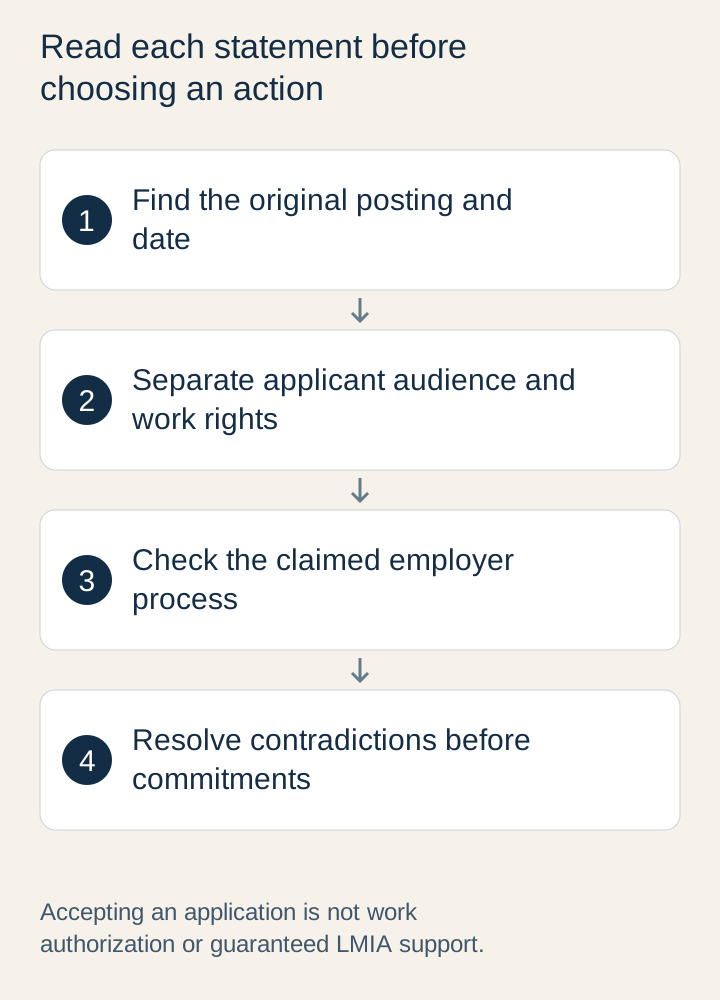
Apply when your background addresses the genuine duties and the intended-applicant position is clear enough for an honest application. Tailor the resume to relevant experience and explain present authorization accurately. Do not copy an occupation title from a different market and assume it proves the required skills or professional registration. A job advertisement can identify a requirement without assessing your individual qualification.
Seek clarification when the audience or support statement conflicts. Keep the enquiry short, professional and specific to the role. An employer may not respond, and silence does not amount to support. You can mark the matter unconfirmed and continue other appropriate applications. Avoid multiplying near-identical messages to every address associated with a business or contacting unrelated employees with personal files.
Close or pause a lead if the employer confirms that existing permission is essential and you do not have it, or if a material requirement is not met. Do not represent the employer as offering sponsorship simply because it did not explicitly rule it out. A decision not to apply now is not a personal immigration finding; it is a job-search decision based on the available evidence and stated requirement.
Keep the original page and response in a secure personal record where appropriate. If a posting expires, treat its current availability as unconfirmed rather than republishing it as HKJobHunt's own vacancy. This guide neither removes source-company names to repackage jobs nor supplies a verified list of employers. Every actual opportunity needs its own current checks.
6. Protect the boundary between recruitment, payment and permission
Job Bank says searching and applying on its website are free, employers should not ask you to pay them to hire you, and employers cannot make you pay for the LMIA. An offer to sell an “international applicant place” or convert a requested label into approval is not a normal interpretation of a posting. Do not treat a refund promise or a professional-looking invoice as proof that a payment is appropriate.
Different genuine personal services and expenses need their own scope and responsibility checks. This article does not decide every service-fee arrangement or individual dispute. Ask for the real provider, purpose and lawful payer and obtain suitable independent advice when necessary. Do not purchase a job or assume the immigration cost belongs to the worker because the advertisement is directed at overseas candidates.
For actual work permission, follow the person's applicable IRCC process. The Job Bank temporary-worker page includes information aimed at people already in Canada; its possible immediate-start wording cannot be generalized to an overseas applicant. The permission-document guide handles that separate handover in more depth. A positive LMIA is not a substitute for the individual's authorization and conditions.
For broader immigration background, see PremierVisa Group's Canada information. This article concerns temporary-job advertising, not Express Entry scoring or a promise of permanent residence. A recruitment sentence does not decide any of those outcomes. Keep the job, employer process, personal application and future settlement questions in separate records so an answered question does not appear to approve every stage.
Before making an irreversible practical commitment, review what changed since the advertisement was first read. Confirm the role is still being recruited, that the employer's response concerns the same workplace and that any proposed start reflects outstanding permission. You do not need to resolve every future immigration question before submitting a truthful resume, but you should not resign, travel to work or pay for an assumed approval based on an audience label.
7. Frequently asked questions
Does an international-candidate label mean the employer will do an LMIA for me?
No. It describes an audience. Ask about this vacancy's actual employer process and stage; an invitation to apply does not commit the employer to a particular application for you.
Is an LMIA-requested job already approved?
No. Requested and approved are different states. Neither advertisement label establishes your individual work authorization.
Can I say I am legally allowed to work because the employer will help later?
Not if you need a permit and do not currently have it. Describe the actual position and distinguish present authorization from a future process.
Does LMIA-exempt mean no work permit is needed?
Not generally. The applicable route and personal requirements still need assessment. An open permit or a work-permit exemption requires its own eligibility basis.
What if the headline and application form disagree?
Record both, ask the employer which applies to the vacancy and keep the answer. Do not invent authorization or assume the more favourable wording overrides the other requirement.
Submit your job-search background to discuss resume preparation, interviews and realistic employer-contact directions with HKJobHunt. Immigration questions may be referred to PremierVisa Group under an appropriate engagement. No partner employer, LMIA approval, job or work permit is promised.
Prepared with AI assistance. General career information; no named professional review has been confirmed. AI cover illustration does not depict our staff, clients or partner employers.