
To approach a Canadian chef employer, match your actual kitchen responsibilities to the role, prepare evidence of your own work and ask how the recruitment and work-permit steps will be handled. A chef title, attractive food photographs or an LMIA label is not enough. This guide provides an original kitchen-skill evidence card, interview examples and an offer check. It does not offer current vacancies, certify overseas qualifications or promise sponsorship, immediate work or permanent residence.
- 1. Match the kitchen role before applying
- 2. Build evidence that shows your own contribution
- 3. Use a kitchen-skill evidence card for the interview
- 4. Ask practical kitchen questions, not just whether sponsorship is available
- 5. Read pay, hours and the actual employing entity together
- 6. Verify the employer process and the basis for starting
- 7. Frequently asked questions
1. Match the kitchen role before applying
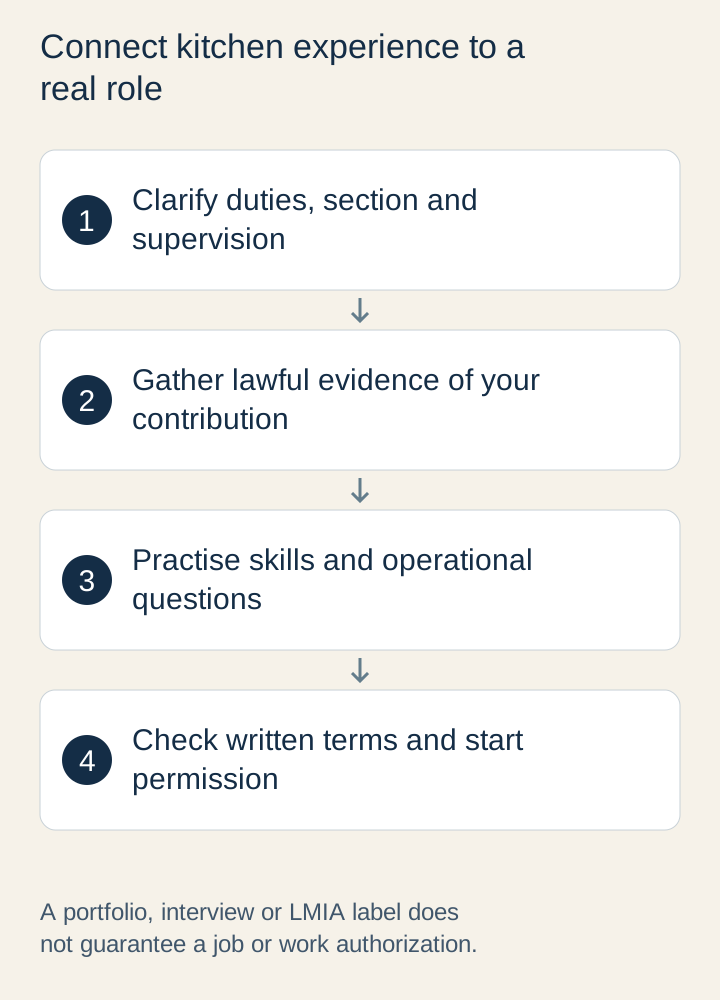
Start with the employer's real tasks: the section you would run, preparation and service responsibilities, supervision, menu input and reporting line. Ask whether the vacancy is primarily cooking, directing a section or managing a wider kitchen. Your previous title may not describe the same responsibilities. A more impressive English title cannot replace the actual work you performed or the duties the employer needs.
Job Bank's chef requirements describe typical credentials, training and experience and distinguish expectations for more senior chef roles. Use that profile to identify questions, not to declare yourself qualified from one matching word. A role called chef in a small establishment may have a different operational scope from the position you held in a large hotel.
Choose vacancies you can discuss concretely. If your strongest evidence concerns a hot-food station, explain that instead of claiming responsibility for the entire restaurant. If you supervised staff, identify what you actually controlled: briefing, allocation, training or checking output. Do not convert occasional help with a task into years of management experience merely because the advertisement asks for leadership.
The Canadian employer-search guide covers search channels and initial screening. Here the added task is building a kitchen-specific application. Keep a dated source for each real posting and use the employer's stated application route. This article contains no live vacancy inventory or verified list of restaurants willing to hire a particular overseas applicant.
2. Build evidence that shows your own contribution
Prepare an accurate employment timeline: employer, location, dates, role and main duties. Identify supporting references and documents you can lawfully use. Explain inconsistent job titles or overlapping dates before they become interview surprises. Do not manufacture pay records, certificates or experience letters. A polished portfolio should make existing experience understandable, not create a history that cannot be checked.
For a skills portfolio, select a small set of your own examples and explain the task, your part and the work context. A dish photograph alone does not show who planned it, prepared it or supervised service. State whether you developed the recipe, executed an established specification or contributed to a team result. Permission to take and use photographs matters; do not copy a restaurant's promotional library or another chef's work.
Protect confidential recipes, customer information and private business records. You can describe a preparation sequence or service problem in your own words without publishing a former employer's proprietary manual. Where evidence cannot be shared, explain the restriction and offer an appropriate alternative, such as a factual reference or a non-confidential discussion of your responsibilities. Do not label absent evidence as verified.
Job Bank mentions trade certification or equivalent credentials, training and experience, and available chef-related certifications. It does not make a portfolio a substitute for every qualification question. Check the actual role, local requirements and any credential the employer requests. This article does not declare that every chef must have Red Seal, or that an overseas certificate automatically has the same Canadian status.
3. Use a kitchen-skill evidence card for the interview
The original six-field card records: role requirement; task and your contribution; work context and period; lawful evidence reference; safety or confidentiality limit; and interview explanation or next question. Create an entry for each important requirement rather than sending every document you possess. Keep the supporting originals secure. This is a preparation tool, not a government assessment form or a certification of competence.
For a fictional example, the requirement is coordinating a busy service section. The applicant describes setting up the station, communicating shortages and briefing the next shift, while making clear that the head chef approved menu changes. A supporting reference can confirm the applicant's responsibilities. This is more useful than “managed all kitchen operations” when that broader claim would be inaccurate.
Practise an original English explanation: “My responsibility was the preparation and service of my section. When an item ran short, I informed the supervisor, checked the agreed substitute and updated the team before continuing.” Adapt it to something you actually did. It shows sequence and communication without inventing a success percentage or implying permission to change ingredients without checking.
| Application claim | Useful evidence or explanation | Avoid |
|---|---|---|
| Ran a section | Actual duties, period and reference | Claiming the whole kitchen without basis |
| Trained colleagues | What you taught and your authority | Inflating team size or formal qualifications |
| Prepared a dish | Your contribution and permitted images | Borrowed photographs or confidential recipes |
| Handled a service problem | Situation, action and communication | Invented results or unsafe improvisation |
If you need help selecting examples and making the resume clear, submit your candidate background. Discuss interview preparation and realistic employer-contact directions. Do not send confidential recipes, customer details or complete identity documents in an ordinary enquiry.
4. Ask practical kitchen questions, not just whether sponsorship is available
Ask which section you would join, who supervises it and how preparation and service shifts are organized. Clarify the equipment, menu style and language used for daily instructions. These questions help you decide whether the job fits your experience. Familiar cuisine does not mean the workplace uses the same systems, and a shared first language does not remove the need to understand safety and operational instructions.
Prepare to discuss safe communication: how you would clarify an unclear instruction, raise an ingredient concern or stop and ask the responsible supervisor. This article gives interview preparation, not a food-safety training course. It does not prescribe cooking temperatures, approve an allergen procedure or replace local requirements. An honest description of what you would check is stronger than pretending to know every unfamiliar system.
If asked for a practical demonstration, clarify the purpose, location, duration, supervisor and actual tasks before agreeing. A request called a trial does not by itself settle employment, payment or immigration issues. Obtain appropriate checks before productive work; do not perform a restaurant shift on the assumption that an interview label removes the need for authorization. This guide does not declare an unpaid trial lawful.
For the separate immigration question, use the LMIA interview answer guide. State your actual current position, identify what remains to be confirmed and ask who administers the employer's process. Avoid promising immediate availability because the manager likes your cooking or because the restaurant has previously employed a foreign worker.
5. Read pay, hours and the actual employing entity together
Ask for the legal employer, worksite, duties, guaranteed pay and paid-hours arrangement in writing. Clarify the difference between the advertised restaurant name and the entity signing the agreement. If an offer changes the kitchen or role discussed, preserve both versions and ask for an explanation. Do not silently modify your resume to make the discrepancy appear to disappear.
ESDC's high-wage requirements distinguish guaranteed wages from components such as tips, overtime and benefits for program-wage assessment. Do not compare restaurant offers only on a total package headline. The wage-stream offer guide explains the separate provincial threshold and prevailing-wage checks; a chef title does not determine the stream.
Ask how scheduled hours, breaks, overtime and deductions are described, and which applicable employment rules the employer uses. Do not assume one overtime rate or weekly schedule applies throughout Canada. A national occupation profile is not the actual contract. Accommodation and meals need their own written terms; free staff housing, guaranteed tips or a particular saving amount should not be invented from a brief advertisement.
ESDC's requirements also prohibit recovery of employer-side LMIA processing and recruitment fees from temporary foreign workers. A payment to buy a kitchen job or a guarantee of sponsorship is not evidence of a genuine offer. Ask what any charge covers and who is responsible. Keep individual professional-service agreements distinct rather than treating all costs as one unexplained recruitment package.
6. Verify the employer process and the basis for starting
IRCC's employer-specific permit guidance distinguishes the employer's LMIA or applicable exemption steps from the applicant's permit requirements. A restaurant offer is not personal work authorization. If a permit is required and you do not hold it, do not claim existing legal authorization on an application or begin kitchen work on the strength of a recruitment promise.
Keep a dated contact record showing who confirmed the duties, which entity would employ you, what process the employer says applies and what remains unsupported. A website, menu and company presence each answer limited questions; none alone proves a genuine vacancy, suitable LMIA or your permission. Use official instructions and appropriate review for the parts that cannot be established from public business information.
When documents arrive, use the offer, LMIA and work-permit guide to hand over the unresolved questions. Confirm who checks the lawful start before agreeing to the first shift. Skills readiness, employer interest and authorization are separate. Do not book irreversible relocation arrangements merely because a video interview or portfolio discussion went well.
Immigration details can be explored through PremierVisa Group's Canada information and an appropriate individual engagement. This article does not promise permanent residence, determine provincial nomination eligibility or use future Express Entry changes as current rules. Its role is to help you present genuine kitchen experience and understand a proposed job, not turn culinary ability into a guaranteed immigration result.
7. Frequently asked questions
Do food photographs prove that I meet a Canadian chef requirement?
Not by themselves. Explain your own contribution, experience and supporting evidence. Check the role and credential questions separately, and use only images you may lawfully share.
Does every chef applicant need Red Seal?
Do not make that blanket assumption from a general profile. Check the actual duties, relevant local arrangements and employer requirements. Available certifications are not the same as a universal requirement for every applicant.
Can I call myself executive chef if I occasionally led a shift?
Describe the actual responsibility and period. Do not inflate the title or claim control of the whole operation without evidence. A precise section-lead example can be stronger than an unsupported senior title.
Can an interview trial be treated as permission to work?
No such assumption should be made. Clarify the actual tasks and obtain appropriate employment and work-right checks first. Calling an activity a trial does not resolve authorization or payment questions.
Does a restaurant that hired foreign workers before guarantee support now?
No. Check this employer, this position, the actual process and your own conditions. Previous hiring is not approval of a new application or proof that you may start immediately.
Submit your candidate background to discuss your kitchen experience, resume, interview examples and practical employer-contact direction. Start with your role history and questions. No restaurant placement, LMIA, work permit or immigration outcome is guaranteed.
Prepared with AI assistance. General career information; no named professional review has been confirmed. AI cover illustration does not depict our staff, clients or partner employers.