
For an overseas tradesperson seeking an Australian 482 job, a strong work history is only one part of preparation. Identify the actual trade and work location, check whether a skills assessment is required, and establish the applicable occupational licence before promising a start. This guide helps you assemble a job-to-evidence dossier and ask an employer about supervision and training. It does not certify an applicant, advertise verified vacancies or authorize regulated work.
- 1. Describe the work and location before choosing a pathway
- 2. Keep assessment, qualification, licence and permission separate
- 3. Use a licensed-trade example without generalising it
- 4. Build a project record that explains your own contribution
- 5. Use the job-to-evidence dossier to expose missing arrangements
- 6. Plan the assessment and start without inventing certainty
- 7. Frequently asked questions
1. Describe the work and location before choosing a pathway
Start with a genuine position description, rather than a broad advertisement for construction workers. Record the employing entity, state or territory, workplace, principal tasks, equipment and reporting relationship. Installation, maintenance, fault diagnosis and supervision may be different responsibilities. Do not translate every technician, fitter or assistant title into the same Australian trade because the English wording sounds more attractive.
Make a factual account of your own history alongside the vacancy. For each employment period, distinguish work you personally completed, work you assisted with and work another licensed person supervised or certified. A senior overseas title does not prove identical Australian authority. If you also managed materials, scheduling or subcontractors, explain those activities separately from hands-on work rather than presenting a management period as uninterrupted trade practice.
The official 482 Skills in Demand overview describes a temporary sponsored visa with nomination, skills and relevant English requirements. A trade appearing relevant to an occupation does not establish an available sponsor or an approved nomination. This article concentrates on application evidence and operational readiness; it is not a substitute for checking the actual visa stream and occupation rules.
Ask the employer to confirm the tasks and location before buying an assessment or course. A vacancy covering several sites needs a clear explanation of where you would actually work and which responsibilities apply there. If that information is unavailable, record it as unresolved. Do not spend money on the assumption that an advertisement's national branding makes the licensing requirements identical everywhere.
2. Keep assessment, qualification, licence and permission separate
Home Affairs' skills-assessment guidance says certain primary SID applicants need a mandatory assessment and that an assessment may also be requested where it is not mandatory. Check the actual applicant and applicable rules, including any exemption, with the correct authority. Neither “all tradespeople need the same assessment” nor “482 never needs an assessment” is a safe starting point.
A skills assessment considers skills for a defined purpose. A qualification records training or demonstrated competency under its own arrangements. A state or territory occupational licence establishes permission within its particular category and conditions. Immigration permission is another decision. Do not combine these into one status such as fully approved when only a training certificate has been obtained.
| Evidence or decision | What it helps establish | What it does not establish by itself |
|---|---|---|
| Overseas qualification and employment records | Your training and actual past work | An Australian occupational licence |
| Relevant skills-assessment outcome | The stated assessment result and scope | Unrestricted practice in every state |
| Occupational licence or provisional authority | Work permitted under its conditions | A visa, job or contracting entitlement |
| Offer and proposed sponsorship | An employer's written proposal and stage | Granted work permission or every licence |
Use this distinction when responding to a recruiter. A precise answer might be that an assessment outcome is held but the intended state's licence is still being checked. State the real status and next action. Do not describe an application receipt, booked assessment or course enrolment as a successful outcome, even if you expect the remaining stage to be straightforward.
3. Use a licensed-trade example without generalising it
Trades Recognition Australia's licensing guide explains an Offshore Technical Skills Record, or OTSR, in specified licensed trades. It describes further licensing and Australian-context training steps, including supervised employment. An OTSR records assessed skills; it is not simply an unrestricted occupational licence. The guide also cautions that permission to work in a trade does not necessarily permit contracting.
TRA's electrician guidance directs applicants to the relevant state or territory regulator. As one concrete example, NSW's electrical-work page requires the appropriate licence or certificate for electrical wiring work and distinguishes doing, supervising and contracting. Overseas-trained applicants have their own requirements to investigate. This is an NSW electrical example, not a national checklist for every trade.
If your proposal involves a provisional certificate or supervised training, ask who will provide the appropriate supervision, what tasks you may perform and how training and employment will fit together. Confirm the actual conditions with the regulator and provider. An employer saying “we have electricians here” does not itself identify your authorized work or satisfy the supervisor and training arrangements.
Do not generalise a licensed electrical pathway to welding, carpentry, mechanical work or another state. Check each occupation and local requirement. Equally, the absence of one particular occupational licence does not mean there are no site, safety, training or task restrictions. This guide provides questions for the responsible parties; it does not instruct anyone to perform electrical work or another hazardous operation.
4. Build a project record that explains your own contribution
Create a private evidence index with qualifications and transcripts; employment periods and duties; payment or other employment corroboration you legitimately hold; project records; and current assessment or licensing correspondence. This is an editorial preparation system, not a universal list of documents accepted by every assessor. Obtain the current instructions for the exact programme and purpose before submitting material.
For each relevant project, record its type, approximate period, your role, actual tasks, supervision and a suitable verification contact. Describe the work without disclosing client addresses, confidential drawings or security arrangements. A photograph may illustrate a setting but does not alone prove that you completed the work, were paid, or held the necessary authority. Do not borrow another worker's images to fill an evidence gap.
An original hypothetical rewrite is: “I assisted the maintenance team with scheduled equipment work, recorded observations and referred matters outside my authorized scope to the responsible supervisor.” Use it only as a model of contribution language, not as a claim to copy. An applicant who actually held a different responsibility should describe that responsibility accurately. Avoid invented project values, perfect safety records or signed-off work you did not certify.
For a résumé structure, see the overseas-experience résumé guide. Keep the concise employer-facing account connected to the private evidence index. If dates, company names or responsibilities differ between records, identify the reason and seek a factual correction or explanation. Do not silently rewrite the originals so that every document appears to say the same thing.
If you need help organising this account, submit your job-search background to discuss résumé preparation, interview questions and possible employer approaches under the confirmed service scope. Individual licensing, assessment and immigration issues need appropriate separate review.
5. Use the job-to-evidence dossier to expose missing arrangements
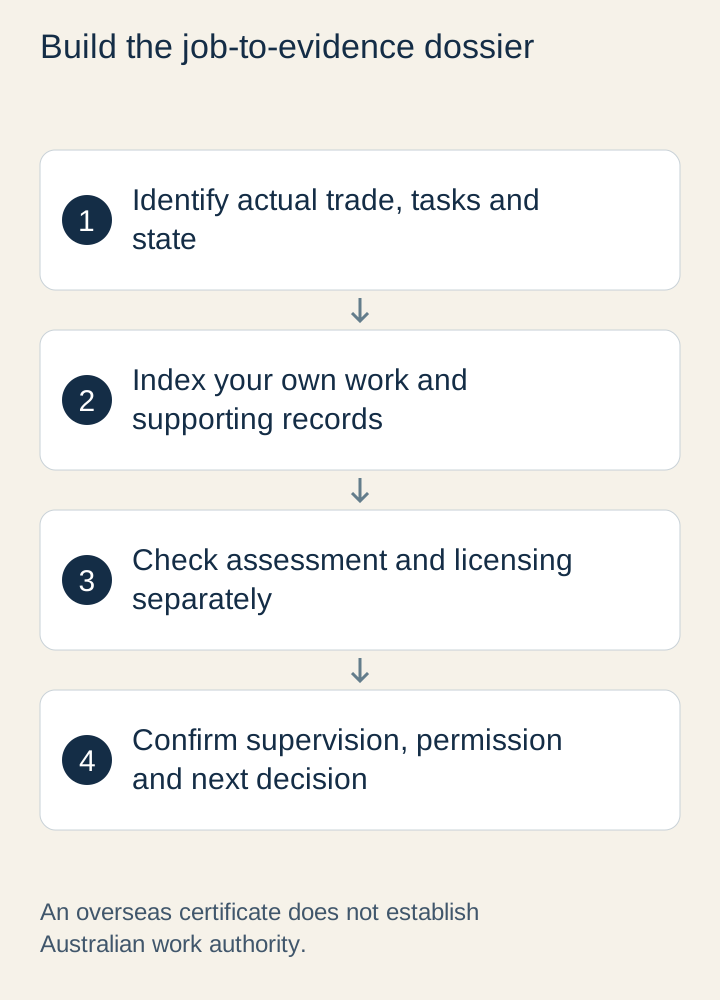
The practical asset for this topic has six fields: vacancy tasks and location; your actual role and employment period; supporting record and permitted disclosure; assessment status and purpose; licence or supervision requirement; and unresolved issue, responsible contact and next decision. Fill a row for each important requirement rather than attaching an unstructured folder of certificates. The worksheet is private and does not send information to an employer or CRM.
A fictional example could read: “NSW electrical vacancy; overseas installation history; supervisor confirmation available; assessment status to confirm; NSW certificate and supervised arrangement unresolved; ask employer and regulator before promising duties.” Another could concern maintenance work whose advertised tasks are too vague to identify the relevant trade. Neither example is an actual vacancy, a finding of eligibility or evidence of an HKJobHunt partnership.
Send a short question set: “Please confirm the employing entity, work location and principal duties. Which qualifications or licences are required at application and at commencement? If supervised training is proposed, who arranges it and who confirms the permitted tasks? Which sponsorship steps have actually occurred?” Separate the recruiter response, employer document and regulator advice; they serve different purposes.
Keep a visible next decision. You might be ready for an interview while waiting for a document, but not ready to accept a proposed start. If the occupation or state changes, revisit the assessment and licensing rows. An earlier answer about another job should not silently become confirmation for the new one. This is how the dossier supports an informed conversation without pretending to be an official assessment.
6. Plan the assessment and start without inventing certainty
TRA's RTO Finder says to check programme eligibility and guidelines before selecting an approved registered training organisation. Its listings and assessment capacity can change. Verify the exact occupation, programme, location and provider arrangements rather than treating an old contact list as a guaranteed appointment or an endorsement of every service a provider sells.
Ask the relevant provider what evidence and assessment format apply, whether attendance or travel is necessary and what happens if a required document is missing. Do not assume an overseas video call will satisfy every practical requirement. Some TRA pages retain programme labels such as TSS; that label is not a reason to rename today's Skills in Demand visa or copy historic visa criteria into your application.
Discuss actual work conditions with the employer: location, roster, pay components, tools, induction, supervision and any proposed training commitments. Check who is responsible for each arrangement and obtain a clear explanation before making financial or relocation commitments. Do not assume an unpaid demonstration, visitor status or a course payment permits productive or regulated work. Actual permission and licence conditions must be established for the duties.
For immigration context, use PremierVisa Group's verified 482 explanation alongside official sources and suitable individual advice. If the employing entity or written proposal differs from the interview account, use the employer-document comparison guide. Keep an interview invitation, offer, assessment, licence and visa decision as separate milestones; future permanent residence is not established by any one of them.
7. Frequently asked questions
Does my overseas trade certificate let me work independently in Australia?
Do not assume so. Check the actual trade, state or territory and licence category. Overseas training can support your history without establishing Australian authority for the proposed tasks.
Does a positive skills assessment include a full occupational licence?
Not automatically. TRA describes further licensing and training steps for specified licensed trades. Read the outcome and ask the relevant regulator what it permits and what remains.
Does every 482 tradesperson need exactly the same assessment?
No single statement covers every case. Home Affairs distinguishes mandatory assessments, possible requests and applicable exemptions. Confirm your specific circumstances and the correct assessment programme.
What if a past employer cannot provide a detailed letter?
Record the gap and the legitimate evidence you have, then ask the relevant recipient about acceptable alternatives. A private project log helps preparation but is not automatically an accepted replacement or proof of paid work.
Can an employer's willingness to train me settle the licensing issue?
It does not itself settle it. Check the actual authority, permitted duties, supervision and provider arrangements. A proposal and an approved licence remain different stages.
Start with one real vacancy and the evidence you can lawfully explain. For help preparing the employer conversation, submit your background with your trade, actual work history, intended state and unresolved requirements; leave out confidential project documents.
Prepared with AI assistance. General career information; no named professional review has been confirmed. AI cover illustration does not depict our staff, clients or partner employers.