
For an Australian nursing role potentially involving subclass 482, track professional registration, relevant English evidence, employer selection and immigration permission separately. A job interview does not grant registration, and registration does not guarantee sponsorship. This guide helps overseas nurses prepare a factual application handoff and useful questions about one role. It does not assess a person's registration pathway, set universal test scores or promise a job, visa or later permanent residence.
- 1. Identify the nursing role before planning the application
- 2. Describe registration as an evidenced status
- 3. Give each English requirement its own evidence row
- 4. Read employer criteria without making them national rules
- 5. Build a four-track handoff for one vacancy
- 6. Coordinate a lawful start without promises about timing
- 7. Frequently asked questions
1. Identify the nursing role before planning the application
Ask whether the vacancy is for a registered nurse, enrolled nurse or a support position. Do not translate every overseas nursing or care title into Australian RN. The Nursing and Midwifery Board of Australia's scope-of-practice fact sheet describes RN and EN as different nursing divisions with protected titles. Their responsibilities differ, and an individual's scope also depends on competence, setting and applicable conditions.
Record the actual clinical setting, patient group, seniority, reporting relationship and duties. A hospital ward, residential aged-care service and community role may require different experience and employment checks. An overseas senior title does not automatically establish the Australian grade or permission to perform a particular duty. Equally, unfamiliar terminology should prompt a question rather than a claim that your experience is worthless.
If the advertisement is actually for daily-living support, use the separate care-worker role guide. A care role is not an RN vacancy simply because the workplace employs nurses. Decide which job you are considering now, not only which professional position you hope to reach later. An informal promise of future progression should stay separate from the present offer and its conditions.
This article focuses on job preparation around a possible Skills in Demand, subclass 482 arrangement. It is not a complete registration course, a 485 graduate-job plan or a clinical practice manual. Keep occupation-specific and individual regulatory decisions with the relevant authority and appropriate professionals; a recruitment summary cannot make those decisions on their behalf.
2. Describe registration as an evidenced status
The Australian Government's support and education page for nurses and midwives separates successful NMBA registration from the visa process and notes that a migration skills assessment may be involved. WA Health's overseas employment requirements expressly warn that acceptance by ANMAC for skilled migration does not guarantee NMBA registration. Do not call all three processes an AHPRA assessment and assume one successful step completes the rest.
Make the status precise: not yet applied, application submitted, further information requested, or registration confirmed with its actual type and conditions. A payment receipt, account registration, course enrolment or preliminary message is not final professional registration. If you have a decision, read the original and check what it permits rather than copying an agency's interpretation into your résumé.
Use the regulator's current instructions for your complete background. Primary education, previous registrations, practice history and other circumstances can matter. Do not assume a passport, a particular school or a colleague's route establishes your pathway. This draft does not prescribe a universal exam sequence, a bridging course or a streamlined route for all overseas nurses. Verify the applicable instruction before paying for a course or examination.
NMBA explains that its public register shows registration and associated restrictions or conditions. Your application should accurately reflect the result and any limitation relevant to the proposed role. Discuss how a condition would affect the duties with the appropriate employer and regulator; do not remove it from a document or imply unrestricted practice to improve shortlisting. Public verification also does not replace the other recruitment and immigration checks.
3. Give each English requirement its own evidence row
The NMBA English-language fact sheet says new registration applicants must meet its standard regardless of visa status. It describes different evidence pathways and explains that a visa-related test result can be used only when it also satisfies the registration requirements. The fact that a test was accepted somewhere else is not universal proof for the nursing regulator.
Keep separate rows for registration English, the relevant immigration requirement and the employer's communication needs. Record the authority, purpose, test and version if applicable, date, component results and the actual evidence or decision. This is a document-control recommendation, not a claim that everyone needs three examinations. The same result may be useful to more than one process, but its acceptance must be checked against each applicable rule.
Before booking, confirm the current accepted test, required results, validity and any relevant evidence pathway with the correct authority. Do not use an old social-media scorecard, a common standard for another health profession or a migration-points table as the nursing answer. This guide deliberately does not quote a universal score or promise an English exemption; the appropriate standard and individual evidence need current review.
Employer communication expectations also concern real work: explaining a concern, documenting clearly, understanding instructions and knowing when to escalate. Prepare to discuss genuine examples without disclosing patient information. A clinical communication example can help an interviewer evaluate you; it does not certify test compliance or replace the professional registration standard. Avoid presenting confidence in an interview as formal evidence of meeting every English condition.
4. Read employer criteria without making them national rules
NSW Health's international recruitment page asks for current registration evidence and appropriate work permission and describes its own overseas recruitment context. WA Health sets out its own sequence and says sponsorship is negotiated for experienced nurses and midwives applying in critical-shortage areas. These are official employer examples, not a universal promise that every health service will sponsor or use identical experience requirements.
For the actual vacancy, ask which registration status is needed at application, offer and commencement. Ask what recent specialty experience, references and employer checks apply and who confirms them. Do not infer a fixed national minimum from one employer's page, or treat a position appearing in a search as a partnership with HKJobHunt. A genuine vacancy can still be unsuitable for your present scope or background.
Prepare a clinical employment timeline with employer, setting, role, dates, hours and your actual responsibility. Supporting references should be authentic and issued by the appropriate person. Distinguish employment evidence, a professional registration record and an employer's assessment of suitability. Do not add procedures you never performed, increase seniority or invent hours to meet a preferred grade. If evidence is missing, note the gap and ask about an appropriate alternative rather than creating it.
Use the comparison below to keep recruitment conversations accurate. It is an original preparation aid, not a government checklist or a determination of suitability.
| Evidence | What it can address | What it does not establish alone |
|---|---|---|
| Actual registration decision and register | Professional status and conditions | Employer selection or work visa |
| Accepted English evidence for a named purpose | That process's language requirement | Every other authority's acceptance |
| Employer reference and work chronology | Experience, period and responsibility | Australian registration or nomination |
| Written offer and confirmed employer process | Proposed employment and actual stage | Permission to begin clinical work |
For application preparation, submit your job-search background to discuss your résumé, interview and employer questions under the confirmed service arrangements. Professional registration and immigration assessment remain separate; this invitation does not confirm an employer, a clinical credential or a licensed advisory service.
5. Build a four-track handoff for one vacancy
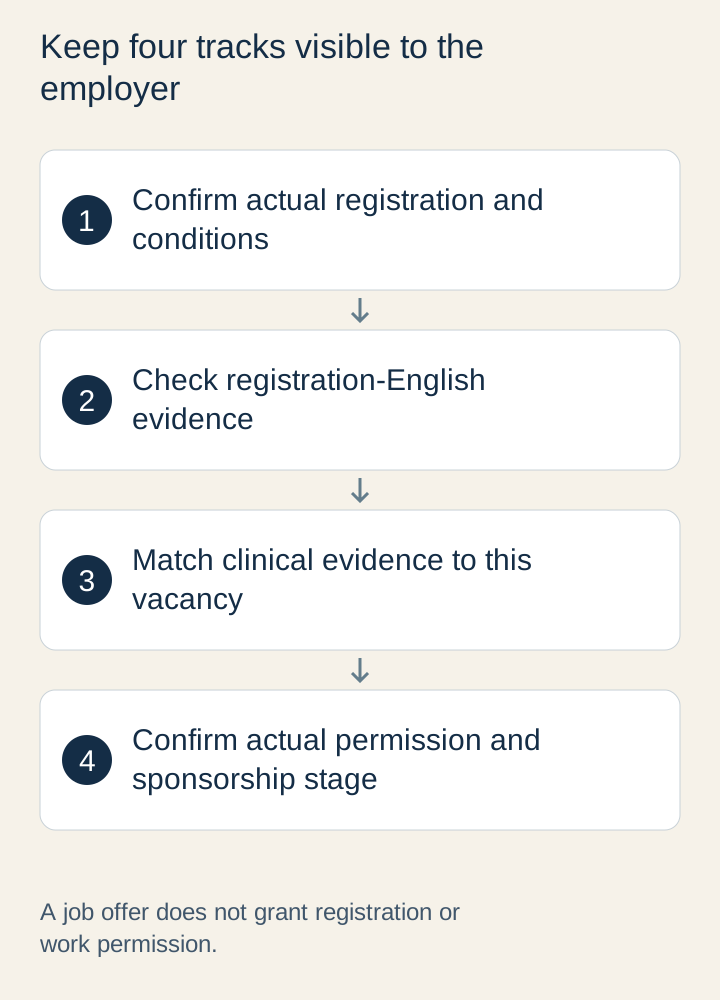
Use six fields: the track and question; current factual status; evidence and date; outstanding condition; responsible authority or contact; and the effect on the next application or start decision. Put registration, English, employment and immigration on separate rows. This is the distinctive practical asset for this topic: it lets HR see what is ready and what still needs a decision without turning a collection of documents into a false all-clear.
An original hypothetical row could record “registration application submitted, receipt retained, final status pending, regulator responsible, no claim of confirmed registration.” Another could record “employer interested, specialty reference requested, not yet a written offer.” These are fictional examples, not actual applicants or employer cases. A row marked complete means only that its stated event is supported; it does not certify overall eligibility.
Write a short handoff message: describe your true qualification and clinical background, give the actual registration position, identify the relevant English evidence, and ask what the employer needs next for this role. Separate what you can provide from what the employer must decide. Do not attach a patient's records, unredacted clinical photographs or confidential hospital files as proof of competence. Use non-sensitive summaries first and an agreed appropriate route for necessary personal supporting documents.
Before the interview, prepare an explanation of your own responsibility, supervision and escalation in a genuine situation. Remove patient-identifying details and focus on professional reasoning without turning the story into clinical advice. Ask the employer about induction, the work setting, reporting lines and support within your permitted scope. An orientation programme is not a substitute for required registration, competence or immigration permission.
6. Coordinate a lawful start without promises about timing
The Home Affairs 482 overview identifies a temporary sponsored arrangement with nomination, skills and relevant English requirements. Recruitment interest, employer nomination and an individual visa decision are distinct. If you already hold Australian permission, check its actual conditions for the proposed work; do not assume everyone applying for a sponsored role has the same current rights.
Keep registration outcome, remaining employer checks, immigration steps and practical relocation dates separate. Ask what must be confirmed before the first clinical duty, not only before a ticket is booked. WA Health specifically advises against major decisions such as resignation or relocation without confirmed registration and a firm offer; that advice does not itself establish immigration permission. Add the applicable work-right checks to your own plan rather than treating an offer as authority to start.
For the offer, ask about actual location, role classification, hours, remuneration and conditions. Experience evidence can matter to employer grading, but a recruiter headline is not a confirmed pay assessment. The 482 salary-offer guide explains the separate salary questions; it does not determine the nursing award or grade for your case. A large salary does not remove registration requirements or establish visa approval.
For visa detail, see PremierVisa Group's verified 482 explanation, alongside official sources and appropriate individual review. Do not combine employment, professional registration, a temporary visa and future permanent residence into one promised outcome. Update each track when its real evidence changes, and keep unresolved items visible for whoever takes over the next step.
7. Frequently asked questions
Does overseas nursing registration let me work as an Australian RN?
Do not assume that equivalence. Check NMBA registration and the actual type, conditions and permitted role, alongside work permission. Overseas credentials are part of the background to assess, not an automatic Australian grant.
Is an ANMAC result the same as NMBA registration?
No. The official WA guidance distinguishes them, and government information separates professional registration from migration processes. Confirm which assessment is actually required for your specific purpose.
If my test satisfied a visa process, is nursing English complete?
Only if the result and evidence also meet the applicable registration requirements. NMBA explains that visa status does not remove its standard. Do not rely on the test name alone.
Will every hospital sponsor an overseas nurse?
No such promise follows from a nursing shortage or an official employer example. Confirm the actual role, employer decision, candidate conditions and immigration steps; a website listing is not an individual offer.
Can I begin while the final registration decision is pending?
Do not treat submission as registration or assume permission for clinical duties. Have the actual registration, scope, employer and work-right conditions confirmed before starting the relevant work.
Complete the four-track handoff for one suitable vacancy. If you need preparation support, submit your background with your setting, experience and actual status, without patient information or unnecessary sensitive records.
Prepared with AI assistance. General career information; no named professional review has been confirmed. AI cover illustration does not depict our staff, clients or partner employers.