
For an overseas IT candidate seeking an Australian 482 job, a portfolio should help an employer examine your actual contribution, technical judgement and fit for a specific role. It does not establish migration eligibility or replace employment records. Start with one genuine vacancy, select relevant work you may disclose, and prepare to explain decisions and limitations. This guide provides a project-to-interview proof map, including a fictional technical example, without promising sponsorship or a hiring outcome.
- 1. Match the vacancy to real responsibilities before choosing a label
- 2. Choose a project that supports questions about your decisions
- 3. Write outcomes that remain true under technical questioning
- 4. Build a project-to-interview proof map
- 5. Rehearse a technical discussion and ask about the assessment
- 6. Keep the hiring portfolio separate from formal visa evidence
- 7. Frequently asked questions
1. Match the vacancy to real responsibilities before choosing a label
Read the position description for the work, not just the headline Software Engineer. Record what the team builds or operates, which responsibilities the employee owns, the expected technical depth and the working arrangements. A role involving business requirements, software development, testing, data or infrastructure needs its actual responsibilities explained. A fashionable title or a familiar programming language does not settle an immigration occupation.
The ACS occupations and ANZSCO guidance tells readers to examine full occupation descriptions and select skills honestly. Use that as a reason to describe your work accurately. It is not proof that every title on a résumé fits a particular 482 stream, or that every IT candidate needs the same ACS process. Check the applicable visa rules separately rather than using a general occupation page as a live-vacancy list.
Create a short vacancy brief: principal responsibility, a problem the employer needs solved, relevant experience you have, an evidence item and the unresolved question. Distinguish an employer's stated requirement from your inference. If the advertisement merely says cloud experience, ask whether the work is deployment, platform operations, security configuration or something else. Do not invent the employer's architecture to make a project seem relevant.
An experienced candidate should select evidence of appropriate depth rather than collecting every framework used since university. A career changer can explain transferable work and a personal learning project without presenting either as years of paid software employment. Preserve original job titles and clarify the duties. The objective is an accurate conversation about fit, not a more impressive label that contradicts the records.
2. Choose a project that supports questions about your decisions
A useful project discussion identifies a real problem, constraints, alternatives, your own decision, how it was checked and what remained limited. It can concern software, testing, operations or another relevant IT activity. A glossy screenshot proves very little about who built a system or how it behaves. Start with the part you can explain when the interviewer asks why an apparently reasonable alternative was rejected.
For an employment project, distinguish your own work from team output and decisions made by a technical lead. You may have implemented a component, investigated a failure or coordinated a release without owning the whole architecture. Those contributions can be valuable when accurately described. Do not claim a company's total revenue, entire platform or all reliability improvements as your personal achievement.
Personal projects and academic exercises can demonstrate learning and reasoning, but label them clearly. If a sample is reconstructed with synthetic data, say so; it is not a production customer system. If it is based on a tutorial or open-source component, identify that contribution and the part you added, using the applicable permissions. Do not remove attribution to make a borrowed project look original.
Keep disclosure limits visible. Obtain the necessary permission before sharing work materials, and do not publish private repositories, credentials, customer data or proprietary diagrams just because a recruiter asks for evidence. Where you cannot disclose the work, discuss an approved high-level account or a separately created demonstration. A request for a project discussion is not a universal authorization to release a former employer's assets.
3. Write outcomes that remain true under technical questioning
The government's job-application guidance recommends tailoring a factual résumé to employer criteria and preparing specific work examples for interviews. For IT applications, connect the vacancy requirement to your action and a defensible result. A short skills list can help navigation, but the reader should also understand what you actually did with those skills.
An original hypothetical weak sentence is “Built a scalable booking platform.” A more precise teaching example is “Implemented duplicate-request handling for a demonstration booking service, documented failure cases and tested the retry behaviour; production load and payment integration were not evaluated.” The second sentence is not a claim about a real candidate or employer. It demonstrates a bounded contribution and an honest limit instead of an unsupported scale claim.
When a genuine outcome has a number, record what was measured, the baseline, period and method, and whether it describes your part or a team result. Do not invent a percentage because résumé advice says every bullet must contain one. Where evidence is qualitative, describe the observed change and how it was checked. An unresolved or negative result can still support a useful technical explanation if you can explain the diagnosis and next decision.
Use the overseas-experience résumé guide for the broader structure. This article adds the bridge from an IT project claim to an interview demonstration. Keep the portfolio description, résumé and application form consistent about dates, role and ownership. If you have moved from coding into management, show the distinction rather than filling recent years with hands-on claims you cannot support.
4. Build a project-to-interview proof map
The practical asset has six fields: vacancy criterion; decision and alternative; your action; evidence and disclosure permission; verification and known limits; and the interview question or next demonstration. A row should lead to something you can actually show or explain. Do not mark a broken link, a future demo or an empty repository as evidence already delivered.
Here is an original fictional comparison for a booking-service demonstration. It is not a customer system or a template copied from a company assessment.
| Interview concern | Evidence to prepare | Boundary to state |
|---|---|---|
| Duplicate requests | Explain the chosen handling and a repeat-request test | Demonstration behaviour, not proven production scale |
| Failure between steps | Diagram the failure case and recovery reasoning | Unimplemented recovery remains a proposal |
| Technical ownership | Identify your component and review contribution | Team decisions are not all your own |
| Operational readiness | Show how a failure could be detected and investigated | A local exercise is not an operated live service |
A sample row might connect a reliability requirement to the decision to track a request identifier, an alternative considered, the part you implemented and the test you ran. Explain what happens if the same identifier is reused incorrectly and which case the demo does not handle. The aim is a coherent discussion of assumptions and evidence, not to prescribe an architecture suitable for every business.
If you need help selecting your examples and preparing the employer conversation, submit your job-search background. Under the confirmed service scope, discuss résumé, interview preparation and possible employer approaches. Send a safe summary rather than credentials, private code or customer information; immigration matters need separate individual assessment.
5. Rehearse a technical discussion and ask about the assessment
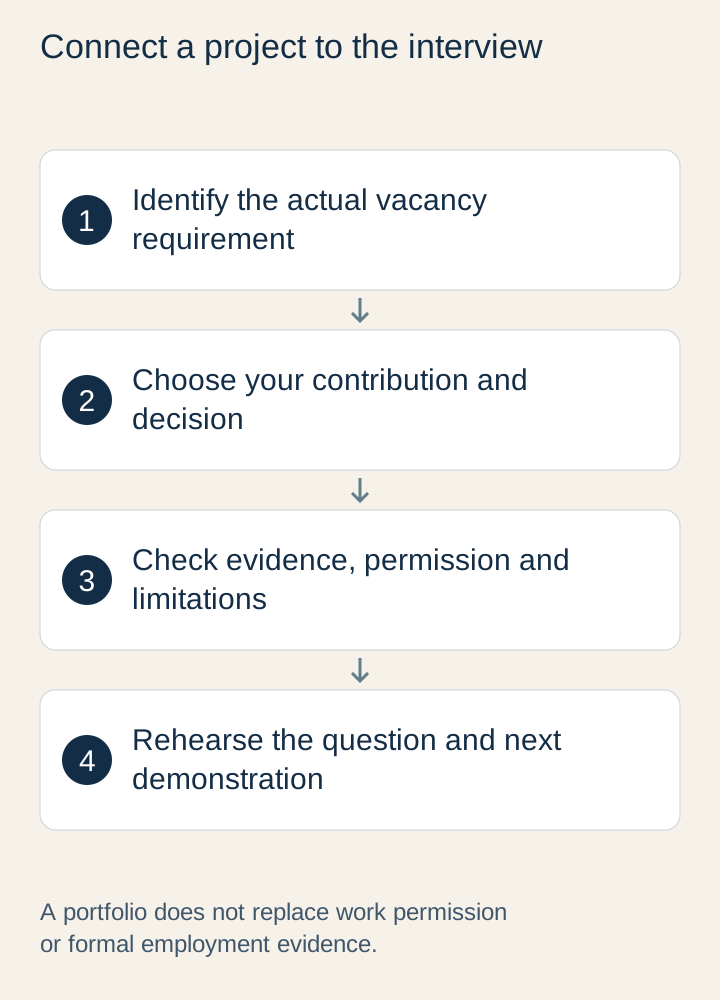
Before the interview, ask about the format, expected duration, permitted resources and what may be demonstrated. DEWR's guidance advises checking whether an interview includes tasks and what documents to bring. Do not assume every employer uses the same coding test or system-design round. If accessibility, equipment or time-zone arrangements matter, raise them with the responsible contact rather than guessing from an online interview story.
Practise this original response structure: identify the problem and constraint; explain your own action and one alternative; describe the check and result; then state a limitation and a next step. In the fictional booking exercise, you might explain why retries were relevant, what duplicate behaviour was observed and how the test supported your conclusion. Do not memorise claims about production transactions that the project never processed.
Prepare for follow-up questions: what would change under a different requirement; what failed first; how would you verify the next assumption; which decision belonged to someone else? If you do not know, describe the uncertainty and how you would investigate. A confident answer that invents an implemented feature can be contradicted by the next demonstration. Clear reasoning is more useful than treating every limitation as something to conceal.
Clarify any take-home task's scope, confidentiality, ownership arrangements and whether the output is for evaluation or actual business use before accepting it. Do not give a prospective employer access to a previous employer's systems or do productive work on the assumption that an interview invitation grants permission. This guide makes no universal finding about a particular test's pay or legal status; raise the actual arrangement with appropriate advisers if needed.
6. Keep the hiring portfolio separate from formal visa evidence
The 482 overview requires an approved sponsor's nomination, suitable skills and relevant English. A strong technical interview does not establish those conditions or create current work authorization. State actual permission and future sponsorship needs accurately. An employer's willingness to discuss sponsorship is different from a completed nomination or granted visa.
Home Affairs' skills-assessment guidance distinguishes mandatory assessments for certain SID applicants from possible assessment requests. Do not purchase ACS services solely because an advertisement mentions software engineering, and do not assume a portfolio removes an assessment requirement. Confirm whether one applies, which authority and purpose are relevant, and what the current instructions require.
Where an ACS migration assessment is relevant, its employment-reference requirements concern verified duties, periods and authorized employer documentation; references copied from occupation descriptions are not accepted. Its experience-evidence guidance distinguishes assessment-eligible professional paid work from unpaid exercises. A hiring résumé may discuss learning projects while those projects do not become paid employment evidence for an assessment.
Keep separate folders and recipient checklists for the hiring portfolio and any formal application. Do not submit the whole job-search folder to ACS: follow its current document requirements, including material it says not to upload. For immigration context, see PremierVisa Group's verified 482 explanation. Hiring success, assessment, work permission and any future permanent residence remain separate decisions; no portfolio format guarantees any of them.
7. Frequently asked questions
Must every IT applicant have a public code repository?
This guide does not set that requirement. Check the employer's instructions and offer evidence you may legitimately disclose. An approved explanation or original demonstration may be more appropriate than confidential code.
Can a personal project count as years of paid experience?
Do not present it that way. It may demonstrate learning and reasoning, while formal experience assessment has its own criteria and supporting records. Label the context and dates accurately.
Should I use Software Engineer because it seems sponsorship-friendly?
Use the real responsibilities and examine the relevant occupation and visa rules. A title, technology list or occupational classification does not prove an available job or individual eligibility.
Can I write an impressive percentage without the old dashboard?
Do not invent one. Use a result you can support, explain the measurement limits or choose a factual qualitative contribution. Keep team outcomes separate from your own action.
Does passing the technical test mean I can start work?
No. Confirm the employer's actual conditions and your work authorization for the duties. An interview result, offer or assessment receipt is not itself visa approval or permission to work.
Prepare one example you can defend before sending a larger portfolio. For help deciding what to show and what to ask, submit your background with the target role, your own contribution and unresolved questions, without confidential technical material.
Prepared with AI assistance. General career information; no named professional review has been confirmed. AI cover illustration does not depict our staff, clients or partner employers.