
Consider a 482 overseas talent search when your business has a clearly defined skilled vacancy, a credible explanation of the hiring gap and the capacity to support the actual employment and sponsorship process. Difficulty recruiting alone does not establish visa eligibility. Before asking for candidate profiles, settle the duties, workplace, pay basis, selection criteria and decision owners. This guide turns those questions into an employer-readiness brief, helping a hiring manager decide whether to start a focused search, repair the role or obtain further advice.
- 1. Define the business problem before choosing the visa label
- 2. Create a role brief that a recruiter and manager can both use
- 3. Separate the search decision from sponsorship and nomination decisions
- 4. Plan local recruitment evidence before buying advertisements
- 5. Use a readiness brief with evidence owners and decision gates
- 6. Budget for lawful employment and a realistic start
- 7. Frequently asked questions
1. Define the business problem before choosing the visa label
Begin with the work that is not being done. Identify the service, production or operational problem, who currently covers it, and the result the proposed employee would be responsible for. A role description saying only “experienced overseas worker needed” does not explain the vacancy. Describe the actual tasks, level of responsibility, reporting line, workplace and working pattern. Separate essential skills from preferences that could be developed through reasonable onboarding.
The government's overseas-worker hiring guide distinguishes employing a non-citizen with existing work rights from sponsoring a skilled worker for a visa. Those are different options with different checks. This article focuses on preparing a possible 482 search; it does not assume every overseas applicant needs sponsorship or that every difficult vacancy belongs in that program.
Review why previous recruitment has failed. Was the advertisement unclear, the location unexpected, the remuneration uncompetitive, the selection requirement unnecessarily narrow or the interview process too slow? Use actual recruitment observations rather than a claim that no Australians want the work. An overseas search cannot fix a role that management has not defined or approved. If the duties are still changing, resolve that uncertainty before promising candidates a stable position.
2. Create a role brief that a recruiter and manager can both use
Write a concise brief containing the legal employing entity, business activity, workplace, reporting structure, principal duties, proposed hours, employment arrangement and approved remuneration basis. Add the selection evidence: qualifications where relevant, actual experience, examples of completed work and any registration or licensing issue requiring separate verification. A job title translated from another market may conceal a different level of responsibility.
Distinguish what must exist at interview from what can be established before starting work. For example, an applicant may be able to discuss overseas technical work in detail but still require confirmation of a local professional requirement. Do not advertise that all overseas qualifications are automatically accepted. The hiring manager should identify the responsible regulator or assessment question and the person who will obtain suitable advice. Do not make the recruiter guess from a title alone.
Use a clear evidence question in place of vague enthusiasm. “Describe your responsibility for diagnosing a recurring equipment fault and explain how you checked the result” gives the interviewer something to assess. It does not certify competence in a regulated occupation. State that the example is for interview design and adapt it to the real role. Do not demand confidential customer records or original employer documents that an applicant has no right to disclose.
Keep the selection criteria consistent across the brief, advertisement and interviews. If an essential requirement changes, update the approved version and review its effect on the search and any nomination work. Do not retrospectively rewrite the selection standard to exclude someone or make a preferred applicant appear to have met an earlier requirement. A useful brief provides an honest account of the role, not a paper trail constructed around a predetermined result.
3. Separate the search decision from sponsorship and nomination decisions
Home Affairs' sponsoring overview describes separate employer, nominated-position and individual visa steps. Starting a talent search does not establish sponsor approval. Being a sponsor does not establish that every proposed occupation or candidate qualifies. A recruiter can help assess a resume against a role, but the immigration pathway requires appropriate verification of the actual business, stream, position and applicant.
Use three decision owners: the business manager confirms the real role and resources; the recruitment contact manages the search and assessment process; and the appropriate immigration professional addresses sponsorship and visa questions within an agreed engagement. In a small business one person may coordinate several tasks, but the questions remain different. Record who is responsible instead of assuming that sending a candidate profile transfers every obligation to the recruitment service.
Do not select a familiar occupation code and then rewrite the daily job to fit it. Establish the duties first, then check the relevant pathway and occupation rules. Core Skills, Specialist Skills and Labour Agreement arrangements are not interchangeable. The occupation-and-duties guide provides a related candidate-facing discussion, but a directory entry is neither a current vacancy nor an assessment of your proposed nomination.
4. Plan local recruitment evidence before buying advertisements
Home Affairs' labour market testing page says the evidence and method depend on the stream and whether exemptions or alternative arrangements apply. Under the standard Core Skills and Specialist Skills arrangements, most nominations involve at least four weeks of advertising within the four months immediately before lodgement, with two qualifying advertisements. Read the full requirements before treating those numbers as a sufficient checklist.
Suitable media, advertisement content, application acceptance periods and evidence all matter. A social post is not automatically a qualifying advertisement. Nor does finding an overseas candidate make testing unnecessary. Determine the applicable basis with the responsible professional before spending money or fixing a nomination date. Labour agreements have separate provisions; this readiness article does not decide whether a particular employer or nationality qualifies for an exemption.
Preserve the actual advertisement, publication dates, channel and recruitment results in an organized file. Keep objective notes explaining how applicants were assessed against the real criteria. This is useful preparation, not a claim that the article lists every legally required document. Have the person handling the nomination confirm what evidence is required for your actual circumstances. Never backdate advertisements or manufacture unsuccessful interviews.
If you would like help clarifying the vacancy and search brief, submit the employer's recruitment requirements to discuss talent search, screening and interview arrangements. Immigration work and any recruitment engagement need their own confirmed scope; an initial enquiry does not create a pool of available or approved candidates.
5. Use a readiness brief with evidence owners and decision gates
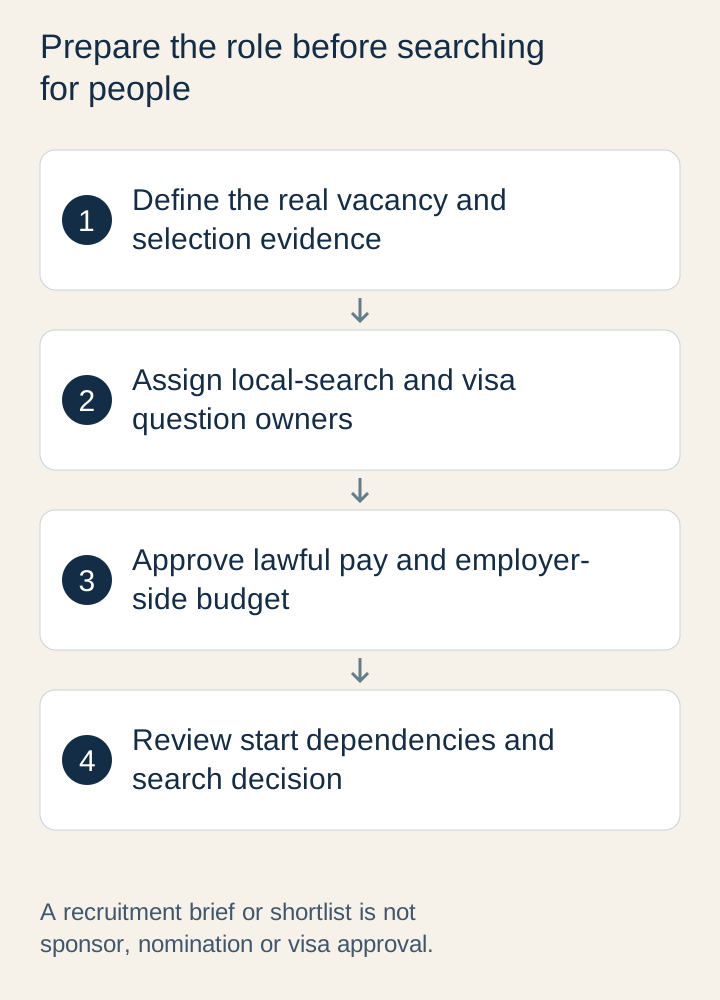
The practical asset for this topic is a six-field employer-readiness brief: role and business need; essential skills and evidence; local-search position and applicable testing question; pay and employer-side budget; sponsorship or applicant questions and responsible professional; and start dependencies with a management decision. Mark each field confirmed, outstanding or requiring review. These are planning states, not a government eligibility score.
| Current position | What it suggests | Next management action |
|---|---|---|
| Role and budget are approved; pathway questions have owners | A focused search may be worth discussing | Approve a scoped search and evidence plan |
| Duties, workplace or pay are still unsettled | Candidate comparisons will be unreliable | Repair and reapprove the brief first |
| A possible candidate exists but testing is unassessed | Selection does not resolve nomination requirements | Check the applicable evidence route |
| An urgent start is essential but permission is unconfirmed | Timing risk remains material | Plan lawful alternatives and dependencies |
For a fictional example, a maintenance business needs a technician to diagnose faults and coordinate scheduled work. The manager initially asks for “any overseas mechanic.” A brief review reveals that the worksite, roster and responsibility for supervision are unclear. The immediate task is to settle those points and the evidence needed to assess experience. Sending more resumes before that decision would expand the workload without resolving the vacancy.
After clarifying the role, the business can ask a recruiter: “Using this approved brief, what experience can be evaluated at screening, what needs a technical interview, and which questions require separate professional confirmation?” The recruiter should explain the scope, deliverables and limitations. A screening summary is not a guarantee of a candidate's competence, registration, visa eligibility or arrival date. Keep the underlying evidence and unanswered questions visible to the manager making the decision.
6. Budget for lawful employment and a realistic start
Home Affairs' salary-requirements guidance distinguishes the applicable income threshold from the annual market salary rate. Meeting one quoted threshold does not by itself establish an acceptable nomination salary. The comparison depends on the relevant work and evidence. Use the applicable stream and intended lodgement date when obtaining advice, rather than adopting a remembered salary figure from an old advertisement.
The business should understand base pay, superannuation, hours, allowances and other employment costs under the actual arrangements. The government's hiring guide also emphasizes migrant workers' workplace rights and employer obligations. Overseas recruitment is not a way to substitute a private agreement for minimum employment requirements. Do not present an indicative total package as a legal pay calculation or assume that accommodation resolves every salary obligation.
Include employer-side recruitment, sponsorship and nomination responsibilities in the budget. The ABF guidance explains restrictions on recovering specified costs from sponsored workers and the prohibition on benefits exchanged for sponsorship. Do not fund a business hiring plan by selling sponsorship or assuming the worker can reimburse every cost. Personal application and relocation arrangements need separate, itemized consideration.
Build a dependency-based start plan: selection, required checks, any registration, nomination, visa position and practical travel or notice arrangements. These may overlap, but an interview success is not the final clearance. Use official current information for processing expectations and avoid guaranteed dates. Before the employee begins, verify the actual work rights and conditions through appropriate official checks; business.gov.au points employers to VEVO and the relevant visa conditions.
Assign an onboarding supervisor, a clear worksite contact and a plan for induction, communication and performance feedback. An overseas hire may understand the technical work but need explanation of local systems or site practices. Ask about support needed without assuming personal family circumstances or promising services you have not arranged. For immigration context, see PremierVisa Group's 482 information; any professional service depends on actual assessment and written engagement.
7. Frequently asked questions
Does difficulty recruiting mean the business qualifies for 482 sponsorship?
No. It identifies a hiring problem. The business, position, chosen stream and applicant still require separate checks, and the role must reflect genuine work.
Must we choose a candidate before discussing an overseas search?
No. Begin with an approved role brief and clear search scope. Some immigration questions depend on the eventual person, so record which decisions remain provisional rather than presenting all stages as approved.
Can a recruiter arrange labour market testing after we fix the start date?
The testing basis and evidence need to be assessed before relying on a nomination timetable. Do not backdate records or assume every advertisement qualifies. Start planning should reflect outstanding dependencies.
Is the minimum visa income threshold a complete employment budget?
No. The market salary assessment, applicable workplace requirements and other employer costs remain relevant. Obtain a calculation for the actual role and date instead of treating a single number as an all-inclusive quote.
Does a shortlist contain workers who can start immediately?
Not necessarily. Screening, references, skills or registration checks and actual work permission may remain outstanding. Ask what has been checked for each profile and distinguish evidence from an anticipated outcome.
Submit your recruitment needs with the role, workplace, essential skills and current hiring difficulty to discuss talent search and interview arrangements with HKJobHunt. Avoid including employees' confidential records in the initial enquiry. Sponsorship and immigration matters may be referred to PremierVisa Group for case-specific assessment; no current candidate pool, guaranteed fill or approved visa is promised.
Prepared with AI assistance. General career information; no named professional review has been confirmed. AI cover illustration does not depict our staff, clients or partner employers.