
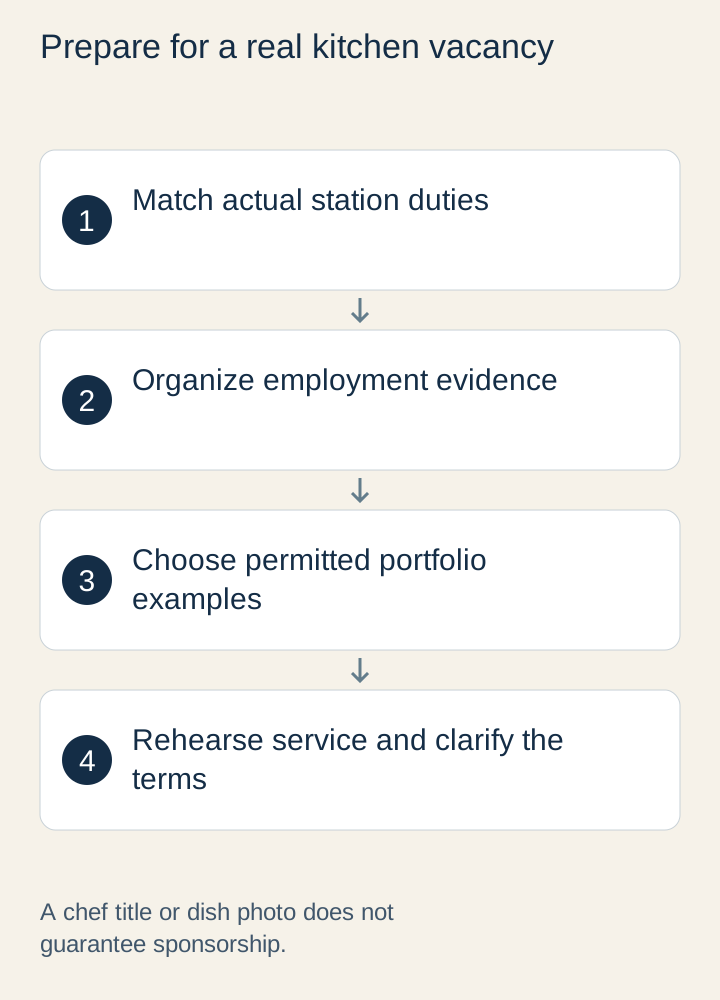
For a chef seeking Australian 482 sponsorship, start with the kitchen role you can genuinely perform, then show an employer how your experience fits its service. Build a resume, a permitted portfolio and employment evidence that tell the same story. Ask whether the particular vacancy accepts applicants needing sponsorship. A chef title, a dish photograph or inclusion on an occupation list is not a job offer or visa approval. This guide focuses on practical kitchen recruitment rather than selling a sponsorship place.
- 1. Identify the kitchen role, not just the translated title
- 2. Search for a vacancy that matches your kitchen experience
- 3. Build a resume and evidence file around your own contribution
- 4. Make a portfolio that explains work, not only finished dishes
- 5. Rehearse a kitchen-service example and ask practical questions
- 6. Check practical assessments, written terms and work permission
- 7. Frequently asked questions and your next action
1. Identify the kitchen role, not just the translated title
List your normal work: station responsibilities, preparation, service coordination, menu input, stock decisions, quality checks and any training duties. Distinguish work you do independently from tasks you assist with. An employer needs to understand whether you can take responsibility for the proposed station and service, not merely whether a former business called you a chef.
The Australian Bureau of Statistics’ ANZSCO 2022 Chef description separates Chefs from Cooks and kitchenhands. Chef is code 351311 in that classification. Do not translate every kitchen job into Chef or assume a senior title proves the underlying work. Classification and recruitment suitability need the actual duties.
At the source check, Home Affairs’ skilled-occupation page listed Chef for 482 Core Skills with caveats, including exclusions concerning factory mass production and limited-service restaurants. Check the particular business and position against the current rules; a familiar restaurant label cannot settle the question. Home Affairs uses ANZSCO 2022 for subclass 482, even though other occupation classifications may appear in general career statistics.
Write a short role statement such as “I work on the hot-food station, prepare components for service and coordinate handovers under the head chef.” This is an original teaching example. It is useful only if it accurately describes your experience. Do not add menu planning, staff management or cost-control authority merely because those duties would make a vacancy appear more attractive.
2. Search for a vacancy that matches your kitchen experience
Combine an accurate English role title with a location and a sponsorship phrase. Illustrative searches include “chef de partie sponsorship Australia” and “chef 482 sponsorship regional kitchen”. Search the same role without the visa phrase as well, then ask about sponsorship where the advertisement is silent. These are search exercises, not evidence of currently available jobs.
Read the service description carefully. A restaurant, hotel, catering operation and production kitchen may need different experience. Cuisine familiarity matters, but so do preparation methods, station ownership, service coordination and the ability to communicate about dietary requests. Do not claim a skill because you have seen it performed by another chef. Identify both strong matches and training needs before applying.
Use the original employer vacancy where possible. Confirm the worksite and whether the contact is the employing business or a recruiter. An advertisement mentioning sponsorship may still impose conditions you do not meet, or may be collecting candidates for later demand. Ask whether offshore applicants are included and whether the sponsorship discussion concerns that specific role.
Our employer-search guide provides a wider contact record. For chef applications, add the cuisine, station, service type, expected responsibilities and any proposed practical assessment. Do not count repeated advertisements as separate offers or treat an old sponsor record as proof that the business is recruiting now.
3. Build a resume and evidence file around your own contribution
For each kitchen role, record employer, location, dates, actual hours or employment pattern, station and responsibilities. Explain unfamiliar Hong Kong, Taiwan or mainland job grades in plain English without inflating seniority. If your title changed while the duties remained similar, describe the change accurately instead of creating an artificial promotion story.
Write achievements that a head chef can discuss with you. For example, “Prepared station handover notes and recorded shortages for the next service” is clearer than “excellent kitchen management” when your contribution was coordination. This is an invented teaching sentence, not a client result. Use it only as a writing pattern for your own work.
Maintain a private index of relevant employment letters, contracts, pay records, qualifications and permitted work examples. The index helps you locate evidence; it is not a list of documents that every applicant must submit at the first contact. Keep dates and duties consistent across your resume, references and later formal applications. Missing records should be identified, not replaced with invented employer letters.
Trades Recognition Australia’s current program explanation retains the TSS program name while referring to Skills in Demand subclass 482 applicants. Assessment arrangements depend on matters such as occupation, passport and background or a request for assessment. Do not infer that every chef follows the same route, that an overseas certificate automatically substitutes for assessment, or that a restaurant interview is the official assessment.
If your evidence needs organizing, submit your career background to discuss your resume, kitchen experience and interview preparation. HKJobHunt confirms services and contractual arrangements separately; an enquiry does not establish a restaurant partnership, a vacancy or eligibility.
4. Make a portfolio that explains work, not only finished dishes
Choose examples you are allowed to share. A photograph you took may still reveal an employer’s confidential process or another person’s information. Obtain appropriate permission and remove customer details, internal prices and private staff records. Do not download a restaurant’s menu photographs, remove its name and present the work as your own.
For each example, explain what it shows, when and where the work was performed at an appropriate level of detail, your role and what you can discuss at interview. A finished plate alone may not show preparation planning, portion consistency, communication or safe handling. Add a short process explanation without disclosing proprietary recipes or claiming sole authorship of team work.
| Portfolio item | What to explain | What it does not prove by itself |
|---|---|---|
| Dish photograph you may use | Your station, task and contribution | A complete commercial-service skill set |
| Anonymized preparation sequence | How you organize tasks and handovers | A former employer’s endorsement |
| Permitted service example | How you communicated changes or shortages | That you managed the entire kitchen |
| Training or qualification record | Issuer, subject and actual status | Australian registration, visa eligibility or a job offer |
The table is an original recruitment tool, not an assessment authority’s prescribed portfolio. Use a small, relevant selection and keep a fuller evidence index privately. If the employer requests a particular example, clarify what it needs to assess before preparing a large presentation.
An honest limitation can improve the conversation. If you have strong experience in one cuisine but have not run a different station, explain transferable skills and the training you would need. Do not promise immediate independent performance of unfamiliar tasks merely to keep the sponsorship discussion open.
5. Rehearse a kitchen-service example and ask practical questions
Use a service-preparation card with six fields: proposed station, a real service problem, your actions, communication and safety considerations, supporting evidence and a question for the head chef. This topic’s worksheet turns a portfolio into a conversation about work. It is not a fabricated case study or a claim that the employer will use a particular test.
For an illustrative interview prompt, imagine a shortage identified before service. A useful answer explains how you confirmed the issue, informed the responsible chef and followed the agreed plan. Describe what you actually have experience doing; do not invent a perfect incident in which you alone rescued the whole restaurant. If you have not handled that situation, explain how you would seek instruction rather than claiming past success.
An original English opening is: “My main station experience is in preparation and hot-food service. I can explain how I organize handovers and communicate shortages. Could you tell me which station and responsibilities this vacancy covers?” Replace the station details with your own. Clear questions about work are more useful than a statement that you will do anything for sponsorship.
Ask about the reporting chef, roster, preparation versus service duties, communication expectations, equipment and any role-specific training. If accommodation is offered, ask whether it is optional, who provides it and what deductions or conditions apply. Keep housing and employment terms separate; an accommodation offer does not establish the suitability of a job or a visa.
For sponsorship wording during the interview, see the interview-stage guide. State your current work-right position accurately and ask whether this vacancy can be considered. Do not claim that experience in a particular cuisine removes English, employer-side or personal requirements.
6. Check practical assessments, written terms and work permission
Before a practical assessment, ask about tasks, duration, supervision, location and payment. Fair Work’s unpaid-trial guidance distinguishes a necessary, limited and directly supervised skills demonstration from work exceeding what is reasonably needed. Do not treat extended productive shifts as automatically lawful merely because they are called a trial.
Work authorization is a separate issue. Home Affairs’ work-restrictions page states that a Visitor visa or ETA does not allow work. An invitation to demonstrate skills does not itself determine whether the proposed activity is permitted for you. Clarify your own conditions before travel or attendance; do not assume unpaid activity creates an exception.
Before accepting, obtain written duties, employing entity, worksite, hours and pay components. Distinguish Australian-dollar hourly or annual figures, gross pay, superannuation, overtime arrangements and any deductions. A sponsorship salary test and employment pay entitlements must be considered on their own terms. This guide does not turn a hypothetical salary package into evidence that a particular offer meets either set of rules.
If the advertised role changes, resolve the change in writing rather than adjusting your history to fit it. A kitchenhand job cannot become a Chef role simply by changing the heading. Likewise, a business’s willingness to sponsor does not remove the occupation caveats or the applicant’s own requirements. Avoid paying for a supposed guaranteed sponsorship place.
For detailed immigration questions, read the PremierVisa 482 verification guide and check the current official rules for your case. Employment interest, nomination, visa permission and any later permanent-residence application remain separate decisions.
7. Frequently asked questions and your next action
Does the title “chef” make a position eligible for 482 sponsorship?
No. Actual duties, the business setting, the applicable occupation framework and caveats, employer requirements and personal criteria all matter. A title or list entry does not establish a suitable vacancy or approval.
Can I use pictures from my former restaurant?
Only share material you are entitled and permitted to use. Consider copyright, confidentiality and personal information, and describe your actual contribution. Do not present another chef’s or a restaurant’s work as your own.
Does every chef need the same TRA assessment?
Do not assume that. Check the current program, occupation, passport and individual circumstances with the responsible authority or appropriate professional. A commercial interview and an official assessment serve different purposes.
Should I agree to any trial to improve my chances?
No. Clarify activities, supervision, duration and payment, then check your actual work permission. A trial label or lack of payment does not settle employment and immigration questions.
Can a cuisine specialty replace English or other requirements?
A specialty may be relevant to the restaurant’s hiring needs, but it does not itself remove visa conditions. Explain the skill honestly and assess the remaining requirements separately rather than accepting a guarantee.
Your next action is to choose a genuine vacancy, map its station duties to your experience and prepare one permitted portfolio example with a service-preparation card. If you need individual support, submit your career background to discuss resume preparation, interviews and realistic employer-search directions within confirmed services. HKJobHunt belongs to the PremierVisa Group service network and does not guarantee a job, sponsor or visa.
Prepared with AI assistance. General career information; no named professional review has been confirmed. AI cover illustration does not depict our staff, clients or partner employers.
Sources: ABS ANZSCO 2022 Chefs; Home Affairs occupation list; Home Affairs 482; TRA program; Fair Work trials; Work restrictions.