
A useful resume for an Australian employer considering 482 sponsorship shows the work you have actually performed, the results you can explain and the evidence behind your history. It also states your present work-right position accurately. There is no special resume format that secures sponsorship. This guide helps experienced overseas applicants translate unfamiliar titles into clear responsibilities, rewrite vague claims and prepare an evidence matrix without inventing achievements or presenting a job application as a completed visa assessment.
- 1. Separate the hiring document from the immigration evidence file
- 2. Start with the vacancy’s duties and selection criteria
- 3. Build a resume with a clear route to relevant evidence
- 4. Rewrite achievements with action, scope, result and support
- 5. Use a claim-to-evidence matrix before sending the application
- 6. Describe work rights accurately and test the final file
- 7. Frequently asked questions and your next action
1. Separate the hiring document from the immigration evidence file
The resume helps an employer decide whether to discuss a role with you. An immigration application has a different purpose and may require more detailed supporting material. Do not load your first application with every personal document, but do not assume a concise resume will later replace the evidence needed for an assessment.
Home Affairs’ Skills in Demand 482 overview identifies suitable skills, relevant English requirements and approved-sponsor nomination among the basic conditions. A well-written application does not establish those conditions by itself. Neither the word “engineer” nor an employer’s interest confirms the appropriate occupation, registration or visa stream. Preserve a truthful account of the job you held while leaving eligibility conclusions to a separate process.
Create two working files. The first is a readable resume tailored to a genuine vacancy. The second is a private evidence index recording where your dates, duties, qualifications and achievements can be substantiated. The index does not need to accompany every application. Its purpose is to stop the public summary and underlying history from becoming inconsistent as you revise versions.
If an old employer no longer exists or a record is missing, note the gap and seek advice on acceptable alternatives when needed. Do not create a substitute reference letter and attribute it to a company. Incomplete evidence is a problem to explain, not permission to invent a more convenient history.
2. Start with the vacancy’s duties and selection criteria
Read the position description and mark the essential tasks, tools, experience and qualifications. Then match each requirement to something you have actually done. Put uncertain matches in a separate column. This keeps an attractive advertisement from becoming a script that you copy into your own work history.
The Australian Government’s Applying for a job guidance recommends clear, accurate and tailored applications. Use the employer’s terminology when it truthfully describes your experience, explain unfamiliar abbreviations and follow the requested application format. These are practical writing principles, not a formula that guarantees a particular applicant-tracking-system score or an interview.
For an applicant from Hong Kong, a local title such as an internal officer grade may need a brief explanation of responsibilities. An applicant from Taiwan might describe what a department-specific engineer title meant in daily practice. An applicant from mainland China may need to explain an internal rank without translating it into a senior Australian title. The important comparison is the work performed and level of responsibility, not the apparent prestige of the English label.
Use our duties and occupation-title guide when an unfamiliar title causes confusion. Keep the original title where necessary and add a plain-language explanation. If you coordinated a project but did not manage staff, do not rewrite the role as a people-management position. A recruiter should be able to distinguish your own actions from those of the team.
3. Build a resume with a clear route to relevant evidence
Start with your name, professional contact information, current location and a short statement of the kind of work you can perform. Follow with relevant skills, recent or relevant employment, qualifications and applicable registration. The order can change to suit the vacancy; there is no universal layout that fits a trade applicant, a healthcare professional and an experienced software specialist equally well.
For each role, include the employer, dates, location and an understandable title. Add a brief context line if an overseas employer or business activity will be unfamiliar to an Australian reader. Then select a few responsibilities and achievements that answer the advertised requirements. Avoid long inventories of every duty you have ever held, especially when the details obscure the work the employer needs now.
Keep qualification and licensing claims precise. A qualification obtained overseas is not automatically an Australian registration. If recognition, assessment or registration is pending, state the actual stage. Do not use “licensed in Australia” because you hold a licence elsewhere. Where a role is regulated, consult the relevant local regulator before making a claim about work you may undertake.
For referees, confirm permission and contact arrangements before sharing someone’s details. If an employer specifies how referees should be supplied, follow that instruction. Do not list a person who cannot reasonably explain your work, or give a colleague an invented managerial title. Protect confidential information in portfolios and remove unnecessary personal identifiers from sample work.
4. Rewrite achievements with action, scope, result and support
Use four questions: What did I do? What was the scope? What changed? What could support the statement? A numerical result can be helpful when it is reliable, but precision should not be manufactured. An honest description of an improved process can be stronger than an unsupported percentage.
| Weak claim | Original teaching rewrite | Evidence to consider |
|---|---|---|
| “Responsible for maintenance” | “Scheduled servicing, documented recurring faults and prepared handover notes for the next shift.” | Role description, permitted maintenance records, supervisor reference |
| “Excellent customer service” | “Explained service options, recorded complaints and coordinated follow-up with the operations team.” | Training record, anonymized workflow, referee account |
| “Increased efficiency” | “Replaced an informal handover with a shared checklist so unresolved issues were visible to the next shift.” | Approved process document and explanation of your own contribution |
| “Managed a project” | “Coordinated task updates and escalation records for a project led by the department manager.” | Project role record showing coordination rather than overall ownership |
These are invented teaching examples, not client achievements or statements to paste into a resume regardless of experience. Replace them with work you have performed. If you cannot explain a claimed improvement at interview, return to the underlying task and describe it more narrowly.
When a result involves numbers, check the period, baseline, unit, data source and your contribution. A team result should not become a personal result unless the wording makes your role clear. If a figure is commercially confidential, use an approved description or omit it. Do not change the number slightly and assume the confidentiality problem has disappeared.
If you need help choosing evidence or explaining experience, submit your career background to discuss resume and interview preparation. HKJobHunt confirms the service scope separately. Editing can improve clarity; it cannot supply experience you have not gained or guarantee an employer’s decision.
5. Use a claim-to-evidence matrix before sending the application
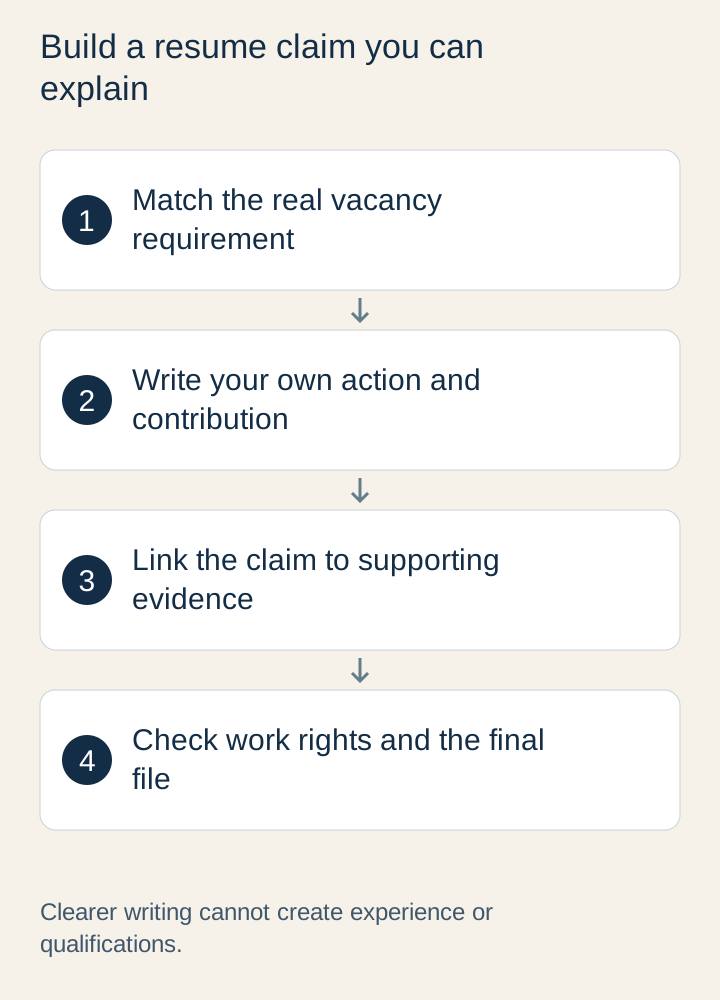
For every significant resume claim, record the wording, vacancy requirement it addresses, source evidence, date or period, any confidentiality restriction and a short interview explanation. This private matrix is this topic’s practical asset. It lets you identify weak statements before a recruiter or reviewer asks you to explain them.
For a hypothetical example, a claim about introducing a handover checklist could link to an approved process document and a supervisor who remembers your role. The interview explanation should describe the problem, your actual contribution and the limits of the outcome. If the checklist was a team initiative, retain that distinction instead of presenting yourself as the sole designer.
Use separate labels for “supported”, “needs clarification” and “remove or narrow”. They are editorial working labels, not immigration eligibility categories. A claim can be entirely truthful yet need more precise dates or a better explanation of part-time hours. Record that distinction rather than either deleting useful experience or pretending the supporting file is complete.
Compare all versions against a master employment timeline. Check dates, overlapping roles, business names and locations. Explain a period of study, caring responsibilities or job search accurately where relevant. Do not conceal a gap by extending another employer’s dates. The concise application and the later detailed record should tell the same factual story even if they contain different levels of detail.
Prepare an interview question for every strong claim: “What did you change?”, “Who else worked on it?” or “How was the result checked?” If you need an invented story to answer, the resume needs revision. This rehearsal is a practical test of clarity and credibility, not a promise that those exact questions will be asked.
6. Describe work rights accurately and test the final file
If you are overseas and do not hold Australian work authorization, an original example is: “Currently based outside Australia; employer sponsorship would be required before commencing work.” If you hold a visa, describe your actual status and any relevant conditions accurately. Do not claim unrestricted rights, an approved transfer or permanent residence based on an anticipated application.
The official migrant job-search resources point readers towards checking their current visa conditions. That check is separate from resume editing. Avoid a fixed promised start date when work authorization and relocation arrangements remain uncertain. An honest availability statement is more useful than an optimistic date that later has to be withdrawn.
Follow the employer’s file-type instructions. Use readable headings, normal text and restrained formatting; test that text can be selected and that the document remains understandable when copied into plain text. Check the exported file on another screen and verify page breaks, contact information and links. This is a practical readability check, not proof of compatibility with every recruitment system.
Remove comments, tracked edits, hidden draft notes and confidential attachments before sending. Give the file a professional, recognizable name and keep a record of the version, vacancy and submission date. If an online form requests a separate work-right declaration, answer it truthfully rather than assuming a line in the resume overrides the form.
For separate visa research, use the PremierVisa 482 verification guide. Once your application is clear, the employer-search guide helps organize suitable vacancy research. Neither document is a live job offer or an individual visa assessment.
7. Frequently asked questions and your next action
Do I need a separate “482 resume”?
There is no wording or layout that secures sponsorship. Tailor a truthful resume to the role and state your present work-right position clearly. The employer and any immigration reviewer still need their own information and decisions.
Must every achievement include a percentage?
No. Use a number only when you can support its meaning, period and source. A clear account of a process, responsibility or problem solved can be useful without a numerical result. Do not invent a metric to make an ordinary task sound impressive.
Should I translate my job title literally?
Keep an accurate title and explain actual duties if the translation is unclear. Do not use a more senior title to make the role resemble the vacancy. Classification and licensing questions depend on more than a label.
Should I attach all my evidence to the first application?
Follow the genuine employer’s instructions and share information proportionately. Maintain a private evidence index so you can respond when appropriate, rather than sending sensitive identity, financial or confidential business records unsolicited.
Can editing fix a missing qualification or experience gap?
Editing can clarify what you have and expose what is missing. It cannot create a qualification, registration or period of work. Record the gap and discuss whether further preparation or another role is appropriate.
Your next action is to select one genuine vacancy, rewrite the most relevant experience and check every important claim against the evidence matrix. If you need individual support, submit your career background to discuss resume preparation, interviews and realistic employer-search directions. HKJobHunt belongs to the PremierVisa Group service network; recruitment, sponsorship, work authorization and permanent residence remain separate outcomes.
Prepared with AI assistance. General career information; no named professional review has been confirmed. AI cover illustration does not depict our staff, clients or partner employers.
Sources: Home Affairs 482; DEWR Applying for a job; DEWR migrant job-search resources.