
Being in Australia can make interviews easier, but it does not establish permission to start a particular job. For an onshore applicant discussing Skills in Demand subclass 482 sponsorship, first identify the visa currently in effect, its actual conditions and the proposed duties. Then separate what you can lawfully do now from what requires a future decision. Use a written handoff record so the employer can plan recruitment without mistaking an application or a conditional offer for authorization.
- 1. Start with current permission, not the future visa you want
- 2. Separate a bridging visa grant from the visa being in effect
- 3. Approach employers with an accurate, useful status statement
- 4. Ask what this employer is actually proposing
- 5. Use a six-field current-permission handoff record
- 6. Review the start plan whenever the facts change
- 7. Frequently asked questions
1. Start with current permission, not the future visa you want
Prepare a current-status summary before answering a work-rights question. Include the visa in effect, the date checked, relevant employment restrictions and any unresolved issue. Home Affairs' VEVO guidance explains that the service provides current visa details and conditions. It also lets holders send evidence to an organization. A résumé heading saying “onshore candidate” cannot replace this information.
Use the actual grant notice and current information together, with suitable individual advice where their application is unclear. Do not infer unrestricted permission from an Australian address, a tax file number, a bank account or an employer's willingness to interview. Nor should you assume a colleague with a similarly named visa has identical conditions. Relevant dates, the person holding the visa and the work being proposed can differ.
The practical first question is narrow: what permission supports these duties, for this organization, at this time? A recruiter may be able to answer questions about the vacancy while being unable to assess your conditions. Record that limit rather than treating a confident reply as immigration advice. This article supplies a preparation method, not a finding that an individual may start work or make a valid onshore application.
2. Separate a bridging visa grant from the visa being in effect
Home Affairs' Bridging visa A explanation distinguishes grant and effect. Where a substantive visa is held when the bridging visa is granted, its conditions continue to apply while that substantive visa remains in effect. When it ceases, the bridging visa conditions apply. Other commencement circumstances exist; read the actual notices rather than assuming every bridging visa follows a single timeline.
Work permission on a bridging visa depends on its conditions. Do not describe an application receipt, a bridging grant or a pending 482 application as automatic unrestricted work rights. A future visa can be relevant to recruitment planning while being the wrong evidence for today's proposed shift. If the current position is uncertain, obtain clarification before giving the employer an unconditional availability statement.
Make a dated note of which document supports each statement. For example, distinguish current permission checked today from a future application still awaiting a decision. Do not invent an activation date from a recruiter's estimated processing time. If circumstances change, revisit the work-rights statement and tell the responsible contact what changed without disclosing unrelated family or identity information.
3. Approach employers with an accurate, useful status statement
Select actual vacancies matching your experience and read the employer's work-rights requirement. If the advertisement requires existing unrestricted permission, do not select yes simply because you are nearby or willing to seek sponsorship. Ask the verified contact whether the position can consider your actual circumstances. A clear no is useful information: record it and redirect your effort instead of rewriting your status to pass a screening question.
An original enquiry might say: “I am currently in Australia and have experience relevant to the advertised duties. My present work permission has conditions that need to be considered against this role. Does this vacancy consider applicants who may require 482 sponsorship, and who should receive a limited work-rights summary?” This is a fictional teaching example, not a message already sent or a promise of employer interest.
Describe the conditions accurately when understood; do not use the example to conceal a restriction. Explain interview availability separately from employment availability. You can be ready to discuss your experience without being ready to start productive duties. If a form has only a date box and cannot express a necessary condition, ask how the employer wants the accurate answer recorded rather than entering a date you cannot support.
Follow the government's job-application guidance: tailor factual experience to the selection criteria and prepare genuine examples. Local availability does not replace evidence of skills. Use the 482 résumé guide to connect your own actions with relevant outcomes, and the employer-verification guide when the employing entity or representative is unclear.
Keep a version of each submitted application and the answer you gave about permission. If the employer later asks a different question, compare the wording before replying. A question about interview availability is not necessarily a question about immediate work authorization; answer the question actually asked and clarify any ambiguity.
4. Ask what this employer is actually proposing
Obtain the role description, employing entity, workplace, expected hours and responsibilities. Ask whether the employer is merely considering sponsorship, preparing an application or reporting a particular decision. These descriptions are not interchangeable. Someone saying the company has sponsored before does not confirm the present nomination, the particular role or your personal visa position.
Discuss the proposed recruitment stages and identify who handles each part. The hiring manager can explain performance expectations; a separate person may coordinate nomination information or individual immigration advice. Ask who will confirm the basis for the first working day. Do not assume that an unsigned offer, a recruitment fee receipt or a forwarded screenshot establishes government approval.
Fair Work's migrant-worker guidance explains that workplace and immigration obligations both matter and only Home Affairs can grant, refuse or cancel visas. Pay and workplace protections are not displaced by a sponsorship discussion. Equally, a promise to pay fairly does not itself resolve permission to perform the job. Keep those checks visible together.
For support preparing the conversation, submit your job-search background. Discuss résumé preparation, interviews and possible employer approaches under the confirmed service scope. Personal visa conditions and any regulated-profession requirements need suitable separate assessment.
5. Use a six-field current-permission handoff record
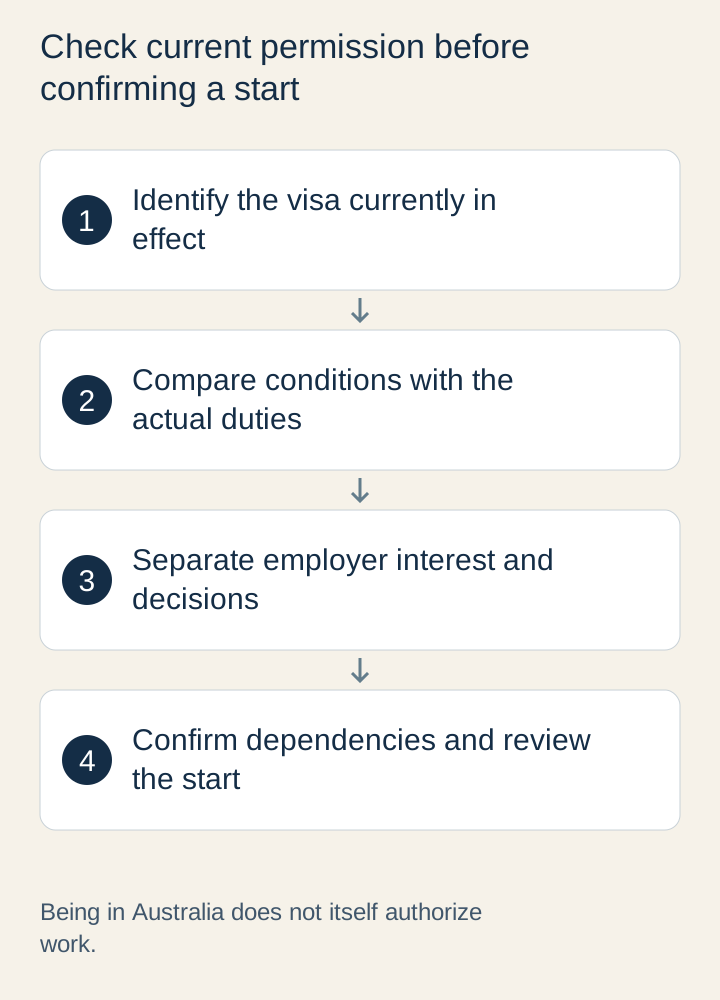
Keep one private record for each proposal. Its six fields are: current visa in effect and check date; relevant restrictions with supporting evidence; employing entity, duties and location; proposal or application stage; first-day dependencies; and owner, next evidence and review point. The accompanying blank worksheet is a preparation tool, not a visa application, an employer database or a form sending data to CRM.
Fill the record with evidence states rather than optimistic labels. Write “not yet confirmed” where information is missing. If the employer has only agreed to discuss sponsorship, record that exact stage and the next question. Do not upgrade it to a submitted or approved nomination because a meeting went well. Keep sensitive document references in a secure personal copy rather than putting identity numbers in a shareable planning table.
| Planning question | Useful evidence or reply | What it does not establish |
|---|---|---|
| What permission applies now? | Current visa details, conditions and check date | Permission under a future visa |
| What work is proposed? | Actual entity, duties, location and schedule | That the proposal fits those conditions |
| What sponsorship stage exists? | Specific application or decision and responsible contact | Personal approval from employer interest |
| When could work begin? | Confirmed permission and remaining role requirements | A guaranteed date from an estimated timeline |
Consider a fictional applicant whose employer wants a Monday start. The record shows a conditional offer but an unresolved question about current conditions. The useful next action is to identify who will obtain the missing clarification and arrange a date review. It is not to write Monday as confirmed, rely on the applicant's proximity to the office or assume a pending application removes the restriction.
This method also improves an employer discussion about flexibility. Ask whether the recruitment decision can proceed while an unresolved permission issue is assessed, what evidence is needed before a roster is finalized and who will notify both sides of a change. The employer may have genuine operational constraints. A conditional conversation can expose those constraints without promising an outcome or asking either side to ignore them.
6. Review the start plan whenever the facts change
Before the proposed start, compare the final duties, entity and location against the information used for the permission check. A change in job title may conceal materially different work; a familiar trading name may conceal a different employing entity. Ask about the actual arrangement. Update the status summary if the current visa changes or a bridging visa comes into effect, and confirm the relevant conditions again.
If you already hold a primary 482 visa and are changing employers, use the separate 482 employer-change and handover guide. General nomination transfer and limited work arrangements after ceasing sponsored employment need to be distinguished. Do not turn a general recruitment article into a blanket statement that every onshore applicant can immediately switch employers, or that no alternative work can ever be permitted.
Plan practical readiness as well as permission: registration where required, notice or handover obligations, induction, equipment and an agreed contact. These preparation categories do not create a universal statutory checklist. Ask about the specific requirements of the role, and do not use a successful interview as a substitute for a professional registration decision or an approved work arrangement.
For broader visa context, see PremierVisa Group's verified 482 explanation. Keep the immigration assessment separate from the recruitment record. An offer does not guarantee a visa, sponsorship does not establish permanent residence and an employer's preferred date does not extend existing permission. Where a core condition remains unresolved, keep it explicit and obtain suitable advice before acting on the proposed work.
7. Frequently asked questions
Does being in Australia mean an employer can hire me immediately?
No. Location can help with interviews but does not establish permission for a particular job. Check the visa in effect, actual conditions and proposed duties before confirming work availability.
Does a Bridging visa A grant automatically replace current conditions?
No. Grant and effect are different. Home Affairs explains that an existing substantive visa's conditions continue while it remains in effect; work permission on the bridging visa depends on its own conditions when applicable.
Should I put unrestricted work rights on my résumé to get an interview?
Only state that if it accurately describes your actual permission. Otherwise describe the relevant limitation and sponsorship need truthfully, and ask whether the particular vacancy can consider your circumstances.
Is employer interest enough to confirm a first day?
No. Separate the recruitment proposal, application stages and actual permission. Use a conditional start discussion with an owner for each unresolved requirement rather than treating interest as approval.
Can a consultant confirm everything from my résumé alone?
A résumé helps explain experience but does not establish visa conditions or an employer's formal proposal. Ask what evidence and appropriate individual assessment are needed; do not send unnecessary identity documents through an initial enquiry.
Prepare one accurate current-status summary and one role-specific handoff record. To discuss résumé, interview and employer-contact preparation, submit your background with relevant experience, current location and the question you need to resolve. Leave confidential records out of the initial message.
Prepared with AI assistance. General career information; no named professional review has been confirmed. AI cover illustration does not depict our staff, clients or partner employers.