
Arrange a 482 employee's start by confirming actual permission and conditions, reconciling the agreed job and assigning responsibility for induction and follow-up. An accepted offer or booked flight is not enough to establish that work can begin. This guide gives employers and new employees an original first-day handover record, practical questions and a feedback plan. It focuses on carrying a genuine recruitment decision into everyday work, without certifying a visa, approving a contract or promising a successful probation outcome.
- 1. Separate readiness to employ from permission to start
- 2. Reconcile the job the employee accepted with the job being prepared
- 3. Send useful arrival information without assuming relocation is complete
- 4. Make induction an explanation, not just a folder receipt
- 5. Use a first-day handover record with clear evidence states
- 6. Agree early feedback and handle changes before they spread
- 7. Frequently asked questions
1. Separate readiness to employ from permission to start
Begin with the actual person, employing entity, worksite and proposed duties. Identify which parts of the arrangement are confirmed and which depend on an outstanding decision. A recruitment team may have selected the candidate while the responsible immigration professional is still checking permission. Keep that distinction visible in the start plan rather than letting a calendar invitation become an assumed clearance.
The Australian Government's overseas-worker hiring guide says employers must make sure employees are allowed to work and check the conditions of their visas, pointing to VEVO as an official route. Use appropriate current evidence and obtain suitable advice when its meaning is unclear. This article does not assess a person's conditions, explain every transitional arrangement or treat a lodged application as permission.
Record who performs the check, its date, the relevant evidence and the unresolved question. Do not place complete identity documents or private reference numbers in a widely shared onboarding calendar. The supervisor needs to know whether the proposed work is cleared and what limits affect the assignment; the full private file should be available only through an appropriate secure process. No individual's visa record is being checked in this guide.
If the worksite, duties or legal employer changes before starting, refer that change to the appropriate person before assigning the new work. Do not assume an internal transfer label resolves immigration or professional requirements. Distinguish an overseas new arrival from someone already in Australia with existing conditions. The fact that both are joining the same team does not make their permission evidence interchangeable.
2. Reconcile the job the employee accepted with the job being prepared
Compare the agreed offer, position description, remuneration information, hours or roster and worksite with the supervisor's onboarding instructions. Check referenced attachments and the identifiable versions. A recruiter may have described one location while a local manager prepares a different site. Clarify a discrepancy before it becomes the employee's first-day surprise. Use the offer-question guide for deeper version and clause issues.
The government's onboarding guide recommends agreeing employment conditions and reflecting agreed changes in the written contract where one is used. An induction folder should not silently introduce different duties, pay or repayment obligations. Questions about the effect of any actual document need appropriate review; this article does not declare that a signature or an informal message has a universal legal consequence.
Give payroll the information it needs through its approved secure channel. Explain the relevant forms and who can answer questions about wages, superannuation, leave and records. Do not ask a new employee to put bank information or tax identifiers in a public group chat. A manager confirming that payroll has received a form is a different event from payroll validating the information or actually paying wages.
For a practical confirmation, ask: “Which role description and roster are we using on the first day, and who should I contact if they differ from the offer?” The employer can answer with the approved version and named operational contact. This is an original communication example, not legal drafting or a requirement to disclose confidential business records beyond what the actual process needs.
3. Send useful arrival information without assuming relocation is complete
The government onboarding page recommends giving the new employee the place, arrival time and person to ask for. Add the practical details needed for your worksite: entry instructions, appropriate clothing or equipment, accessibility questions and an alternative contact if the supervisor is absent. These details should describe what has actually been arranged, not an aspirational welcome package.
For an overseas arrival, distinguish the reporting address from any temporary accommodation and the travel plan. Confirm who provides each piece of information and whether an employer contribution is approved, conditional or not offered. Do not promise school places, healthcare eligibility or family work rights as an onboarding benefit. The family-arrival guide deals with separate family preparation rather than making it a condition of access to this public article.
Prepare a delay message before it is needed: “My expected arrival has changed. Which reporting arrangements should we review, and who will confirm the revised work-start position?” This keeps travel, operational scheduling and actual permission separate. A delayed flight does not itself answer whether a change affects a visa requirement or contract; refer the particular issue to the appropriate person. Avoid a generic guarantee that any delay is harmless.
| Handover stage | Employer confirms | Employee can clarify |
|---|---|---|
| Before the start | Actual permission check and approved job | Outstanding conditions and correct contact |
| Arrival arrangements | Place, time and supervisor | Travel changes or access needs |
| Induction | Safety, role and information delivery | What remains unclear before tasks begin |
| Early feedback | Expectations, support and next review | Evidence of progress and help needed |
These are planning responsibilities, not a complete statutory checklist or evidence of a real placement. If your business needs help organizing recruitment and interview preparation, submit the employer's requirements to discuss the actual scope with HKJobHunt. No available candidate or approved immigration service is assumed.
4. Make induction an explanation, not just a folder receipt
Introduce the employee to the business, role and people who provide daily direction. Explain workplace safety, emergency procedures, reporting concerns, relevant policies and how to obtain help. The government's onboarding guide includes work health and safety information and continuing employer obligations. The detailed requirements depend on the work and jurisdiction; this article does not certify a site or replace necessary training and supervision.
Fair Work's information-statement page says new employees must receive the Fair Work Information Statement before, or as soon as possible after, starting. Other statements depend on the actual employment arrangement. Use the current official source to determine what applies. This guide links to the page rather than copying an old PDF or presenting outdated pay figures.
Distinguish a document sent, received and explained. A tick that an email was sent does not show the employee can find it or understands a practical instruction. Invite questions and ask the employee to explain the immediate task or safety escalation route in their own words. This is a useful communication check, not a test of whether a person deserves employment based on accent or background.
Do not assume that prior overseas experience covers the local equipment, customer procedures or reporting system. Agree what can be performed independently and what requires instruction. Where a regulated activity or licence matters, have the appropriate person confirm the actual requirement before assignment. An induction completion box cannot create a professional qualification or permit work beyond the employee's actual authorization.
5. Use a first-day handover record with clear evidence states
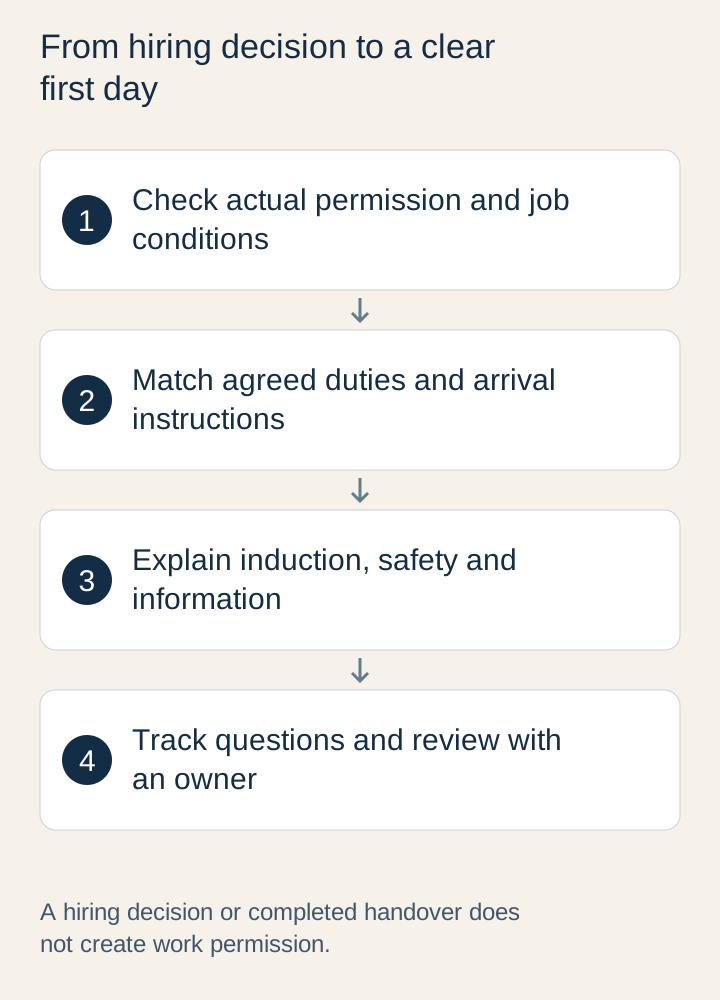
The practical asset is an original six-field record: actual job or task; permission or document evidence; responsible contact; first-day instruction; employee question or unresolved issue; and next review with its owner. Use separate states such as prepared, delivered, explained and outstanding. These are management labels, not government approvals. Keep the record limited to necessary information and avoid attaching private identity data to the shared version.
Consider a fictional employee arriving for a technical role. The offer identifies one site, while the welcome email names another. The employee records the difference and asks the hiring manager to confirm the actual reporting location and refer any necessary assessment. The team does not mark the discrepancy resolved merely because a colleague says both sites belong to the same brand. This is teaching material, not a customer story.
A handover question can be: “What will I do first, who supervises that task, and what must be checked before I start it?” The employer's response should identify a practical assignment and contact, alongside any unresolved dependency. If the answer remains uncertain, record the issue and obtain the required clarification rather than using a ceremonial welcome to conceal it.
Close each item with the evidence actually obtained. A revised instruction may resolve a location question; it does not necessarily settle a separate permission question. Keep operational confirmation, professional assessment and employee understanding distinct. The record is useful because it makes the remaining work visible, not because every field must be marked complete on the same day.
6. Agree early feedback and handle changes before they spread
Explain the actual probation terms, performance expectations, available support and review arrangements. Fair Work's probation guidance says employees retain normal entitlements during probation, including relevant minimum standards. Full-time and part-time employees accrue and can access paid leave entitlements as applicable. Do not describe probation as a period without ordinary employment rights or assume one length applies to every role.
Agree feedback that relates to the genuine work: task quality, safe procedures, communication and required training. Set a practical review with the supervisor and record what was discussed, what support is offered and what evidence will show improvement. This article gives no mandatory review interval or universal dismissal procedure. A manager's dissatisfaction does not by itself decide a contract, immigration outcome or right to a remedy.
Where duties, hours, worksite or employment circumstances change, route the actual facts to the responsible employment and immigration contacts. Do not wait until several departments have implemented different instructions. The cost-and-dependency guide helps a business plan changes without assuming refunds or a guaranteed timetable. Keep the individual employee informed using accurate stages and agreed channels.
For immigration background, see PremierVisa Group's 482 explanation. The employer's welcome, a completed induction and a passed review do not guarantee permanent residence or a future visa. Any immigration work depends on a suitable case-specific assessment and engagement. Keep practical workplace support clear and useful without turning routine onboarding into an unsupported promise of settlement.
7. Frequently asked questions
Does accepting the offer mean the employee can begin immediately?
No. Confirm actual work permission and conditions for the person and job, alongside practical readiness. An accepted offer or appointment date does not replace that check.
Is sending an induction folder enough?
It records one delivery step. The employee may still need explanation, safety instruction and a contact for unresolved questions. Record what was provided and what remains outstanding.
Does probation remove ordinary leave entitlements?
No. Fair Work says employees retain relevant entitlements during probation. Check the actual employment arrangement rather than assuming rights begin only after confirmation.
Should the shared handover contain complete passport and bank records?
No general need follows from using this tool. Use appropriate secure processes and limit the shared record to necessary evidence references and operational information.
What if the first-day role differs from the offer?
Record the discrepancy, ask the responsible manager to clarify it and refer any affected professional or permission question before assuming the change is acceptable.
Submit your recruitment needs to discuss talent search and interview arrangements with HKJobHunt. Explain the role, worksite and current stage without sharing employee confidential files in the initial enquiry. No actual placement, visa approval or guaranteed probation result is promised.
Prepared with AI assistance. General career information; no named professional review has been confirmed. AI cover illustration does not depict our staff, clients or partner employers.