
You can approach Australian employers while living overseas, but each employer decides whether it will consider an offshore candidate and discuss sponsorship for a particular role. A remote interview is a recruitment step, not work authorization. This guide helps applicants in Hong Kong, Taiwan and other overseas locations prepare a truthful application, arrange a video interview and negotiate a conditional start. It includes a six-field offshore handoff record, not a verified employer list or a guaranteed timetable.
- 1. Separate overseas recruitment from permission to apply for a visa
- 2. Build a shortlist that can answer an offshore enquiry
- 3. Prepare an employer-facing pack with a private evidence index
- 4. Arrange the video interview with both local dates visible
- 5. Negotiate a conditional start with a six-field handoff record
- 6. Follow up using evidence rather than a promised departure date
- 7. Frequently asked questions
1. Separate overseas recruitment from permission to apply for a visa
Home Affairs' 482 Core Skills information says an applicant can be inside or outside Australia when applying, but not in immigration clearance, and can be inside or outside when a decision is made. That answers a location question about this visa stream. It does not require every employer to recruit overseas or mean an applicant already satisfies the nomination, occupation, skills, English and other conditions.
Start with your actual background and a real position description. Ask whether the role accepts overseas applications, whether remote interviews are available and whether sponsorship is considered for this particular vacancy. A company's past sponsorship or an advertisement mentioning relocation is not confirmation of the current proposal. Do not describe willingness to discuss as an approved nomination or a job reserved for you.
State where you currently live and the work permission you actually hold. If you need sponsorship to work in Australia, say that accurately rather than claiming unrestricted rights because you are available for an interview. A Hong Kong or Taiwan address does not itself establish a passport category, visa entitlement or professional registration. Do not infer an individual's route from the language or location of the application.
An offshore search is also different from a plan to arrive and start working. This guide does not recommend travel as a workaround for hiring or immigration conditions. Establish the actual permission for any proposed activity, and seek suitable individual advice where needed. An employer's confidence, a flight booking or an invitation to visit cannot create authorization by itself.
2. Build a shortlist that can answer an offshore enquiry
Search for the actual role and relevant locations, then inspect the employer's own instructions. Save the advertisement, date, source link and position details. Distinguish a live application page from an old vacancy, an expression of interest or a general agency registration. A platform's result count is not a count of employers willing to sponsor you, and a saved advertisement is not proof that applications remain open.
Read restrictions before preparing a large submission. If the role explicitly requires current work rights, do not answer yes merely to pass a form. You may ask the authorized contact whether the requirement is firm or whether a different suitable vacancy considers overseas candidates. If the answer remains no, record that result and direct your effort elsewhere. Do not invent a local address or borrow someone else's contact details to look onshore.
A concise original enquiry could say: “I am currently based overseas and have relevant experience in the advertised work. Does this position consider offshore applicants requiring sponsorship, and can the initial assessment be completed remotely?” Add one relevant contribution, not a long personal history. This is a teaching sentence, not a message already sent or an employer-approved template.
Check the identity of the contact before sharing sensitive material. The official Scamwatch employment-scam guidance warns that false advertisements can appear on trusted platforms and recommends contacting representatives through independently sourced details. A professional video call or familiar logo does not settle authenticity. For a fuller company-document check, use the employer-verification guide.
3. Prepare an employer-facing pack with a private evidence index
The government's job-application guidance recommends a factual, tailored résumé and attention to the employer's selection criteria. For an offshore application, explain your relevant duties and contribution in language the employer can understand. Keep original job titles accurate, clarify unfamiliar terms and distinguish paid work, study and personal projects. Stronger wording cannot create a missing qualification or employment period.
Use the actual submission checklist for the vacancy. A useful preparation pack may include a résumé, a short role-specific letter and a safe example of relevant work where permitted. Keep a separate private index for qualifications, work periods, references and any registration or assessment evidence. This is not a universal list of documents to send to every recruiter or upload to a visa application.
Check that the application form, résumé and interview account agree about dates, current location and sponsorship need. If a form asks when you can start, explain the conditions instead of selecting an unrealistic date to look competitive. Where a field does not allow a necessary explanation, ask the responsible contact how to record it truthfully. Preserve the submitted version so that you can discuss what the employer actually received.
Protect identity and third-party information. Scamwatch advises caution with personal information and identity documents until the recipient is verified. Ask what a requested document is for, who receives it and how to use the appropriate secure process. Do not send private customer records or a full family file simply to show commitment at an early recruitment stage. Formal applications may require different evidence later; follow their actual requirements.
4. Arrange the video interview with both local dates visible
Ask for the interviewer's name and role, the vacancy reference, format, expected duration, meeting platform and any task or document requirements. DEWR recommends finding out whether an interview includes tasks and what to bring. Do not assume a nurse, tradesperson and software candidate will face the same process. Ask which part concerns employer selection and which, if any, is a separate professional assessment.
Confirm the date, local time and named location for both parties in the calendar invitation. Do not rely on a remembered time difference: the Australian location and date matter, including daylight-saving arrangements. A label such as Australia time is not precise enough. If an invitation changes, acknowledge the new arrangement and retain the latest version rather than assuming the original time still applies.
Check the link, camera, microphone and permitted demonstration materials before the appointment. Choose a quiet setting and arrange a contact method if the call fails. Do not install unfamiliar software or provide remote access to your device merely because someone presents it as an interview requirement. Clarify the process through the verified company contact. A connection problem should lead to a clear rescheduling or fallback discussion, not a rushed disclosure of credentials.
Prepare one factual example matched to the role and questions about actual duties, supervision, location and initial expectations. Explain your own action, evidence and limitation rather than claiming every team result. If you do not understand a question, ask for clarification. Agree before any recording or sharing of confidential material; a recruitment meeting does not remove the responsibilities you owe to previous employers or customers.
For help selecting examples and preparing the conversation, submit your job-search background. Discuss résumé, interview preparation and possible employer approaches under the confirmed service scope. Individual immigration and regulated-profession questions need suitable separate assessment.
5. Negotiate a conditional start with a six-field handoff record
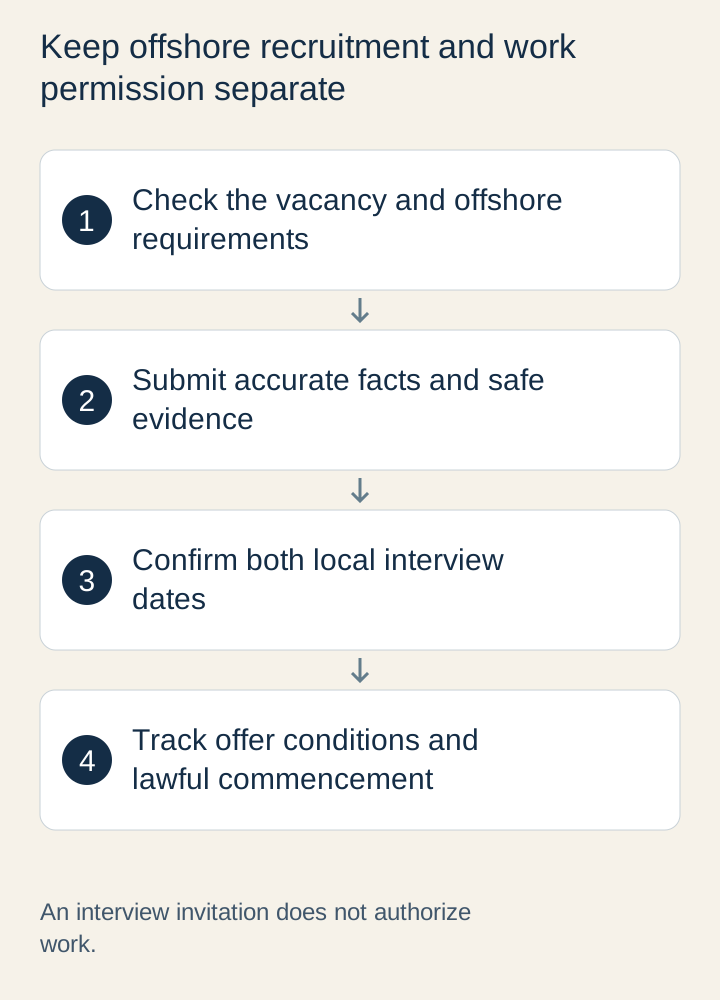
The practical worksheet records: vacancy and verified contact; current location and actual permission; documents and employer questions; interview appointment with both local dates; offer and visa dependencies; and responsible person, next evidence and next decision. Keep one record per proposal. A blank worksheet does not contact an employer or send information to CRM, and a filled row is not proof that a visa stage has been completed.
Use milestone language when discussing availability. The following comparison is an original planning aid, not a universal visa procedure or a promise that the steps always occur in this order.
| Milestone | A useful confirmation | What remains separate |
|---|---|---|
| Interview invitation | Format, both local dates and participants | Job selection and work permission |
| Conditional offer | Written duties, site and outstanding conditions | Nomination, personal visa and registration |
| Reported application stage | Which application, actual evidence and owner | A government decision |
| Proposed first workday | Permission, professional requirements and employer readiness | Any later permanent-residence plan |
An original hypothetical answer is: “I can attend remote interviews at agreed times. My employment start remains subject to the actual offer conditions, required permission and any professional requirements. Can we identify the remaining steps and review the date when the relevant evidence is available?” It is not evasive to separate interview availability from lawful commencement. Do not turn this example into a fixed processing estimate.
The Core Skills page also describes a commencement obligation: begin employment within 90 days of entering Australia if outside when the visa is granted, or within 90 days of grant if inside at grant. Read the actual grant and conditions with appropriate advice and coordinate a compliant start with the employer. This is not permission to ignore entry conditions, delay indefinitely, or assume the same rule describes every visa and agreement.
6. Follow up using evidence rather than a promised departure date
After the interview, send a concise factual summary if appropriate: role discussed, document you agreed to provide, unresolved question and the next contact point. Do not describe a courteous meeting as an offer. If a written proposal differs from the conversation, ask for clarification and retain both versions. A recruiter, employer and migration representative can have different responsibilities; identify who is confirming each item.
If someone says an application has been lodged, ask which application and what evidence relates to your case. Do not request unrelated employee files or treat a payment receipt as approval. Home Affairs says processing guidance is based on recently decided applications and is not specific to your case. This guide provides no fixed number of weeks from interview, nomination or lodgement to grant.
Fair Work's migrant-worker fact sheet separates workplace and immigration obligations and explains that only Home Affairs can grant, refuse or cancel visas. Employer instructions cannot replace the actual permission. If asked to start productive work, travel on an assumed status or undertake an unclear trial, establish the applicable position before proceeding; remote recruitment is not a blanket authorization for work arrangements.
For immigration context, see PremierVisa Group's verified 482 explanation. Keep resignation, travel, housing and family changes tied to evidence and the actual conditions rather than a salesperson's date. Reassess if the employer, role, location or your circumstances change. A successful offshore interview can be useful progress while important decisions remain outstanding.
7. Frequently asked questions
Must I enter Australia before applying for every 482 role?
No universal employer rule requires that. Ask the particular employer about offshore recruitment. The Core Skills visa page permits offshore application, but that does not establish job suitability or personal eligibility.
Does a video interview prove the employer or vacancy is genuine?
No. Verify the contact and company through independent channels and compare the documents. A familiar face, logo or professional meeting is not sufficient evidence by itself.
Can I say I have work rights because I can relocate quickly?
No. Relocation availability and actual authorization are different. State your current permission and sponsorship needs accurately across the form, résumé and interview.
Should I give a fixed start date before a visa decision?
Explain the actual dependencies and ask how the employer wants conditional availability recorded. Review the date against the grant, conditions, professional requirements and commencement obligations when available.
Is a fast result in another applicant's story my timetable?
No. Your recruitment, documents, nomination and personal application have their own facts. Official processing guidance is a general indication, not a guaranteed departure date.
Start with one role that genuinely considers your circumstances. For help with the offshore handoff, submit your background with your current location, relevant experience and unresolved questions, without identity documents or confidential records.
Prepared with AI assistance. General career information; no named professional review has been confirmed. AI cover illustration does not depict our staff, clients or partner employers.