
Prepared with AI assistance. General career information; no named professional review has been confirmed. AI cover illustration does not depict our staff, clients or partner employers.
- 1. Assemble the offer and the documents it refers to
- 2. Turn pay, hours and location uncertainties into answerable questions
- 3. Translate a sponsorship promise into a stage and responsibility
- 4. Separate cost categories before discussing repayment
- 5. Track each issue from original clause to revised version
- 6. Review probation, ending arrangements and the final package
- 7. Frequently asked questions
1. Assemble the offer and the documents it refers to
Keep the dated offer, proposed contract, position description, remuneration schedule and any policies or relocation agreements incorporated by reference. Ask for a missing attachment before assuming its content. A short offer can refer to a longer document containing important conditions. Record the version actually received so that later discussion does not rely on an old attachment with the same filename.
Confirm the employing entity, role, workplace, expected hours and the person authorized to answer questions. If a recruiter forwards the file, identify which statements come from the employer and which are the recruiter's interpretation. Use the employer-verification guide for deeper identity or document contradictions, rather than treating this register as a business or sponsor approval check.
Separate understanding from acceptance. Before replying to an acceptance button, signature request or broad confirmation message, establish what action is being requested and obtain suitable advice where the commitment is unclear. This article does not declare that an unsigned document or informal message has no legal effect. Preserve the actual wording and circumstances instead of relying on that assumption.
2. Turn pay, hours and location uncertainties into answerable questions
Read the remuneration and work pattern together. Ask what the quoted amount includes, which payments are fixed or conditional, how superannuation is expressed, and how additional hours or allowances are treated under the applicable arrangements. A total package does not answer every component question. The salary-offer guide handles a fuller pay comparison; here the goal is to identify the exact clause needing clarification.
For example, “Does the annual figure include employer superannuation?” is more useful than “Is the salary good?” Likewise, ask which workplace the role ordinarily uses, whether other sites or travel are expected and what roster is proposed. A company address in an email signature may not identify the daily workplace. Record how the reply affects transport, family responsibilities or an intended relocation.
Fair Work's employment-contract explanation says a contract cannot remove minimum entitlements or provide less than them. The relevant National Employment Standards, award or enterprise agreement need to be considered where applicable. A signed contract is not a reason to assume every term overrides those rules, and a salary above one threshold does not automatically settle every workplace obligation.
Ask which instrument and classification the employer has used, and who can explain the calculation or arrangement. This guide gives no universal hourly rate, overtime formula or current visa salary threshold. If the required facts are missing, mark the item unresolved and seek appropriate assistance rather than filling the gap with another occupation's pay scale or a remembered figure.
3. Translate a sponsorship promise into a stage and responsibility
The Core Skills official page separates nomination and personal visa requirements from recruitment. Ask what the employer's statement actually means: considering sponsorship, preparing information, reporting a lodged application or referring to a specific decision. Identify the application, responsible person and available evidence. The register is not a checklist certifying that each formal stage has been completed.
If the offer mentions a future permanent-residence pathway, ask whether it describes a later discussion, conditional consideration or another specific undertaking. Keep that wording for appropriate review. Employer intention cannot guarantee a government decision or that the applicant will satisfy future rules. Avoid assigning a monetary value to an uncertain promise when comparing offers.
Clarify the proposed start and what happens if an outstanding requirement is delayed or the role changes. An anticipated visa timetable is not a work authorization. If the applicant is already in Australia, actual current permission may require its own analysis; if changing a primary 482 employer, the transfer guide distinguishes ordinary nomination transfer and limited post-cessation arrangements. Do not reduce every case to the same start rule.
An original question could say: “Which application or decision does this sponsorship statement refer to, who is coordinating it and what evidence will support the proposed start? Please identify how the date will be reviewed if an outstanding condition changes.” This is a preparation example, not a legal clause or a message already sent on your behalf.
4. Separate cost categories before discussing repayment
Ask for an itemized description of each cost, who receives it, what it pays for, when it arises and the proposed responsibility. Distinguish business sponsorship or nomination costs from an applicant's own visa-related expenses and negotiated relocation items. A single heading such as all immigration costs does not reveal the actual category. Keep any separate service agreement alongside the employment documents for the appropriate reviewer.
The Australian Border Force's sponsorship guidance explains that payment or benefits in exchange for sponsorship are prohibited and that sponsors cannot recover specified recruitment, sponsorship or nomination costs, including associated agent costs and the SAF levy. Renaming a charge training or a debt does not automatically resolve its nature. This does not mean every applicant expense or relocation arrangement has the same legal treatment.
Fair Work's deducting-pay guidance sets limits on wage deductions. Its pay-back guidance also addresses unreasonable payment requirements and terms benefiting an employer. A signature alone is not a universal answer, but neither is a generic online statement that every repayment term is invalid.
Where a clause requires money after resignation or another event, record its exact trigger, covered items, calculation and relationship to any deduction authority. Obtain appropriate advice on the full wording before relying on a conclusion. Do not calculate an actual debt, recommend ignoring a formal demand or sign a separate acknowledgement simply because the recruiter calls it standard practice.
For help organizing recruitment questions, submit your job-search background. Discuss résumé, interview and employer communication within the confirmed service scope. Legal enforceability and personal immigration advice need the suitable separate professional assessment.
5. Track each issue from original clause to revised version
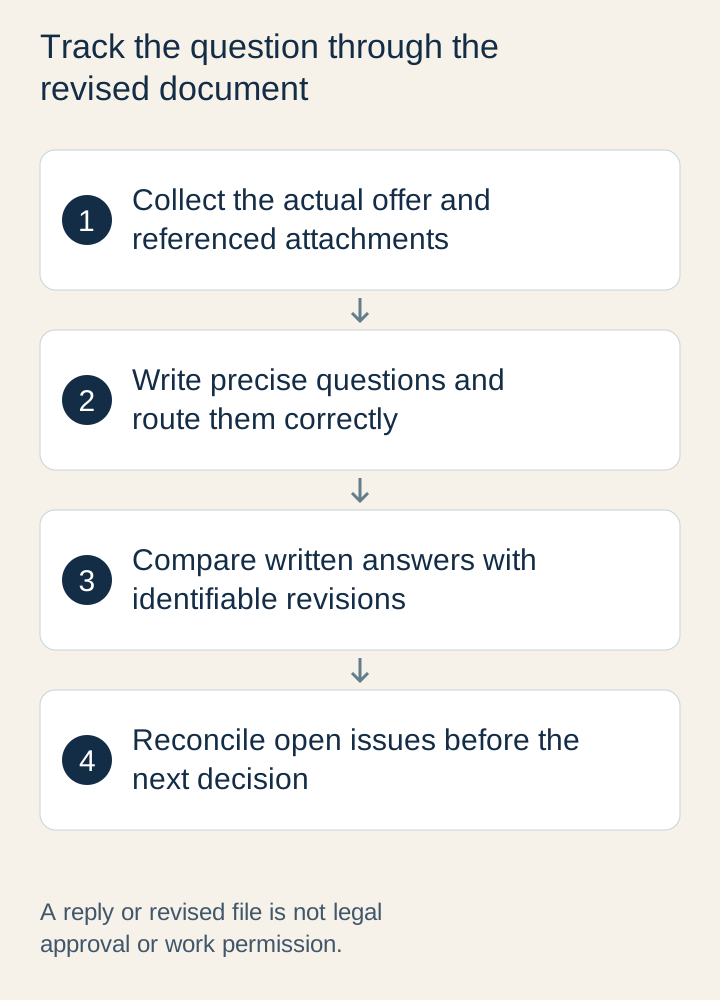
The original six-field register records: document and clause reference; exact question or contradiction; supporting evidence and practical impact; responsible contact and written answer; revised version or outstanding change; and next decision or professional-review question. Use one row per issue so an answer about flights does not accidentally close an unresolved deduction clause.
| Status | Evidence that supports it | What still needs attention |
|---|---|---|
| Question recorded | Clause reference and specific uncertainty | Employer or appropriate reviewer's answer |
| Answer received | Dated written response from the responsible person | Whether the document reflects it |
| Revision received | Identifiable updated wording and attachments | Differences, unresolved terms and professional review |
| Decision prepared | Relevant questions reconciled or explicitly outstanding | Actual informed acceptance or other action |
A fictional problem illustrates the process: an offer says relocation support is available, while an attachment mentions repayment without identifying the covered costs. Ask which items and triggers apply and request an explanation of the intended document change. When a new version arrives, compare both provisions. A reply saying “we will sort that out” is not evidence that the repayment wording has been clarified.
Keep the original clause intact in the private record and mark your own summary as a summary. Do not alter the employer's file and represent it as an agreed amendment. If proposed wording is needed, have the appropriate person prepare or review it. The accompanying worksheet is a blank teaching tool; it neither sends questions to the employer nor provides a legal approval or CRM submission.
Prioritize the next enquiry by practical consequence. An unclear employing entity, a cost that could affect the move or an unexplained first-day condition deserves a precise question before a minor formatting issue. Send a short numbered set to the appropriate contact where you choose to communicate, and retain the answer against the corresponding row. If a reply explains a general policy but does not answer the particular clause, keep the item open and specify what is still missing. This prioritization is an original communication method, not a legal rating or an instruction to accept every remaining term once the employer has replied.
6. Review probation, ending arrangements and the final package
Identify the stated probation period, performance expectations, notice arrangements, termination provisions and any linked relocation or service consequences. Ask what practical event activates a clause and which documents it refers to. These are preparation questions, not a claim that a standard probation length or notice period applies to every job. Keep employment termination separate from a government visa decision.
Fair Work's contract-help guidance distinguishes advice about minimum entitlements from matters needing legal help, including non-compete clauses and some contractual benefits. Use that distinction to route questions. A recruiter or a generic checklist cannot approve a restriction simply by calling it normal, and a calculator for wages does not review the whole contract.
Before deciding, reconcile the final version with the issue register. Check the employing entity, duties, pay schedule, worksite, start conditions and every referenced attachment. Confirm which documents have changed and which previous versions are superseded. If an important answer remains separate from the proposed document, ask how it is intended to operate and obtain suitable advice rather than assuming an email automatically resolves any conflict.
Retain the final documents and the relevant correspondence securely. If circumstances change after acceptance, review the actual commitment and appropriate process; this article is not a blanket right to withdraw or change dates. For immigration background, see PremierVisa Group's verified 482 explanation. Recruitment, contract decisions, nomination, visa permission and any later permanent residence remain distinct.
7. Frequently asked questions
Does a signed offer mean my 482 visa is approved?
No. The recruitment commitment and government decisions are separate. Establish the actual nomination, visa and work-permission position before relying on a proposed start.
Is an employer's email enough to close every issue?
Not automatically. Record the answer and compare it with the document and attachments. Where wording conflicts or its effect is unclear, obtain suitable review rather than assuming a universal legal result.
Are all relocation repayment clauses prohibited sponsorship charges?
No universal conclusion follows from the label. Identify the actual cost category, trigger and wording; prohibited sponsorship recovery and other employment-law limits must be assessed appropriately.
Can Fair Work review every contractual promise for me?
Its guidance distinguishes minimum-entitlement help from contractual matters needing legal advice. Check the appropriate route for the actual issue, especially restrictions or benefits outside the applicable award.
Should I treat a promised future permanent-residence pathway as guaranteed value?
No. Clarify the actual undertaking and conditions, and keep the government's decision separate. An employer cannot guarantee future eligibility or approval.
Bring a concise list of unresolved clauses to the next discussion. To prepare that list, submit your background with your role and main questions, without sending private contract or identity files in an initial general enquiry.
Prepared with AI assistance. General career information; no named professional review has been confirmed. AI cover illustration does not depict our staff, clients or partner employers.