
An occupation appearing on a visa list does not mean an employer has a vacancy or that you qualify for it. For a 482 job search, identify the stream and current classification, compare the actual duties, verify a real recruitment opportunity and check your own evidence separately. This guide focuses on turning a list entry into useful employer questions. It provides an occupation-to-vacancy record, rather than a sponsor directory, an eligibility decision or a promise of work.
- 1. Decide what kind of list you are reading
- 2. Keep the classification version attached to your notes
- 3. Compare the actual work before choosing a label
- 4. Establish whether there is a real recruitment opportunity
- 5. Use an occupation-to-vacancy evidence record
- 6. Check personal requirements without turning the search into guesswork
- 7. Frequently asked questions
1. Decide what kind of list you are reading
A statistical occupation classification, a labour-shortage analysis, a visa occupation list and a recruitment website answer different questions. A classification describes work; a visa list is used under particular migration rules; an advertisement concerns an employer's recruitment activity. Finding a similar title in all three places does not automatically connect the records or establish a genuine opportunity for you.
The Home Affairs skilled occupation page explains that the combined information includes occupation codes, relevant lists, assessing authorities and applicable caveats. Read the visa and stream column rather than searching a Chinese title and stopping at the first match. An entry associated with another visa cannot simply be carried across to a new 482 proposal.
For the 482 Core Skills stream, nomination in an occupation on the CSOL is one requirement. The Specialist Skills and Labour Agreement streams have different frameworks. This article uses Core Skills list-checking as its main example; it does not declare that the CSOL is the complete rule for every 482 stream or that another stream is automatically available when a title is absent.
2. Keep the classification version attached to your notes
Home Affairs currently identifies ANZSCO 2022 for subclass 482 and explains that the chosen code must align with the position's tasks and responsibilities. Newer labour-market publications may use a different classification. Do not replace the visa classification with a newer statistical code merely because a search engine shows it first. Retain the source, version, relevant stream and date checked in the same record.
Jobs and Skills Australia's CSOL consultation explanation distinguishes statistical classification, shortage analysis and the government's occupation-list decision. Recognition in OSCA does not guarantee inclusion on the CSOL, and a consultation group is not a government decision. This is a useful warning about interpreting proposals; the consultation page is not used here as evidence that a particular later amendment has commenced.
For current Core Skills rules, the 482 occupation instrument is the relevant primary reference. Its current compilation was checked for this draft. It connects listed occupations to corresponding tasks and provides circumstances in which an occupation does not apply. Do not use the similarly named subclass 186 instrument as though it were the 482 instrument, or copy a list total into an employer count.
3. Compare the actual work before choosing a label
Write down what you actually do and what the new position actually requires. Useful details include recurring tasks, technical responsibility, supervision, decision-making, tools and work environment. Preserve the original job title and explain unfamiliar local terminology. Translating a title is reasonable; changing a past role to claim duties you never performed is not.
A fictional candidate called an operations coordinator might mainly arrange schedules and follow up deliveries, while a different role with a similar title involves designing processes and supervising a substantial function. The names alone do not settle classification or skill level. Ask the employer for the proposed position description and clarify the substance. This illustration assigns no occupation code and establishes no visa eligibility.
Build a comparison with three evidence states: supported match, unresolved question and material difference. A statement such as “I helped the team” is too broad to support a particular technical duty. Write your own action and the context, then identify a safe supporting record. Do not convert participation into management responsibility, or describe a training exercise as paid professional work.
The government's application guidance recommends understanding selection criteria and presenting accurate relevant experience. Use that to communicate with employers, while leaving formal classification or assessment questions to the appropriate process. The résumé preparation guide helps turn genuine experience into clear evidence without treating stronger writing as a new qualification.
4. Establish whether there is a real recruitment opportunity
Save the actual advertisement, employer or agency contact, vacancy reference, location, date and application instructions. Determine whether the page is a live role, an expression of interest or general career information. A searchable occupation directory is useful for orientation, but it is not a stock of approved jobs. Nor is a platform's result count a verified number of sponsors willing to employ you.
Ask the authorized contact whether the particular vacancy considers applicants needing sponsorship and what experience is essential. Separate a willingness to discuss the possibility from an approved sponsorship or nomination stage. If the employer requires current unrestricted work rights, do not claim them because your occupation appears on the list. State the actual position accurately and ask whether your circumstances can be considered.
An original enquiry could say: “I found the advertised role and have relevant experience in these duties. Could you confirm the employing entity, the main responsibilities and whether this vacancy considers applicants who may require sponsorship?” Add a short factual example, not a full visa argument. This is a fictional teaching sentence, not an employer-approved message or evidence of a partnership.
To prepare that conversation, submit your job-search background. Discuss résumé, interview and possible employer approaches within the confirmed service scope. A consultant enquiry does not establish an available job, approved nomination or personal work permission.
5. Use an occupation-to-vacancy evidence record
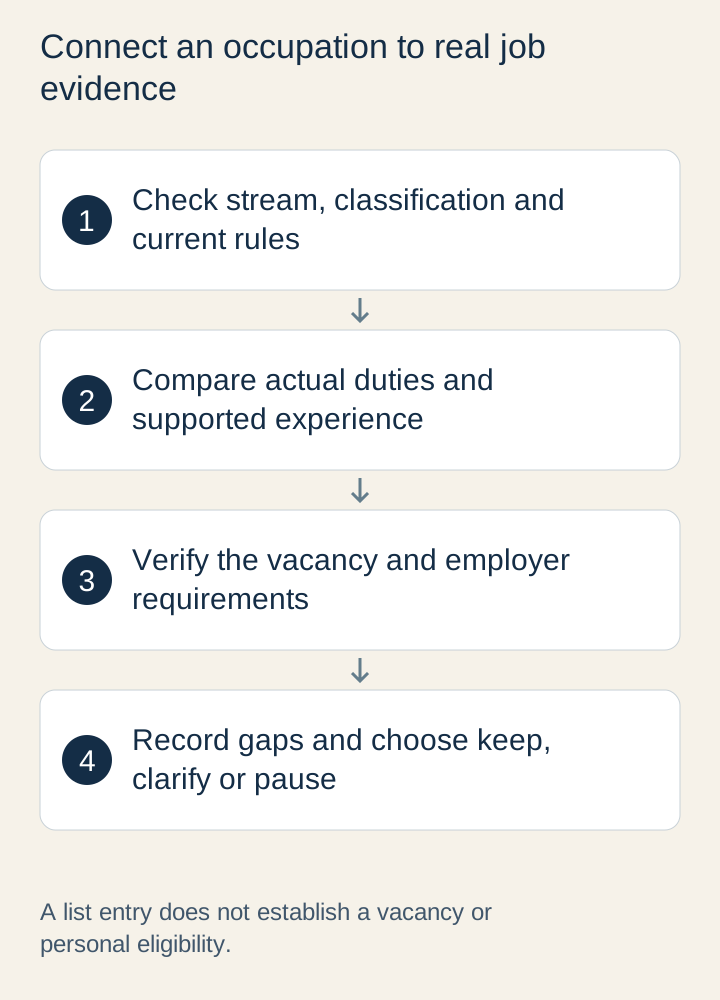
The practical record has six fields: stream, classification and source date; current list entry and any relevant caveat; actual vacancy and verified contact; duty comparison and your evidence; personal qualification or permission questions; and owner, next evidence and decision. Keep one record per proposal so that evidence from one employer is not silently reused for another role.
| Evidence layer | A useful record | What remains unresolved |
|---|---|---|
| Classification and list | Current stream, version, code and relevant rule | Whether a real job exists |
| Vacancy and employer | Actual advertisement, entity and contact | Whether nomination requirements are met |
| Role fit | Duties, responsibility and supported experience | Formal skills or registration findings |
| Personal position | Relevant evidence and conditions to assess | A government visa decision |
In a fictional example, a vacancy mentions an attractive title but does not describe responsibilities. Your record should show duties not obtained and the person to ask. Do not mark the role as matched simply because the title resembles a list entry. If the reply reveals that the substantive work differs, record the difference and reassess rather than rewriting your history to fit.
Keep the caveat field specific. Record the relevant rule and the facts needed to assess it, not just a green tick saying on list. Some circumstances concern the actual position or business. An appealing salary or company name does not answer every rule. Where a material fact is unavailable, preserve that gap and seek appropriate assessment before making a financial, relocation or employment commitment.
The downloadable blank worksheet is an original teaching tool. It neither searches a live employer database nor submits information to CRM. Store completed evidence securely, and use document references rather than private identity numbers in a shared copy. A completed table organizes the questions; it does not certify the answers or change your work rights.
Give each proposal a next decision: keep, clarify or pause. Keep it where the actual duties fit your supported experience and the employer can explain its recruitment requirement. Clarify it where one answer could resolve a material uncertainty, such as whether the advertised role accepts applicants needing sponsorship. Pause it where the response contradicts the work you can honestly substantiate or leaves the employing entity unclear. These are editorial search-management choices, not legal eligibility categories or predictions of an employer's decision.
Set the next review around evidence, not repeated applications. Record the specific question, the verified contact who can answer and what reply would change your decision. If the advertisement is withdrawn, preserve the record as closed rather than counting it as an active opportunity. If a revised advertisement appears, compare the duties and requirements before reusing the old application. This keeps research activity separate from an actual shortlist and helps you avoid sending the same unsupported claim to several employers.
6. Check personal requirements without turning the search into guesswork
Core Skills applicants still need the relevant skills, experience, English and other applicable requirements. Home Affairs explains that some applicants need a mandatory skills assessment and that others must still demonstrate their skills. Assessment and professional registration serve different purposes. An occupation entry cannot substitute for either, and a successful interview cannot guarantee a visa decision.
The Home Affairs skills-assessment overview directs applicants to the relevant assessing authority, whose procedures differ. Do not order an assessment solely because a commercial website names an authority next to a similar title. Establish whether it is required for the actual visa and circumstances, the correct purpose and the evidence needed. The document-preparation guide helps organize these questions and missing records.
When a proposal develops, compare the final duties, employing entity and location with the versions originally checked. A changed role may require fresh analysis. Keep current work permission separate from future sponsorship discussion, particularly if you are already in Australia; the onshore preparation guide explains that handoff. This article does not authorize a trial, a first shift or a change of employer.
For broader immigration context, use PremierVisa Group's verified 482 explanation. Keep the search focused on a genuine role and supportable experience. Do not pay for a promise that a listed occupation guarantees sponsorship, or assume a temporary work route guarantees permanent residence. Where the evidence does not support the proposal, a useful outcome is to identify the precise gap and choose another realistic application direction.
7. Frequently asked questions
Is every CSOL occupation a job available through HKJobHunt?
No. A visa occupation list and a recruitment inventory are different. The website's reference categories do not establish vacancies, employer mandates or sponsorship offers.
Can I use the newest OSCA code for a 482 application?
Do not assume that. Check the classification required for the specific visa and current rules. Home Affairs currently identifies ANZSCO 2022 for subclass 482; statistical updates do not automatically change that requirement.
Does an identical job title establish a match?
No. Compare actual tasks, responsibility and skill level, and preserve differences. A title can be translated for clarity without inventing duties or renaming the original employment history.
Does an absent title mean every 482 stream is impossible?
Not automatically. Confirm the actual duties, classification and proposed stream. Different streams have different frameworks, but their availability and conditions require assessment rather than a promise of an alternative.
Does exemption from mandatory assessment mean no skill evidence is needed?
No. Home Affairs still requires evidence of the necessary skills and experience. Registration, English and other requirements must be considered separately.
Choose one real role and complete the evidence record before expanding your search. For help with résumé positioning and employer questions, submit your background with relevant duties, experience and unresolved questions. Keep identity documents and confidential work material out of the initial enquiry.
Prepared with AI assistance. General career information; no named professional review has been confirmed. AI cover illustration does not depict our staff, clients or partner employers.