
If you have relevant overseas experience but no Australian work history, give an employer evidence of the tasks you can perform and a clear account of what still needs learning. Do not invent local employment or promise immediate work rights. This guide focuses on interview preparation for a real role potentially involving the Skills in Demand visa, subclass 482: a task comparison, a safe demonstration and an honest plan for genuine gaps.
- 1. Separate missing local experience from missing eligibility
- 2. Translate the employer's concern into a specific task
- 3. Build one small, explainable evidence demonstration
- 4. Answer the local-experience question without hiding the gap
- 5. Use a gap-to-action record, not an application-volume target
- 6. Keep demonstrations, work rights and payment separate
- 7. Frequently asked questions
1. Separate missing local experience from missing eligibility
Start with three questions: have you done the relevant work, can you explain it to this employer, and do you meet the applicable professional and immigration conditions? These questions overlap but are not identical. An unfamiliar overseas employer name can make experience harder to interpret; it does not by itself mean you lack the skill. Conversely, an impressive portfolio cannot create employment history, registration or visa eligibility that you do not have.
The Home Affairs 482 overview describes a temporary sponsored visa and separates nomination, suitable skills and relevant English requirements. The Core Skills page requires at least one year of relevant work experience in the nominated occupation or a related field. Its eligibility detail addresses task level, timing and equivalent experience; a casual count of calendar years is not an individual assessment.
Do not turn that statement into “every candidate needs one year in Australia” or “any overseas year qualifies.” Check the actual duties, evidence and applicable stream. Some applicants require a skills assessment, and Home Affairs distinguishes that assessment from professional registration. If your target work is regulated, identify the relevant local regulator and unresolved requirements before suggesting you can perform restricted duties. This general guide has not checked every occupation's licensing rules.
Write your starting position accurately: relevant overseas experience exists; Australian work history is absent; specified local knowledge or permission remains unresolved. If relevant experience itself is insufficient, record that as a real gap. A short course, practice project or better interview answer should not be presented as a substitute for a requirement it cannot meet. This is an experienced-candidate job-search article, not a 485 graduate-work strategy.
2. Translate the employer's concern into a specific task
Ask what “Australian experience” means for this vacancy. It may refer to a local procedure, a regulatory responsibility, customer communication, software, or the ability to work with limited supervision. Do not assume you know which concern is driving the decision. Read the actual advertisement and duty statement, then ask a focused question: “Which local process would the successful candidate need to handle independently from the start?”
The government's job-application guidance recommends understanding the employer's requirements, tailoring the application and preparing specific examples. Apply that principle to one task at a time. Compare the advertised task with work you actually completed overseas, explain the operating context in ordinary English, and identify the limit of the comparison. A familiar software name alone does not prove the same responsibility or skill level.
For example, an original hypothetical candidate might have maintained a delivery-exception tracker overseas. That can illustrate information checking, escalation and coordination. It does not establish knowledge of an Australian reporting obligation or authority to sign off a regulated process. Say which actions were yours, who approved decisions and what evidence supports the account. Avoid translating a junior title into a senior Australian one simply to make it sound comparable.
Use the following comparison to decide what the employer needs to learn about you. The categories are a preparation tool, not official visa classifications or a scoring system.
| Employer concern | Useful evidence | Remaining question |
|---|---|---|
| Can you perform a comparable task? | A clear personal example and authorized supporting record | How closely does it match this role? |
| Do you understand the local process? | Identified official guidance and an honest learning plan | What must be known or authorized before work? |
| Can you communicate and escalate? | A concise explanation of a genuine decision and its limits | Which team standards apply here? |
| Can you lawfully do the job? | Actual permission, qualification and applicable review | Which conditions remain outstanding? |
3. Build one small, explainable evidence demonstration
Choose a task central to the vacancy and create a modest demonstration that you can explain without reading a script. It could be a fictional exception log, an independent mechanical model, a short software example using synthetic data, or an outline of how you would investigate an operational fault. Select the format that reveals your reasoning; an expensive portfolio site is unnecessary if a short, readable artifact answers the question.
Clearly label newly created material as an independent demonstration using fictional information. It is not a client project, a record of paid work or evidence that you performed the task in Australia. State what you created, the assumptions, the tools and any assistance received. If you used AI or a collaborator, make your own contribution clear and check every part you intend to explain. Do not submit a polished output you cannot discuss under follow-up questioning.
Make the reasoning visible: what problem you assumed, what information you checked, the decision you proposed and when you would seek supervision. Include one limitation rather than claiming your approach works in every setting. A candidate who recognizes an uncertain safety or compliance issue gives the interviewer something concrete to discuss; guessing a local rule with confidence creates a different problem.
Never take confidential client information, an old employer's internal files or someone else's template without permission. Removing a logo does not give you rights to reuse the underlying work. Prefer an independently created example when authorization is unclear. If you can legitimately show a past output, identify its scope and your contribution accurately, use an appropriate disclosure method and respect any restrictions on copying or distribution.
4. Answer the local-experience question without hiding the gap
A useful answer has four parts: state the absence of Australian employment, give the closest genuine experience, identify the relevant difference and propose a reasonable way to assess or address it. Keep the example specific enough for the interviewer to question. Do not start with an apology for your entire background or claim that work is identical everywhere. The employer needs to understand both your competence and the transition required.
Here is original hypothetical teaching wording, not a candidate success story: “I have not worked in Australia. In my previous role I checked delivery exceptions, maintained the action log and escalated pricing decisions to my supervisor. I can show an independent sample of that workflow. I would need to learn your local reporting process and confirm which decisions I could make independently.” Use the structure only where it describes your actual experience; never adopt the example as your work history.
Then invite a task-specific question: “Which part of that process is most different in your team?” If the employer identifies a requirement you genuinely lack, write it down and ask whether it is essential before appointment, can be learned through appropriate induction, or needs a formal qualification or authorization. The employer's preference is not a regulator's exemption. Do not offer to perform restricted work until someone notices a problem.
If you need help turning real experience into interview material, submit your job-search background to discuss your résumé, interview preparation and realistic employer-contact directions under the confirmed service scope. A preparation conversation is not a promise of sponsorship or a professional finding that you meet immigration conditions.
5. Use a gap-to-action record, not an application-volume target
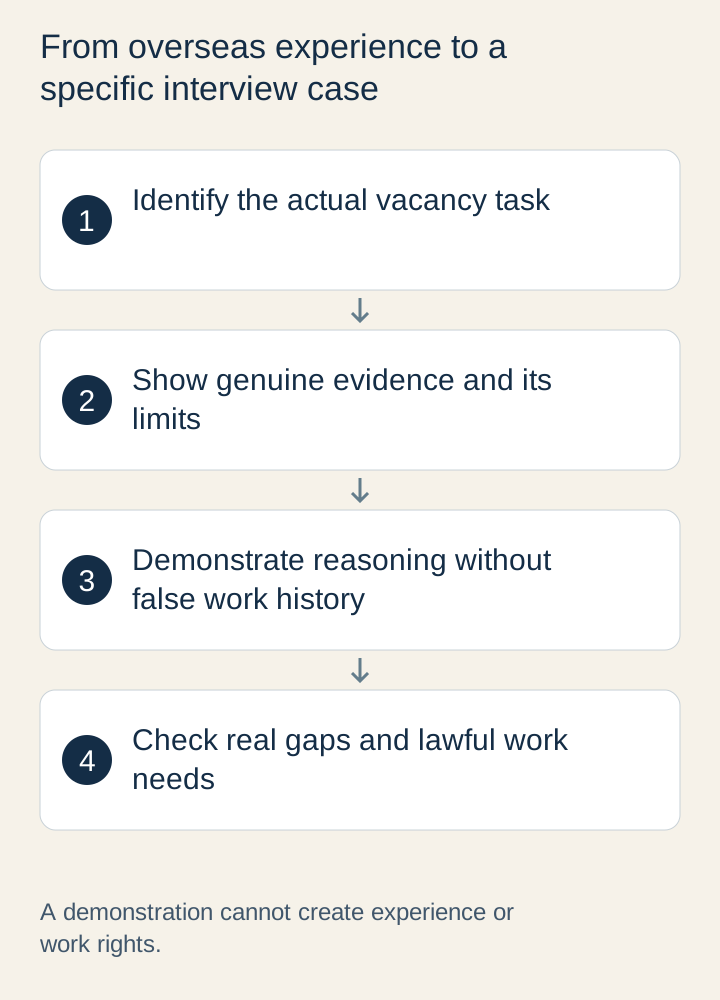
Create six columns: the vacancy's task; your closest genuine evidence; the local difference or unresolved requirement; how that difference will be checked; who is responsible; and what result would change your next decision. This is the distinctive asset for this topic. It turns a broad rejection such as “no local experience” into a specific question while allowing a genuine mismatch to remain a mismatch.
An original hypothetical row might say: employer needs an exception report, candidate can demonstrate overseas tracking, local reporting procedure unknown, ask for the relevant non-confidential process description, recruiter to clarify with the hiring manager, then decide whether to prepare a fictional example. Another row may identify a required registration with no evidence yet. Its next action is regulator research and suitable advice, not changing the résumé to imply registration already exists.
Prioritize gaps that affect whether the job is plausible. Do not buy a course merely because its advertisement mentions employability. Ask what skill it teaches, whether the employer values it, and whether a relevant authority recognizes it where recognition matters. Completing general training may improve understanding without satisfying a mandatory qualification. Keep completion, recognition and permission as separate entries.
After an interview, record the actual feedback rather than inferring a reason from silence. If the employer will not consider sponsorship, improving your portfolio may not address that decision. If your example was unclear, practise explaining it. If duties differ substantially, reconsider the vacancy. The 482 employer-search guide covers channel selection; the résumé evidence guide covers wording and final-file checks. Use this record for the additional question of what still needs demonstrating or learning.
6. Keep demonstrations, work rights and payment separate
Before accepting an assessment task, ask about its purpose, expected output, supervision, time and whether it will be used in the business. An independent fictional example prepared for your own portfolio is different from delivering a customer's real work. Do not assume every “test” is lawful unpaid activity, or that describing productive work as volunteering creates immigration permission.
The Fair Work Ombudsman's unpaid-trial guidance distinguishes a necessary, directly supervised skills demonstration from arrangements that go beyond what is reasonably needed and should be paid. It does not supply a universal free-trial duration for every role. Check the actual circumstances and work authorization separately; an employment-law discussion is not permission under a visa. Do not travel on an assumption that a visitor status allows you to build local experience through work.
Fair Work's migrant-worker rights guidance explains that workplace protections generally apply equally and that employers must comply with workplace and immigration laws. It also identifies Home Affairs as the authority that grants, refuses or cancels visas. A recruiter's confidence, a job offer or completion of a trial is not a government decision.
State your actual location, interview availability and need for an appropriate lawful start arrangement. Do not invent an Australian address, referee or employment period to pass an initial screen. If you already have permission, check its actual conditions rather than using a generic “full work rights” line. For visa detail, use the verified PremierVisa Group 482 explanation; it complements the official sources without replacing individual assessment. A successful interview, sponsorship steps, visa approval and future permanent residence remain distinct outcomes.
7. Frequently asked questions
Must the required Core Skills experience have been in Australia?
Do not equate a lack of Australian history with no relevant experience. The official requirement concerns relevant occupation or related-field experience with specific conditions. Whether your overseas work and evidence meet them needs assessment; no automatic acceptance is promised.
Can a portfolio replace missing work experience?
It can help an employer understand reasoning and practical skills. A newly created demonstration does not become past employment, satisfy every experience requirement or replace registration. Label its origin and limits clearly.
Should I hide that I am applying from overseas?
No. Give accurate location and timing information and distinguish remote interview availability from lawful commencement. A false local address may undermine the credibility that your evidence is intended to build.
Is unpaid work the best way to get local experience?
Do not assume an unpaid label makes an arrangement lawful. Fair Work distinguishes specific trials from employment, and immigration permission must be checked independently. Never accept unverified work rights as the price of an interview.
What if an employer says local experience is essential?
Ask which concrete requirement they mean and whether your evidence addresses it. Some gaps can be explored, while others are genuine prerequisites or employer decisions. Record the answer and redirect effort when the role is not presently realistic.
Choose one suitable vacancy and complete its gap-to-action record. If you need preparation support, submit your background to discuss your evidence, interview questions and realistic next employer approach.
Prepared with AI assistance. General career information; no named professional review has been confirmed. AI cover illustration does not depict our staff, clients or partner employers.