
If a recruiter promises guaranteed 482 sponsorship in exchange for an upfront payment, pause the transaction and verify the contact independently. A real business name, professional website or convincing offer does not prove that the sender is authorized or that the vacancy exists. Separate payment for a job or sponsorship from genuine, clearly identified personal application services. This guide helps overseas applicants examine a suspicious approach, preserve useful evidence and choose the appropriate help channel without treating a checklist as a fraud verdict.
- 1. Stop the pressure before trying to explain the message
- 2. Verify the sender through a route they did not supply
- 3. Identify what the money buys, rather than trusting its label
- 4. Use the message-to-action record before sending more information
- 5. Protect identity and check the actual application stage
- 6. If you already paid, secure accounts and route the evidence
- 7. Frequently asked questions
1. Stop the pressure before trying to explain the message
The first useful action is to create time. Do not let a claim that a place will disappear tonight decide when you transfer money, send identity documents or resign from your current job. Home Affairs' visa-scam guidance warns about guaranteed outcomes, large upfront payments to accelerate a visa and claims that only a few visas remain. An employer cannot sell you a government decision.
Write down what the sender actually offers. Is it an interview, a real position, an introduction, preparation of an application, sponsorship, or permanent residence? These are different things. A message that shifts between them when questioned is not a clear service description. Ask for the legal business name, named contact, exact role, workplace and the specific purpose of every proposed payment before considering the next step.
An ordinary recruitment deadline is not automatically a scam. The concern is pressure combined with missing identity, an unexplained payment or an outcome nobody can guarantee. Do not make a public accusation based only on a spelling error, a messaging app or an unfamiliar accent. Record the uncertainty and verify it through a separate route. You can decline to proceed while a concern remains unresolved without pretending you have completed an investigation.
2. Verify the sender through a route they did not supply
Scamwatch's employment-scam guidance explains that criminals can impersonate recruiters and advertise through trusted platforms. A familiar job-board logo or a genuine company's copied branding therefore does not authenticate the person contacting you. Find the company's official website independently and obtain a main switchboard or recruitment contact from that route. Avoid simply calling the number contained in the suspicious message.
Ask the independently reached organization to confirm the named recruiter, vacancy reference and authority to collect the proposed payment. You do not need to send a passport to ask whether a recruiter works there. If an agency acts for an employer, clarify both organizations' roles. A recruiter might legitimately coordinate an interview, but that does not establish that the person can promise a nomination, approve a visa or collect money on another party's behalf.
An ABN Lookup search can help compare public entity names and registration status. Its FAQ also explains that the service does not provide detailed business contact information and that accuracy depends on supplied updates. An active ABN establishes limited registration information, not a genuine vacancy, sponsor approval or an authenticated bank account. Fraudsters can copy real identifiers. Keep deeper entity and document comparisons in the employer-verification guide.
3. Identify what the money buys, rather than trusting its label
The Australian Border Force sponsorship page says that asking for or receiving a benefit in exchange for visa sponsorship is against the law; offering or providing that benefit is also prohibited. It separately explains that sponsors cannot recover specified recruitment, sponsorship and nomination costs, including associated migration-agent costs and the Skilling Australians Fund levy. Calling the payment a reservation, donation or coordination charge does not settle its actual purpose.
That does not mean every personal application expense or legitimate professional service is free. Obtain an itemized description showing the service, responsible party, recipient, payment stage and contractual basis. If employer-side and personal services are mixed together, ask for separation and appropriate independent advice. A polished invoice or refund promise cannot make a prohibited arrangement acceptable. Equally, a fee label alone is insufficient to decide every contractual question.
Fair Work's payment and repayment guidance addresses unreasonable payments benefiting an employer, including arrangements involving prospective employees and money outside wages. A requirement to pay simply to obtain an offer is a serious concern. Do not agree to receive a stated salary and secretly return part of it to make the arrangement look compliant. If already facing a demand, obtain advice about the actual documents instead of assuming this article cancels a debt.
| What you are told | What remains unverified | Useful next action |
|---|---|---|
| Pay now to reserve sponsorship | Whether the benefit is exchanged for sponsorship | Pause payment and seek independent advice |
| This is a personal visa service | Exact work, provider, fee responsibility and authority | Request an itemized written scope |
| The company has an active ABN | Sender authorization and genuine vacancy | Contact the organization independently |
| A refund makes it risk-free | Enforceability, recipient and recovery prospects | Do not treat a refund promise as protection |
These are screening examples, not findings about a named business or a complete legal fee schedule.
If you need help organizing a genuine job search, you can submit a background summary to discuss your resume, interview preparation and possible employer-contact directions. Do not use that general enquiry to send bank credentials, complete passport copies or unredacted scam evidence.
4. Use the message-to-action record before sending more information
Create one record for each suspicious approach. Use six fields: original claim and date; sender and channel; independently found contact; verification response; money or documents requested; and next protective action. Keep the sender's statement separate from your conclusion. “The main office has not yet answered” means unconfirmed, not “the company has verified the offer.” The record is an original preparation tool, not an official reporting form.
For an illustrative scenario, an applicant receives a message from someone using a genuine company's name. The sender promises sponsorship after a payment to a different individual and says the application can proceed without an interview. The applicant independently contacts the company and asks whether the recruiter and vacancy are authorized. Until an appropriate response arrives, the applicant records the discrepancy and sends neither money nor identity documents. This is fictional teaching material, not a customer story.
Use a question such as: “I received a recruitment approach using your organization's name. Can your recruitment team confirm whether this named person is authorized to discuss vacancy reference X and request this type of payment?” Share only the information necessary to identify the approach. If no vacancy reference exists, state that accurately. Do not fabricate one to make the enquiry appear complete.
Keep a second question for the sender, if communicating remains safe: “Please identify the actual employer, role, worksite, service scope and the basis for the payment, including who receives it.” A reply should be checked independently; it is not self-authenticating. You are not required to keep engaging with a threatening contact just to fill every field. Safety and securing accounts take priority over a complete worksheet.
5. Protect identity and check the actual application stage
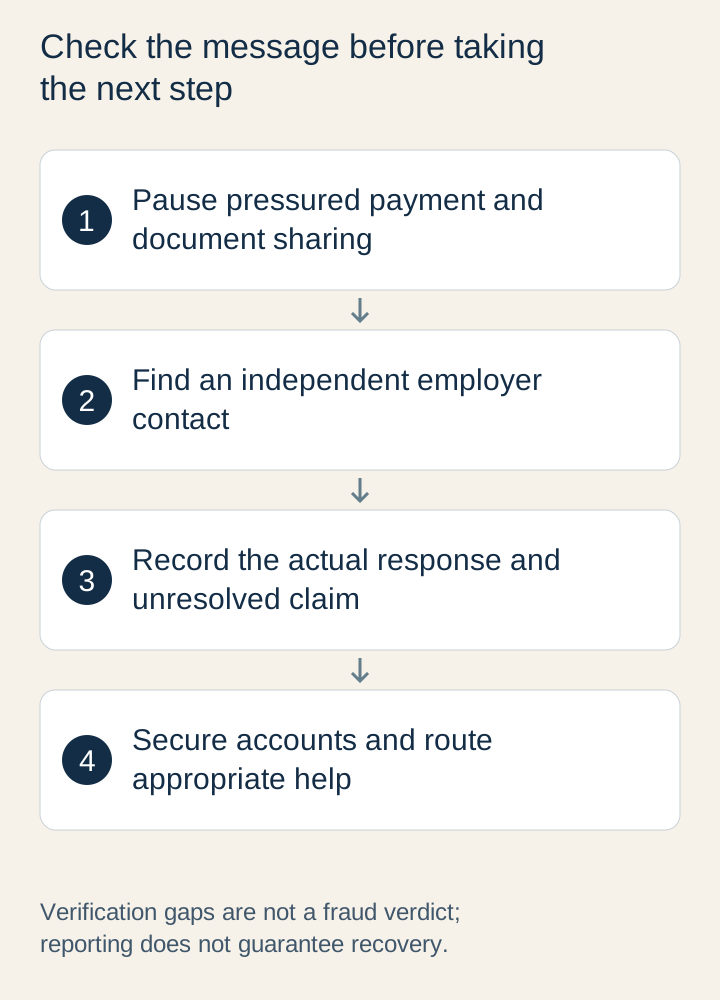
A resume summary, an application file number and a passport image have different sensitivity. Share documents only after confirming the recipient, purpose and submission channel. Scamwatch warns against sending identity documents to an employer or recruiter before being certain they are genuine. Do not install remote-access software, reveal one-time codes or let a supposed recruiter use your personal bank account to move money as part of a hiring task.
If someone claims to have submitted an application for you, ask for the relevant official acknowledgement and a clear explanation of what was submitted. Home Affairs identifies refusal to let an applicant check the application and discrepancies in identity or visa type as warning signs. Follow independently accessed official instructions for your own application; do not log in through a link supplied by the questionable contact. Check an asserted grant through the appropriate official route rather than trusting a screenshot alone.
Where someone claims to be a registered migration agent, verify that claimed registration through the official OMARA register and compare the person's identity. Do not borrow another person's registration number or assume that a company's marketing page verifies every person handling the matter. This guide does not certify HKJobHunt, any adviser or any third party's professional status. The lawful provider and written service scope must be established for the actual engagement.
Keep recruitment, nomination and personal visa permission separate. Home Affairs expressly warns that an ETA or Visitor visa does not permit work. A promise to sort out sponsorship after you arrive is not permission to begin a paid shift or unpaid productive work. For visa background, consult PremierVisa Group's 482 explanation; individual conditions still need appropriate assessment.
6. If you already paid, secure accounts and route the evidence
Scamwatch advises contacting your bank or card provider immediately if you think you have been scammed and asking about stopping transactions. Explain the actual payment method, time and recipient through an independently verified contact channel. Recovery is not guaranteed. If credentials or access were exposed, secure the affected accounts using official recovery instructions and appropriate support. Do not pay another stranger who promises a guaranteed recovery.
Preserve relevant messages, original offer files, invoices, payment confirmations and a timeline securely. Keep original records unchanged and use redacted copies for an initial enquiry where appropriate. Do not publicly post passport pages, account numbers, other applicants' information or private application references. Ask the receiving authority what material and format it needs; this guide's worksheet is not a substitute for its reporting requirements.
Home Affairs' reporting page directs migration-fraud information to Border Watch and notes Scamwatch as another reporting route. It also says that a person dealing with scammers outside Australia may consider local police or consumer authorities in their country of residence. Wage or employment-payment problems may also need Fair Work assistance. These channels serve different purposes; sending one report does not establish a visa outcome or guarantee compensation.
If you are already working or an application is pending, mention that situation when obtaining independent help. ABF states that an employer cannot cancel a visa, but that does not mean your conditions or immigration position can be ignored. Do not resign, disappear from a workplace or make new commitments solely on a generic scam checklist. Get help with the immediate concern and the separate consequences of any proposed employment change.
7. Frequently asked questions
Does a genuine company number prove the message is genuine?
No. Public identifiers can be copied. Verify the sender and vacancy through contact details found independently, and record what the organization actually confirms.
Is any payment connected with a visa automatically a scam?
No. Genuine personal application costs and properly scoped services are different from buying a job or sponsorship. Classify the payment and check the responsible party; a fee name or invoice alone does not establish legality.
Does an interview prove that the opportunity is safe?
No. An interview is one recruitment interaction, not verification of every person, payment or government stage. Apply the independent-contact and document checks even after a convincing video call.
Can a recruiter guarantee approval if the employer is willing?
No. Home Affairs says nobody can guarantee an Australian visa. Employer willingness, nomination and the applicant's eligibility remain separate from the government decision.
Will reporting a scam recover the money?
There is no guaranteed recovery. Contact the payment provider promptly, protect accounts and preserve evidence. Use the appropriate reporting channels and obtain advice about your actual circumstances.
For ongoing job-search preparation, submit your professional background and discuss your resume, interview needs and realistic employer-contact directions with HKJobHunt. This is not a purchase of sponsorship or a promise of employment; immigration matters may be referred to PremierVisa Group for case-specific assessment under an appropriate engagement.
Prepared with AI assistance. General career information; no named professional review has been confirmed. AI cover illustration does not depict our staff, clients or partner employers.