
Prepare a limited recruitment pack and a separate private evidence file when applying for Australian roles that may involve 482 sponsorship. A résumé introduces your experience; it does not replace formal evidence of English, skills or employment history. This guide uses the Core Skills stream as its main reference and provides a document-purpose and missing-evidence register. It helps you request accurate records, track the correct rules and disclose information at the right stage, without declaring a personal application ready to lodge.
- 1. Separate the recipient and purpose before collecting everything
- 2. Build an employment timeline before requesting references
- 3. Request an accurate reference without writing a fictional history
- 4. Track English evidence by test, date and applicable rule
- 5. Use a document-purpose and missing-evidence register
- 6. Confirm assessment requirements and release a controlled version
- 7. Frequently asked questions
1. Separate the recipient and purpose before collecting everything
Start with the actual vacancy instructions and your proposed visa stream. An employer's initial screening, a skills assessment, professional registration and a visa application can require different material. Do not send the largest possible folder to every recipient. Record why a document is needed, who is authorized to receive it and which secure process applies before sharing sensitive records.
The government's job-application guidance recommends a factual, tailored résumé and attention to selection criteria. A useful first application may contain the requested résumé, a short role-specific letter and a permitted work example. It does not automatically require identity documents, financial records or a family file. Follow the real vacancy instructions while questioning an unexplained sensitive request through a verified contact.
The Core Skills official document guidance covers a wider formal application, including categories beyond this article's employment focus. Do not treat this preparation guide as a complete immigration checklist. Health, character, identity, insurance and family requirements may also matter in the actual case; use the applicable official process and suitable individual assessment.
2. Build an employment timeline before requesting references
List each employer, original title, location, start and end dates, employment basis and substantive duties. Separate changed roles within the same company, concurrent work, gaps and study placements so the chronology is understandable. Preserve what the records actually say. A continuous calendar period does not by itself prove continuous full-time work at the required skill level.
The current Core Skills eligibility explanation requires at least one year of relevant experience in the nominated occupation or a related field. It describes experience at the same skill level, gained within the last five years, and part-time or casual work equivalent to at least twelve months full-time work. The period need not be continuous. Do not reduce that to any year in the same industry, or assume the minimum duration alone proves all skills and qualification requirements.
Use the timeline to identify what each record can support. A contract may describe an agreed role; another record may show actual dates or work undertaken. If those accounts differ, preserve the originals and clarify the reason. Do not add overlapping periods twice just to create an attractive total, or convert an unpaid activity into paid employment. This article does not calculate a personal equivalent period or determine whether a particular placement qualifies.
3. Request an accurate reference without writing a fictional history
The Core Skills document instructions describe employer-letterhead references identifying the referee, their role and contact details, the position and service dates. Prepare a factual request explaining the purpose and the actual period to confirm. Where more detail is needed about duties, ask the appropriate person to verify it rather than presenting an embellished template for automatic signature.
An original request might say: “Could you confirm my actual position and service dates on company letterhead, with the authorized referee's name, title and contact details? The attached factual timeline is for checking; please correct anything that does not match your records. Please also tell me how to request confirmation of the duties I actually performed.” This is a fictional teaching example, not a letter sent on your behalf or a guaranteed accepted format.
If the former employer has closed, the contact cannot be reached or the normal letter omits a relevant fact, create a missing-evidence entry. Record the document sought, the attempt made, the specific fact left unsupported and any contemporaneous material available for assessment. Do not invent letterhead, signatures, supervisor details or a convenient explanation. A truthful account of a gap is more useful than a polished document that cannot be verified.
Do not assume a statutory declaration, contract or payroll record always replaces a missing reference for every authority. Ask the actual recipient about its current requirements and obtain appropriate advice on the case. Protect previous employers' and customers' confidential information. A relevant document may still need an authorized way of submission rather than indiscriminate forwarding to recruiters.
4. Track English evidence by test, date and applicable rule
The current 482 English page distinguishes tests taken before 13 September 2025 from those on or after that date. For the Core Skills and Specialist Skills streams, applicants without an applicable exemption must take an accepted test before applying and within the stated three-year period. Use the actual test date and version rather than a remembered score from an old advertisement.
Your private English record should include the exact test name, delivery format, test date, component results, report reference, applicable official table and check date. Compare every required component; an overall result alone may not answer the rule. This article deliberately links the current table instead of reproducing a large score chart that could become detached from its dates.
Home Affairs does not accept entirely online or at-home tests for these visa purposes. A computer-based test at an accepted test centre is a different question from a remote-proctored home test; check the actual product. The page also notes that TOEFL tests taken on or after 21 January 2026 require selecting “Taking TOEFL for Australia” when registering. Keep evidence of the relevant arrangements rather than assuming the brand name alone is sufficient.
An exemption requires its actual conditions and supporting evidence. Studying in English, using English at work or receiving an employer's recommendation does not automatically establish one. For example, the published study exemption specifies at least five years of full-time study at secondary level or above where most classes were in English, with supporting institutional information. Do not describe any English-medium degree as automatically sufficient. Registration-related exemptions likewise require their own facts; visa English, registration and employer communication needs remain distinct.
For help organizing your recruitment account, submit your job-search background. Discuss résumé, interview and employer questions under the confirmed service scope. Personal exemption or application advice requires suitable separate assessment, not a guess from a résumé.
5. Use a document-purpose and missing-evidence register
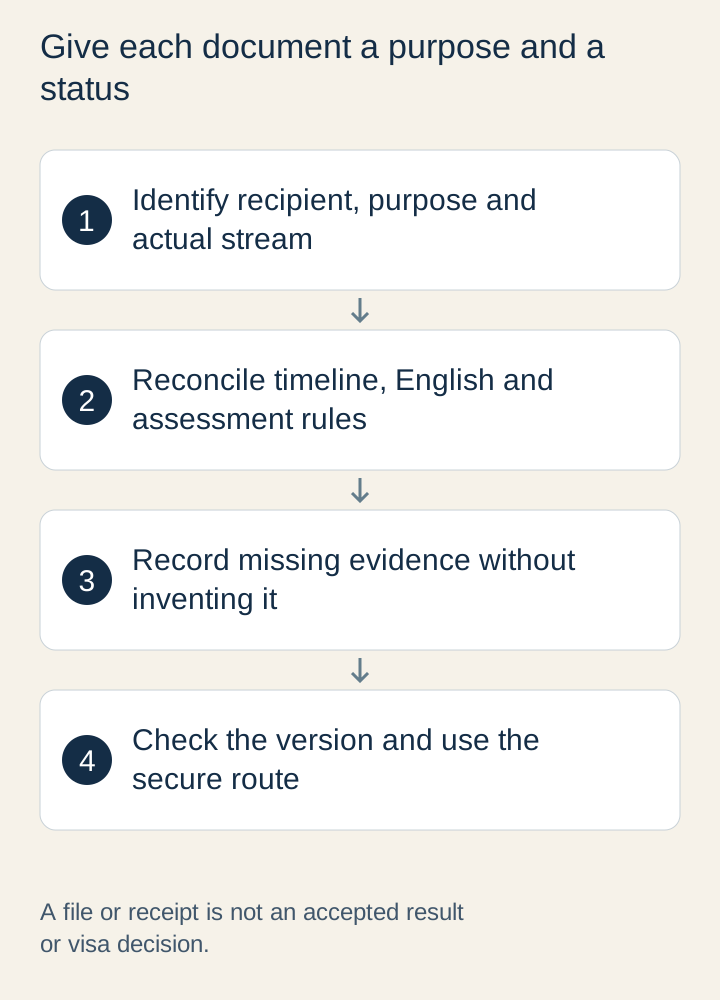
The original register has six fields: fact or requirement; intended recipient and purpose; document, version and relevant date; verified, requested or missing status; discrepancy or missing-evidence action; and owner, secure location and next review. Keep a private row for each evidence issue, with a short shareable summary that excludes identity numbers and confidential material.
| Evidence category | Practical check | A separate question |
|---|---|---|
| Employment history | Dates, actual duties and reference consistency | Does it demonstrate the required experience? |
| English | Test product, date, components or exemption evidence | Which current rule applies? |
| Skills assessment | Correct authority, purpose and actual stage | Is it mandatory for this case? |
| Registration | Relevant jurisdiction, scope and status | Does it permit the proposed professional work? |
A fictional example: the résumé gives a January start, but an employer reference records March. The next action is to establish whether these refer to different events and obtain an accurate explanation or correction. Do not edit the scanned reference yourself to make it agree. Until resolved, the register should show the discrepancy rather than a tick saying complete.
Use status words precisely. A requested letter is not received; a test booking is not a result; an assessment receipt is not a positive outcome. Equally, a file existing on your laptop is not proof that the intended recipient has accepted it. The blank worksheet does not upload anything, validate a document or send data to CRM. It is a private preparation aid, not a formal submission portal.
6. Confirm assessment requirements and release a controlled version
Home Affairs' skills-assessment overview explains that relevant authorities have their own procedures, timeframes and charges. Some Core Skills applicants require a mandatory assessment; when required, the official eligibility guidance says it must have commenced before visa lodgement, with the relevant reference number provided. Do not confuse making an enquiry or booking a future appointment with a process having actually commenced as required.
Not being required to undergo a mandatory assessment does not remove the need to demonstrate relevant skills and experience. Home Affairs can also request an assessment in writing. Professional registration is a different issue: identify the authority and actual work jurisdiction rather than treating an assessment result as permission to practise. The occupation-to-job guide helps distinguish the role, list and personal-evidence layers.
For a formal Core Skills application, the official preparation instructions require English translations alongside non-English originals, clear colour scans or photographs, and a multipage document kept as one file. Translator requirements differ inside and outside Australia; check the actual instructions. Do not remove pages, alter dates or hide qualifications that affect the meaning. Another recipient may have a different format, so do not assume the visa instructions are every employer's submission rules.
Before sharing a version, check names, dates, titles, readable pages and attachment labels against the evidence index. Confirm the recipient, purpose and secure route. If a record has been corrected, distinguish the corrected original from your explanatory note and retain the previous version privately. A replacement filename alone does not tell another person which statement changed.
For broader immigration context, see PremierVisa Group's verified 482 explanation. Recruitment progress, document readiness, nomination, visa approval and actual work permission remain separate. A complete preparation folder cannot guarantee a job or a visa. Where a core item is unresolved, identify the precise gap and responsible next action rather than declaring the file ready because it contains many pages.
7. Frequently asked questions
Should I send the whole visa file with my first résumé?
No universal rule requires that. Follow the actual recruitment instructions, confirm the recipient and purpose, and use an appropriate secure process for sensitive evidence when genuinely required.
Does one calendar year automatically meet the experience requirement?
No. Relevance, skill level, timing and employment basis matter, as do the other applicable requirements. Part-time and casual experience need the relevant equivalent assessment, not a guessed total.
Does an English-medium degree automatically mean an exemption?
No. Compare the published exemption and evidence requirements with the actual study. Do not replace that assessment with an employer's view that your spoken English is good.
If a reference is missing, can I simply replace it with a declaration?
Do not assume that works for every recipient or purpose. Record the gap and available truthful evidence, then check the applicable authority's current requirements and suitable individual advice.
Does a skills-assessment receipt mean my file is approved?
No. Receipt, commencement, assessment outcome and visa decision are different stages. Use accurate status labels and check any timing requirement for the actual application.
Begin with the timeline and the one evidence gap most likely to affect your next recruitment step. To discuss preparation, submit your background, without uploading identity documents or confidential employer records in an initial general enquiry.
Prepared with AI assistance. General career information; no named professional review has been confirmed. AI cover illustration does not depict our staff, clients or partner employers.