
Answer a direct work-rights question when it is asked, and clarify a material sponsorship requirement before either side commits to arrangements that depend on it. You do not need to turn every introduction into a visa presentation. Explain your current position briefly, distinguish it from future sponsorship and return to the work you can do. This guide gives experienced applicants an interview-stage plan, original English response examples and a rehearsal card; it does not promise that a particular employer will sponsor you.
- 1. Match the conversation to the recruitment stage
- 2. Prepare a three-part answer: current status, need and next question
- 3. Connect sponsorship discussion to the work, without selling a visa outcome
- 4. Rehearse difficult questions with an answer-and-boundary card
- 5. Ask questions that reveal the employer’s actual position
- 6. Follow up with facts, and check any work-like assessment
- 7. Frequently asked questions and your next action
1. Match the conversation to the recruitment stage
Read the advertisement and application questions first. If the employer asks whether you currently have permission to work in Australia or will require sponsorship, answer according to your actual circumstances. Do not select a more convenient answer to reach an interview and assume you can correct it later. If a form cannot describe your situation, use the published recruitment contact to ask how to provide an accurate response.
During an initial screening call, a short explanation is usually more useful than a detailed account of every visa you have researched. State where you are, your current work-right position and whether employer sponsorship would be needed for this role. Ask whether the vacancy is open to a candidate in that situation. The employer’s response tells you whether further preparation is worthwhile; it does not determine your visa eligibility.
At a technical or hiring-manager interview, discuss your relevant skills and examples while keeping the previously stated position consistent. Before a proposed offer, confirm who handles the employer-side assessment and what remains unresolved. If the employer suggests an immediate start, a trial or relocation, clarify work authorization before agreeing to anything that assumes you can work.
This timing framework is editorial advice, not a legal deadline that applies to all interviews. Home Affairs’ 482 overview makes clear that Skills in Demand is a temporary sponsored visa with its own requirements. Recruitment interest and a government decision are separate matters. The useful question is whether your answer is accurate and whether the next action depends on permission you do not yet hold.
2. Prepare a three-part answer: current status, need and next question
Before rehearsing, write down facts you can substantiate. Use your actual location and current visa conditions rather than a friend’s situation or an expected approval. Home Affairs explains that VEVO can show current visa details and conditions. A future application or a recruiter’s reassurance cannot replace a check of your present position.
For an overseas applicant without Australian work authorization, an original answer is: “I am currently based outside Australia and do not have Australian work authorization. I would need employer sponsorship before commencing this role. Would you consider an offshore candidate in that position?” This gives the employer a practical screening question without claiming that the applicant is already eligible for a particular stream.
For someone holding an Australian visa, the answer must be personalized: “I currently hold a visa with work conditions. I can provide evidence of my present conditions through the appropriate process. I would like to confirm whether this role and any proposed change of employer require further steps before I start.” Do not use this wording to conceal restrictions; identify relevant conditions accurately once checked and share the appropriate evidence securely.
If you are uncertain, say so precisely: “I need to verify that point against my current visa conditions before giving you a start date. Could I confirm it with your recruitment contact after the interview?” An identified uncertainty is more useful than either guessing or saying that all visa matters are the employer’s responsibility. Keep a note of the question and make sure the correction or confirmation reaches the right person.
3. Connect sponsorship discussion to the work, without selling a visa outcome
A sponsorship conversation can become unproductive when the applicant lists possible immigration benefits while the manager still does not understand their skills. Prepare a concise example of the work that fits the vacancy, then explain the practical requirement. Your experience is relevant to hiring; it does not purchase an exemption from immigration rules.
For example: “My relevant experience is diagnosing recurring equipment faults and documenting handovers. I can explain a recent example and the role I played. I would require sponsorship before commencing work in Australia; is that something your team can consider for this position?” This is a teaching example, not a claim that maintenance work automatically qualifies for 482 sponsorship.
Avoid telling an employer that sponsorship will be easy, cheap or approved quickly because someone else obtained it. Do not promise permanent residence, a guaranteed future visa or that you will pay the employer’s sponsorship costs. A confident interview answer should be clear about your skills and honest about what still needs assessment, rather than confident about decisions outside your control.
The Australian Government’s job-application guidance recommends preparing work examples, understanding selection criteria and checking the interview format. Use those principles to demonstrate suitability. If your resume needs clearer evidence, the overseas-experience resume guide provides a separate claim-to-evidence exercise.
If you need individual preparation, submit your career background to discuss your resume, interview examples and realistic employer-search directions. HKJobHunt confirms the service scope separately; interview coaching cannot guarantee sponsorship or supply a job offer.
4. Rehearse difficult questions with an answer-and-boundary card
Create a rehearsal card with the question, verified facts, a brief answer, a relevant work example and the next question for the employer. Record anything that requires confirmation after the interview. This is a preparation tool, not an immigration declaration form. It helps stop an anxious response from becoming an inaccurate commitment.
| Interview question | Original response framework | What to avoid |
|---|---|---|
| “Can you start next week?” | “I can discuss interview availability now. My work start depends on confirming authorization and the required arrangements.” | Treating willingness or travel availability as work permission |
| “Do you need sponsorship?” | State your present position, then ask whether the specific vacancy can be considered | Hiding a known requirement or promising approval |
| “Will you have permanent residence soon?” | Explain your current status; say that future outcomes are not confirmed | Presenting a planned application as an approved result |
| “Can you come in for a trial?” | Ask what tasks, location, duration and payment arrangement are proposed, and check work conditions first | Assuming that calling something an interview removes work-right issues |
These are original examples. Replace them with facts that apply to you, and do not memorize a sentence you cannot explain. Practice a short answer and a fuller version so you can respond naturally to the interviewer’s level of detail. A short answer should still contain the material fact; brevity is not an excuse to omit a restriction.
For a Hong Kong or Taiwan applicant, rehearse time-zone and relocation questions separately from work authorization. For a mainland applicant, prepare a clear English explanation of your present location and current documents rather than relying on a domestic term for an overseas work arrangement. Nationality and language do not determine an employer’s willingness, so ask about the vacancy instead of assuming a special recruitment entitlement.
After rehearsing, compare the answer with your resume and application form. All three should describe the same present status. If a previous answer was wrong or circumstances have changed, provide a concise correction through the appropriate recruitment channel. Do not create a second, contradictory story for a different interviewer.
5. Ask questions that reveal the employer’s actual position
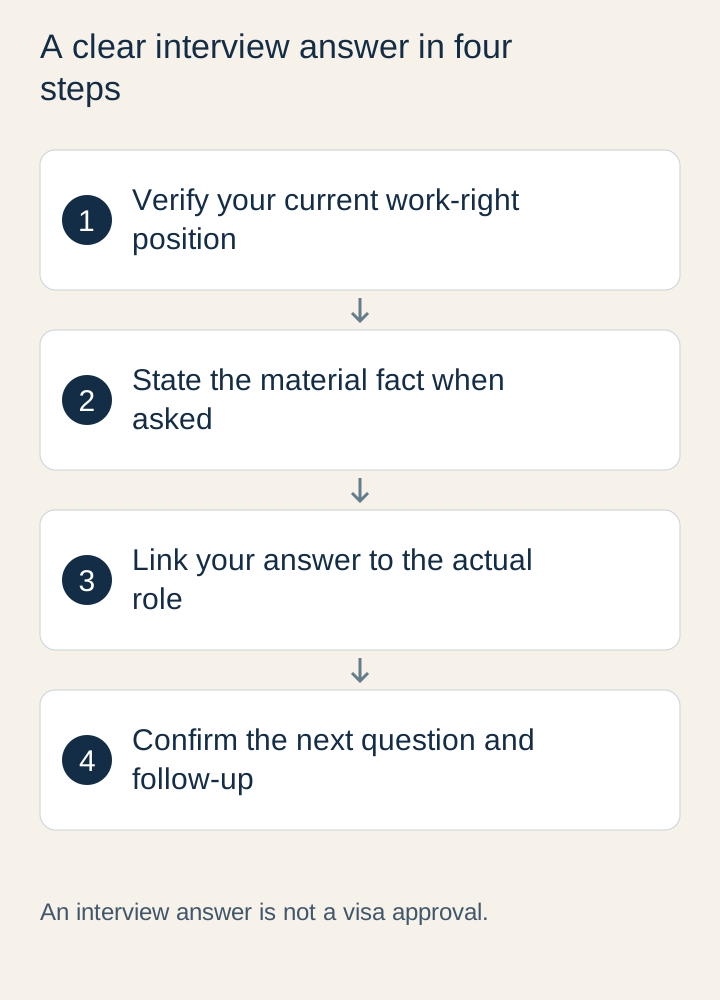
Useful questions are narrow enough to answer: “Does this vacancy accept applicants who need sponsorship?”, “Are offshore applicants included?”, “Who reviews the employer-side arrangements?” and “At what point will you confirm whether the role can proceed?” These questions concern recruitment and process ownership, not a demand that a manager guarantee a visa.
Clarify the actual employing entity and worksite if they are not already clear. Ask whether the interview is for an advertised vacancy or a future talent pool. If a recruiter represents another company, establish who will make the hiring decision. You can then decide what evidence is proportionate at the present stage without sending sensitive files to everyone involved.
You may ask what happens if the timetable changes or sponsorship is not available. An answer such as “we will assess it after the final interview” should be recorded at that stage, not upgraded to an agreement. If the company says it cannot consider sponsorship, acknowledge the answer and ask whether it wishes to retain your application under its normal privacy process; do not argue that a listed occupation obliges it to hire you.
Keep the interview question card separate from the post-interview employer-document log. This article helps you communicate during recruitment. The document log becomes useful when you need to compare verbal promises, written job terms and the employer’s explanation of sponsorship preparation.
6. Follow up with facts, and check any work-like assessment
After the interview, send a short follow-up if it is appropriate to the stated process. Confirm the role, your understanding of the sponsorship discussion and any information you agreed to provide. An original sentence is: “Thank you for discussing the role. My understanding is that sponsorship availability remains under assessment and that I should not treat a start date as confirmed. Please let me know if I have misunderstood.” Adapt it rather than sending a legal-sounding script that does not match the conversation.
Store the date, vacancy reference and next action in your own record. If you share evidence of visa conditions, use the verified employer’s appropriate channel and avoid unnecessary personal data. You do not need to include passport numbers, family information or financial records in an ordinary interview follow-up unless a legitimate later process specifically requires them.
If an assessment involves performing work, check both immigration conditions and employment arrangements. Home Affairs’ work-restrictions guidance states that a Visitor visa or ETA does not permit work. Fair Work’s unpaid-trial guidance explains that a limited, directly supervised skills demonstration differs from work going beyond what is reasonably needed. Payment and immigration permission are separate questions; neither a trial label nor a willingness to work unpaid settles both.
If the proposal is unclear, ask for the tasks, duration, supervisor, location and payment terms before agreeing. Do not fly to Australia expecting to begin work while sponsorship is discussed. For the separate visa framework, consult the PremierVisa 482 guide and current official conditions for your own case.
7. Frequently asked questions and your next action
Should I wait until the final interview to mention sponsorship?
Answer direct questions accurately whenever they arise. If a known requirement affects whether the vacancy is open to you, clarify it early enough to avoid commitments based on a misunderstanding. There is no single interview stage that suits every recruitment process.
What if the online form only offers yes or no?
Do not choose an inaccurate answer merely to continue. Read the question carefully and ask the genuine recruitment contact how to describe your situation if the options are insufficient. Keep a record of the clarification.
Can I say I will have permanent residence by the start date?
Only describe an outcome that is actually established. A planned application or optimistic timetable is not an approval. State your current position and identify what remains uncertain rather than promising a future government decision.
Does a successful interview mean the employer can sponsor me?
No. It may establish hiring interest. The business, position and applicant still need the appropriate assessment and decisions. Ask who will clarify the next stage and what information is needed.
Can I agree to an unpaid trial while sponsorship is arranged?
Do not assume you may work. Confirm your visa conditions and the actual proposed activities, then examine the employment arrangement separately. The word “unpaid” does not create work authorization or make an extended work trial lawful.
Your next action is to prepare one truthful status answer, one work example and two specific questions for the employer. If you need individual support, submit your career background to discuss interview preparation and practical employer-search directions. HKJobHunt is part of the PremierVisa Group service network; employment, sponsorship, visas and permanent residence remain separate outcomes.
Prepared with AI assistance. General career information; no named professional review has been confirmed. AI cover illustration does not depict our staff, clients or partner employers.
Sources: Home Affairs 482; VEVO; DEWR job applications; Home Affairs work restrictions; Fair Work unpaid trials.