
To find 482 visa sponsorship jobs, start with work you can prove you can do, then identify employers recruiting for that work and ask whether they will consider sponsorship for the specific vacancy. A reference to sponsorship in an advertisement is a lead to investigate, rather than an offer or approval. This guide is for experienced applicants applying from overseas or clarifying their current Australian work rights. It explains how to search, screen, contact and follow up without buying a supposed sponsorship place.
- 1. Define the job before searching for a sponsor
- 2. Build three search channels, with a different purpose for each
- 3. Read sponsorship wording as a question to resolve
- 4. Send a short, evidence-based first approach
- 5. Use an employer-contact record that preserves evidence
- 6. Check the opportunity before paying or planning a move
- 7. Frequently asked questions and your next action
1. Define the job before searching for a sponsor
The current visa name is Skills in Demand visa, subclass 482. Home Affairs describes it as temporary employer sponsorship and lists an approved sponsor’s nomination, suitable skills and relevant English requirements among the basic eligibility conditions. A job offer does not itself give permission to work, and an occupation appearing on a visa list does not mean an employer has a vacancy. Check the official 482 overview before making decisions.
Make a one-page search brief. Write your actual duties, relevant qualifications, work locations you can accept and the evidence available for your experience. Add your present location, current work-right status and the conditions that would affect a start date. If you do not currently have Australian work authorization, say that plainly; a willingness to relocate is a separate point. Avoid presenting an expected visa outcome as an existing entitlement.
For example, a maintenance professional might describe equipment maintained, fault diagnosis, safety responsibilities and reporting duties. These details are more useful to a hiring manager than a broad label such as “technical worker seeking sponsorship”. This is an illustrative search profile, not an assessment that the role or applicant qualifies for any stream. Regulated work may also require local registration or licensing, which must be checked with the relevant regulator.
Choose a primary role and a small group of genuinely related job titles. Keep a separate list of duties you have not performed. It prevents a broad search from pushing you towards an advertisement you cannot honestly satisfy. Our guide to comparing duties and job titles explains why a translated title alone is insufficient.
2. Build three search channels, with a different purpose for each
Use job boards to find advertised needs, employer career pages to check the original vacancy and professional contacts to understand hiring requirements. The Australian Department of Employment and Workplace Relations identifies online job-search services, LinkedIn and direct approaches to businesses as possible routes. Its resources for migrants looking for work also explain the importance of checking work rights. None of these channels makes every listed employer a sponsor.
Start with a role, a location and one sponsorship phrase. Illustrative searches include “maintenance technician visa sponsorship Perth”, “chef 482 sponsorship regional Australia” and “software engineer sponsorship considered”. Change one component at a time and record what changed. These are search examples, not claims that those occupations or locations currently have suitable vacancies. Search tools handle quotation marks and filters differently, so read the returned advertisements rather than assuming the query has filtered everything correctly.
Then search the same role without a visa phrase. Some advertisements describe a good technical match without addressing sponsorship. Put these in an “ask first” group instead of treating silence as either acceptance or refusal. Check the company’s own careers page for the vacancy identifier, location and closing information. If a recruiter is advertising, establish whether it is recruiting for a named employer or collecting expressions of interest.
Professional associations, former colleagues and sector events can provide context about teams and skills. Ask for information about a recruitment process rather than requesting a guaranteed introduction. A contact’s past experience of sponsorship is useful background, but it does not establish the employer’s present position. Do not turn a historical sponsor directory into a list of companies currently hiring you.
3. Read sponsorship wording as a question to resolve
The following phrases are original teaching examples. They are not quotations from current vacancies or legal definitions. Their value is to show what information is missing before you invest time in an application.
| Illustrative advertisement wording | What remains uncertain | Useful next question |
|---|---|---|
| “Sponsorship may be considered” | Whether this role and an overseas applicant are included | Would you consider an offshore candidate who requires sponsorship for this vacancy? |
| “Existing work rights required” | Whether the employer excludes applicants needing sponsorship | Is this requirement a firm condition at application and commencement? |
| “482 transfer considered” | Whether the process is limited to existing visa holders | Are applicants without a current 482 considered? |
| “Relocation assistance available” | Whether support includes any visa process | Does this refer only to moving costs, or is sponsorship separately available? |
Look for contradictions between the headline, application questions and full description. A page can mention sponsorship while an individual role requires existing work rights. Do not answer “yes” to a work-rights question simply to get past a form. If the choices cannot represent your situation, ask the recruitment contact how to answer accurately and keep the response.
Also separate the employer’s willingness to discuss sponsorship from sponsorship approval, nomination approval and a visa decision. Your tracking sheet should have different fields for each. “Recruiter says possible” is not the same status as “employer confirmed in writing for this role”, and neither means the government has approved an application. This separation makes your next conversation much more precise.
4. Send a short, evidence-based first approach
Lead with the vacancy and the relevant work you have done. Prepare a resume with consistent dates, responsibilities, qualifications and contact details. Add a brief portfolio or anonymized example only when it helps show job-relevant skills. Do not send client data, confidential employer documents, passport scans or financial records with an unsolicited first message.
Use this original outline and replace its details with truthful information: “I am applying for the advertised maintenance role, reference M-Example. My experience includes planned servicing, fault diagnosis and documenting equipment handovers. I am currently based outside Australia and would require employer sponsorship before commencing work. Would your team consider an offshore applicant for this particular position? I can provide a resume and relevant experience evidence through your recruitment process.” The reference is fictional and should never be mistaken for a live job.
For a Hong Kong or Taiwan applicant, translate an unfamiliar local job title into understandable duties without inflating seniority. For a mainland applicant, explain an industry-specific title using concrete responsibilities rather than assuming an Australian reader recognizes a domestic grade. An international applicant should also state a practical time zone for interview availability. These details help a recruiter assess logistics without suggesting that nationality determines eligibility.
If the employer responds, ask who manages recruitment, what evidence is needed at this stage and whether any interview or technical assessment is expected. Clarify the actual worksite and employment entity before discussing relocation. Do not open by promising to reimburse the employer for sponsorship or recruitment costs.
If your difficulty is turning experience into a credible application, you can submit your career background for a discussion. HKJobHunt can discuss resume preparation, interviews and employer-search directions within separately confirmed service arrangements. An enquiry is not an employer introduction or a job guarantee.
5. Use an employer-contact record that preserves evidence
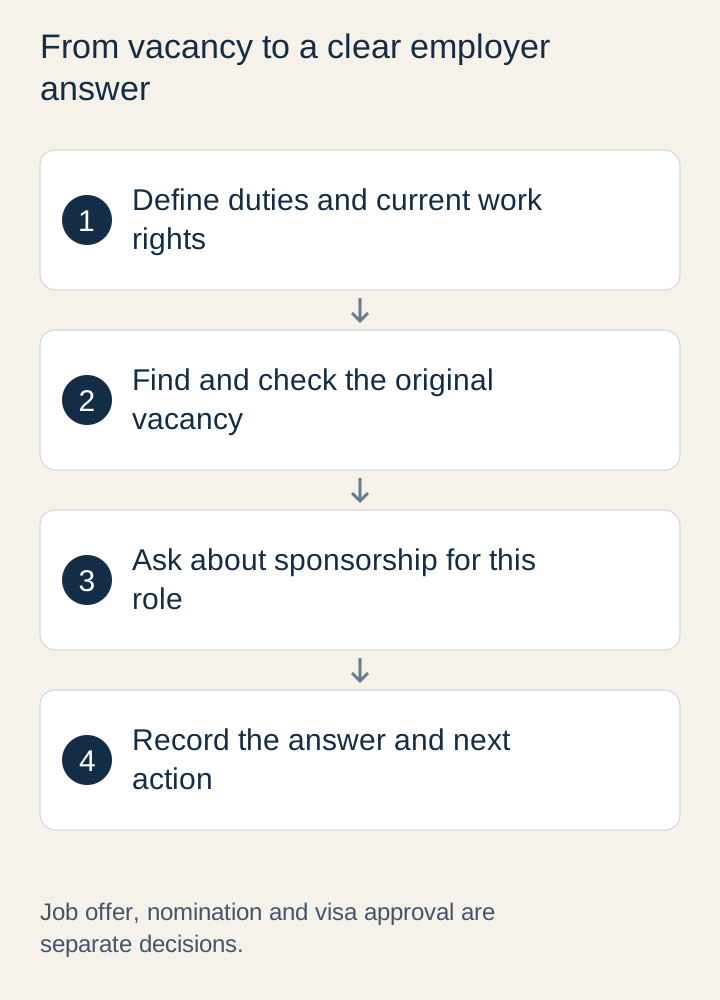
Create one record per vacancy, rather than one record per website. Save the original link and the date seen, because advertisements can change or disappear. If the same role is repeated on several sites, connect the entries to a single vacancy record so you do not mistakenly count it as several opportunities.
Use the accompanying employer-contact workflow while maintaining these fields: employer legal or trading name; employer website; original vacancy URL; vacancy reference; actual location; matching duties; stated work-right requirements; exact sponsorship wording; contact’s business role; date contacted; response; evidence location; unresolved question; next action and review date. Leave an unknown field as “not confirmed”. Avoid a numerical score that makes missing information look precise.
A useful status sequence is “identified”, “screened”, “contacted”, “clarification requested”, “interview”, “written terms received” and “closed”. Keep immigration decisions outside that sequence. You can record the reason for closure, such as a work-right requirement, a technical mismatch or no longer recruiting, without judging the employer’s overall sponsorship status.
For a hypothetical record, the next action could read: “Ask whether the named regional worksite accepts offshore applicants; no payment or documents requested.” Do not populate the teaching record with an invented company and then present it as a verified employer lead. The purpose is to make your search auditable and reduce repeated, unproductive messages.
Agree a follow-up date if the recruiter offers one. Otherwise choose a reasonable interval based on the stated recruitment timetable, send a concise reminder and record the result. There is no universal number of messages that produces sponsorship. If silence continues, put the record on hold and redirect effort towards roles with clearer recruitment information.
6. Check the opportunity before paying or planning a move
Independently locate the business’s official contact channel and confirm that the recruitment approach is genuine. The Australian Government’s Scamwatch employment-scam guidance warns that recognizable platforms and company names do not establish authenticity. Unexpected messages, an absence of meaningful interviews and demands to pay before starting deserve further checks. These signals call for verification; they are not proof against a particular business.
Ask for written duties, worksite, hours, remuneration components and the entity offering employment. Check whether a salary figure is in Australian dollars and whether it is annual or hourly, gross or net, with superannuation separate or included. A quoted package cannot be compared sensibly until its components are clear. This article does not quote a current salary threshold, visa charge or processing promise: those figures must be checked against the applicable official rules and dates for the particular case.
Fair Work’s 482 and 457 workplace-rights fact sheet explains sponsor obligations, including restrictions on passing recruitment and sponsorship-related costs to workers. Do not treat every item called a “service fee” as automatically permitted or every personal application expense as prohibited. Obtain an itemized explanation of the payer, recipient, purpose and contractual basis, and seek independent professional review when needed.
Before resigning, booking non-refundable travel or beginning work, confirm your actual immigration position and work conditions. A recruitment conversation, signed offer or submitted application is not a substitute for work authorization. If you already hold an Australian visa, check your own conditions rather than following another worker’s experience. Keep employment suitability, visa eligibility and long-term residence plans as separate decisions.
For separate visa research, read the PremierVisa 482 official-verification guide. It covers immigration questions beyond this employer-search workflow; your own circumstances still need assessment.
7. Frequently asked questions and your next action
Can I apply while I am outside Australia?
You can ask employers whether they accept offshore applications, but their recruitment policy and the vacancy’s conditions matter. State your current location and need for sponsorship at the appropriate application question. Do not say you can start immediately if your ability to work still depends on an approval.
Does an approved sponsor list tell me who will hire me?
No. A historical or current sponsorship record does not establish a suitable vacancy, a willingness to sponsor you or an individual approval. Use a directory as a research lead, then verify the current employer, vacancy and recruitment contact independently.
Should I hide my sponsorship requirement until after the interview?
Answer application questions truthfully. A short statement of your present status and sponsorship need allows the employer to decide whether discussion is worthwhile. If the advertisement is unclear, ask a specific question before preparing an extensive task or travelling for an interview.
Can I pay someone to guarantee a sponsoring employer?
Do not treat sponsorship as a purchasable place. Request the actual services, employer identity and itemized fee responsibilities in writing. Check applicable restrictions and seek independent advice before paying; a promise of a job or visa cannot replace the required decisions.
How do I know whether my search is improving?
Review whether your records contain better duty matches, clearer sponsorship answers and useful interview feedback. Track reasons applications stop, rather than just the number sent. If most replies require work rights you do not hold, change your screening questions before increasing application volume.
Your next action is to prepare the search brief, screen a small set of genuine vacancies and record one clear question for each employer. If you need individual support, submit your career background to discuss your resume, interviews and realistic employer-search directions. HKJobHunt, part of the PremierVisa Group service network, confirms service scope and contractual arrangements separately; hiring, sponsorship, visas and permanent residence are distinct outcomes.
Prepared with AI assistance. General career information; no named professional review has been confirmed. AI cover illustration does not depict our staff, clients or partner employers.
Sources: Home Affairs — Skills in Demand 482; DEWR — migrant job-search resources; Fair Work — 482 and 457 workplace rights; Scamwatch — employment scams.