
When a 482 job opportunity involves moving your family, separate the employment start from each family member's permission, schooling, healthcare and relocation arrangements. Employer support can help, but the words “family relocation” do not identify who is covered or what is paid. Use a family-readiness record to ask practical questions before committing to travel or housing. This guide helps candidates compare moving together and arriving in stages; it does not assess a family's eligibility or guarantee a school place, job or visa.
- 1. Establish the family application plan before booking the move
- 2. Ask the employer about the actual work pattern and support
- 3. Check school arrangements for the actual state and address
- 4. Separate healthcare eligibility, insurance and payment responsibility
- 5. Compare two arrival plans with a family-readiness record
- 6. Set decisions around evidence and revisit the start
- 7. Frequently asked questions
1. Establish the family application plan before booking the move
The Core Skills official explanation describes eligible secondary applicants and subsequent-entrant arrangements. Family inclusion depends on the relevant family definition and circumstances, including existing visa history. Being a relative is not by itself enough to assume inclusion. Prepare a limited summary of the people intending to move and the questions needing individual assessment.
Home Affairs also explains the connection with the main applicant's nomination or the sponsor's written agreement to secondary sponsorship, and applicable health and character requirements. Ask who will coordinate that evidence and which application arrangement is intended. A hiring manager saying the family is welcome is not the same as the required information being recorded or an application being granted.
Identify whether people intend to apply and travel together or whether an appropriate subsequent-entrant arrangement is being considered. Ask how changes in relationships, dependants or a new birth should be reported and assessed rather than relying on a generic instruction about adding family. Keep each person's actual grant and conditions separate from the household timetable. The main applicant's progress does not prove another application has reached the same stage.
2. Ask the employer about the actual work pattern and support
Obtain the workplace, roster, travel expectations, induction arrangements and the contact responsible for the proposed start. A company's head-office address may not be the daily worksite. Discuss how the actual pattern interacts with school collection, transport and temporary accommodation, without assuming the employer can guarantee a particular family routine or create a flexible arrangement that has not been agreed.
Break relocation support into specific items: flights, baggage or freight, temporary accommodation, local transport, help finding services and any reimbursement. Ask who is covered, what must be approved first, the amount or limit, the payment method and when payment happens. Assistance arranging a service is different from paying its bill. A reimbursement after commencement still leaves an earlier cash requirement for the household.
An original employer enquiry could say: “Could we confirm the worksite and initial roster, and identify which relocation items cover accompanying family members? Please distinguish direct payment, reimbursement and introductions to local services, including any conditions and the responsible contact.” This is a fictional preparation example, not a message already sent or a statement that HKJobHunt has negotiated a package.
Read any repayment or early-departure clause separately. If it affects a decision to move, obtain suitable advice about the actual wording and cost category. Do not assume every relocation expense is a prohibited sponsorship cost, or that calling a charge relocation automatically makes it recoverable. The offer-questions guide helps organize unresolved clauses before commitments are made.
3. Check school arrangements for the actual state and address
Identify the intended state, the child's likely year level and the proposed living area before requesting school information. Ask the relevant education authority about the visa category, enrolment route, documents, placement and applicable fees or exemptions. A colleague's experience in another state, year or school system cannot establish your child's arrangements. Keep a school enquiry distinct from an accepted enrolment.
For a concrete example, the NSW Temporary Residents Program requires a valid visa and applicable enrolment conditions. Its guidance explains that most temporary-resident students pay application and tuition fees, with separate information about exemptions, including a conditional regional-school arrangement for students holding 482 visas. This is NSW guidance, not a national promise or a finding that a particular child is fee exempt.
Record the authority's answer, the date, the conditions relied on and what still needs a decision. Ask whether the proposed address affects the school application, what evidence is needed and which costs are outside tuition. Uniforms, transport, care outside school hours and activities can affect the household plan even where a tuition exemption applies. Do not treat a general description of a region as confirmation for a specific school.
Prepare educational records through the appropriate process and discuss language or learning support with the actual provider. At recruitment stage, the employer generally needs the operational question, such as a proposed arrival sequence or a request to review the start date. Avoid circulating children's identity documents, detailed education files or private support needs to unrelated hiring contacts.
4. Separate healthcare eligibility, insurance and payment responsibility
Core Skills guidance describes adequate health-cover obligations and personal responsibility for healthcare costs for primary and secondary applicants. Ask about the actual people covered, dates, relevant policy requirements and any employer contribution. An employer benefit named health insurance may have a different scope from the cover required for the visa or from the services a family expects to use.
Services Australia's Medicare enrolment guidance identifies eligibility categories and possible Reciprocal Health Care Agreement arrangements. A temporary work visa, an Australian address or a tax payment is not sufficient evidence of Medicare eligibility by itself. Establish the applicable position for each person rather than promising automatic free healthcare to every 482 household.
For insurance planning, request written information about commencement, covered people, exclusions, waiting periods, out-of-pocket expenses and the process for checking treatment. These are questions to ask the insurer or appropriate professional, not findings that a specific product is adequate. Keep medical details within an authorized confidential process, and discuss only necessary scheduling or practical support with the employer.
For help preparing the recruitment conversation, submit your job-search background. Discuss résumé, interview and possible employer approaches under the confirmed service scope. Family visa, healthcare and education assessments need the relevant separate advice and authority confirmation.
5. Compare two arrival plans with a family-readiness record
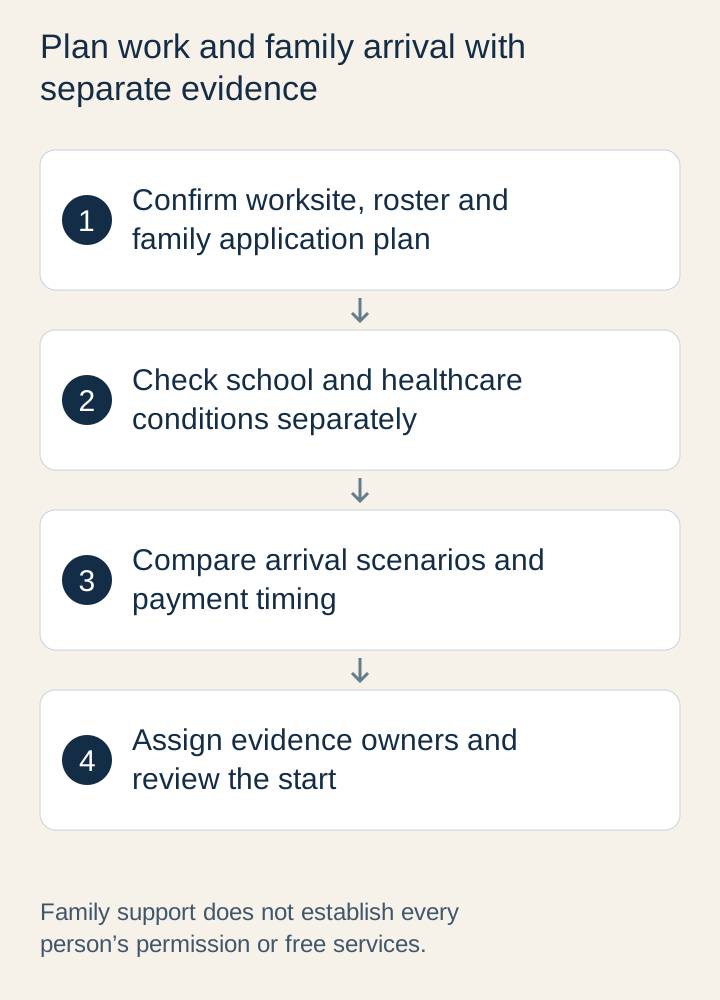
Use six fields: worksite and roster; intended family application and arrival arrangement; school authority and outstanding conditions; healthcare and coverage evidence; one-off and ongoing costs with payment timing; and owner, next evidence and decision point. Keep a private detailed copy and share a limited operational summary. The blank worksheet does not submit an application or send information to CRM.
| Planning issue | Family arrives together | Worker arrives first, family later |
|---|---|---|
| Housing and daily routine | Suitable family space needed from the start | Temporary worker accommodation and later move assessed separately |
| School preparation | Enrolment and transport coordinated with arrival | Existing schooling and later transition both tracked |
| Cash timing | Several initial expenses may fall together | Duplicate households and additional travel may arise |
| Permission and evidence | Each person's actual position still checked | Later applications and conditions remain separate |
These are planning scenarios, not a recommendation that either is cheaper or legally available to every family. A staged move can create duplicate costs and caring responsibilities; moving together can concentrate several decisions before the first salary. Compare the actual household arrangement instead of assuming one sequence always reduces risk.
ASIC's moving-cost guidance recommends planning before moving and separating ongoing expenses from one-off setup costs. Apply that method to dated quotes for housing, transport, freight, utilities and relevant family services. Keep deposits, refundable amounts, reimbursements and ordinary recurring spending distinct so that money temporarily tied up is visible.
Use a cautious income scenario while the partner's own permission and job search are being clarified. A potential second income is not an existing salary, and an estimated bonus is not guaranteed cash for a deposit. This article gives no city rent, school-fee total or required family savings figure. Unknown costs remain unconfirmed rather than being entered as zero to make the plan appear affordable.
Hold a short household planning discussion using the same version of the record. Ask each adult which unresolved item would prevent the proposed arrival sequence, who can obtain the answer and what arrangement is needed in the meantime. For example, if school timing is unconfirmed, identify the care question rather than quietly assuming the new employee can miss induction. If an employer offers an introduction to a school, record the introduction as an action and retain the school's actual answer separately. These are original planning suggestions, not duties imposed on an employer or a finding that a particular family arrangement is feasible.
6. Set decisions around evidence and revisit the start
Create practical decision points: when to review the employment date, when the family arrangement can be assessed, when school information is sufficient and when housing commitments can be considered. Give each unresolved item an owner and the evidence that would change the decision. An interview invitation, a school enquiry and a booking quotation are useful progress, but they are not interchangeable approvals.
If the worksite, roster or offer changes, revisit the family record before reusing the previous budget. A different town can change school, transport and coverage questions. If the family arrival changes, ask whether temporary accommodation or reimbursement arrangements still apply. Retain written revisions and distinguish an employer's answer from a school, insurer or government decision.
Explain a conditional start accurately: “My proposed work start needs to be reconciled with the actual permission and role requirements. We are checking the family arrival separately. Could we agree the outstanding evidence and the next date review?” This original wording does not request permission to work without authorization or promise a processing timetable. The offshore application guide helps separate recruitment availability from lawful commencement.
For immigration background, see PremierVisa Group's verified 482 explanation. Keep the main employment, each person's permission and any later permanent-residence plan separate. Clear family questions can improve a recruitment discussion without turning employer goodwill into a guaranteed migration, education or healthcare outcome.
7. Frequently asked questions
Does an offer saying family welcome establish everyone's visa eligibility?
No. Check the applicable family definition, application arrangement, sponsor evidence and each person's requirements. Employer interest is not a government decision.
Are public schools automatically free for all 482 children?
Do not assume that. Rules and exemptions depend on the relevant jurisdiction and circumstances. Ask the actual education authority and record the basis before budgeting.
Does holding a 482 visa automatically provide Medicare?
No automatic entitlement is established by the visa label alone. Services Australia sets out eligibility categories and applicable reciprocal arrangements; confirm the individual's position.
Is arriving in stages always cheaper?
No. It may create two households, more travel or additional care needs. Compare dated costs and permission dependencies for both scenarios rather than treating one as universally better.
Can the partner's expected salary fund the initial move?
Treat it as uncertain until the actual permission and employment are established. Keep a scenario without that income and identify when each expense must be paid.
Start with the worksite, actual family plan and three unresolved practical questions. To prepare the employer discussion, submit your background, leaving children's identity files, medical records and private financial documents out of the initial general enquiry.
Prepared with AI assistance. General career information; no named professional review has been confirmed. AI cover illustration does not depict our staff, clients or partner employers.