
When an Australian employer says it can sponsor a 482 visa, ask for a coherent record of the employing business, actual job and sponsorship stage before treating the statement as a plan. A company registration, a recruiter’s assurance and an offer letter answer different questions. This guide is for applicants who have already discussed a real vacancy and need to turn verbal assurances into specific written answers. Its practical tool is a discrepancy log, rather than a list of supposedly verified sponsors.
- 1. Write down exactly what the employer has promised
- 2. Connect the advertised name to the actual employing entity
- 3. Match the job discussed, the offer and the planned sponsorship
- 4. Ask about stages without requesting unrelated confidential records
- 5. Use a discrepancy log, with a clear next decision
- 6. Review payment requests and commencement assumptions separately
- 7. Frequently asked questions and your next action
1. Write down exactly what the employer has promised
Begin with the words used in the interview. “We have sponsored before”, “we are applying to become a sponsor” and “we will consider your case” are different statements. Ask which applies to the entity that would employ you and whether the answer concerns your vacancy. Do not silently upgrade an expression of interest into a commitment, or a commitment into approval.
Home Affairs describes the Skills in Demand visa, subclass 482 as a temporary sponsored visa with separate basic requirements, including nomination by an approved sponsor. A recruiting decision does not settle all immigration requirements. The person managing recruitment may also be different from the person preparing the employer-side application. Establish their roles before asking for documents they may not hold.
Create a dated interview note containing the vacancy reference, participants’ business roles, intended worksite, proposed employing entity and the sponsorship statement. Send a short confirmation question through the employer’s independently located recruitment channel. For example: “My understanding is that your team will assess sponsorship for this specific role, rather than that an application has already been approved. Is that correct?” This is an original teaching example, not a required government form.
Keep your own circumstances separate. If you are applying from Hong Kong, Taiwan, mainland China or another location, state where you are based and the work authorization you actually hold. Do not let a convenient proposed start date become a claim that you can legally commence work. Eligibility and commencement conditions require their own assessment.
2. Connect the advertised name to the actual employing entity
An advertisement might show a brand, an offer might name a company and a recruiter might use a different business name. These differences are not automatically wrongdoing; they require an explanation. Ask which legal entity will sign the employment contract, which business operates the worksite and which entity is responsible for sponsorship. Record the relationship rather than assuming all names refer to the same party.
ABN Lookup’s official FAQ explains the public information available, such as an ABN’s status and entity details. It does not provide a complete business contact directory or a guarantee of the underlying information. Checking a registration is therefore an identity check, not evidence that a particular recruiter is authorized or a job is genuine. It also does not establish immigration sponsorship approval.
Use the identifier supplied by the business to reduce confusion between similar names. Compare the relevant public record with the contract name and ask about any difference in location or entity type. Avoid relying only on a screenshot sent by the person selling the service. Save the official page URL, the date checked and the narrow conclusion it supports.
Historical trading names need particular care. The official business-name FAQ distinguishes entity names, registered business names and historical trading-name information. Do not select the first familiar name and assume that it identifies today’s employer. If the relationship is unclear, ask the business for the current registered identity and an explanation in writing. A name discrepancy should remain open until it is resolved.
3. Match the job discussed, the offer and the planned sponsorship
Prepare a comparison with three columns: what was discussed, what the written offer says and what still needs to be confirmed for the proposed immigration process. Include duties, worksite, hours, reporting line, employment entity and remuneration components. This is a candidate’s clarification tool, not a substitute for the employer’s nomination file or professional review.
| Check | Document or answer to request | What it can establish | What it cannot establish |
|---|---|---|---|
| Business identity | Current legal name and business identifier | Which entity is being discussed | Current sponsorship approval or financial stability |
| Actual role | Written duties and worksite | What work the parties intend | That an occupation or visa criterion is satisfied |
| Sponsorship stage | A clear employer-side stage explanation | Whether the discussion is exploratory or an application is underway | Your visa outcome |
| Employment terms | Written pay components and hours | What is being offered | That every employment or immigration rule is met |
The table is an original comparison framework, not an official checklist. For a hypothetical example, imagine an interview describing equipment maintenance at one site while an offer describes general warehouse duties at another. Do not simply change your resume to match the offer. Ask the employer which role is real and request consistent documents before any further immigration assessment.
The same discipline applies to salary. Ask whether the figure is Australian dollars, annual or hourly, gross or net, and whether superannuation or variable incentives are included. This guide does not provide a current salary threshold or charge. A professional assessing the case needs the actual written terms and the rules applicable to the relevant date, rather than a headline package borrowed from another applicant.
If a recruiter says the details will be provided after payment, record that limitation. You cannot compare a role that has not been identified. The sensible next step is clarification, not filling the gap with an assumed employer, worksite or salary.
4. Ask about stages without requesting unrelated confidential records
Ask who is responsible for confirming sponsorship readiness, what stage the employer-side process has reached and what documents will be provided through an appropriate channel. A business may reasonably need to protect other employees’ records, internal finances or personal identifiers. You do not need those files merely to establish that your recruitment conversation is genuine.
Instead request a proportionate explanation tied to your own case. Useful questions include: “Is the proposed sponsor the same entity named in the contract?”, “Who will explain the proposed visa stream and role?”, and “What will I receive to distinguish preparation from lodgement and approval?” Do not ask a recruiter to give you another worker’s approval letter as proof of your own eligibility.
Screenshots and receipts need context. A document bearing a government logo can relate to a different company, person, application or date. Record the document’s stated purpose and ask the responsible professional to explain what it shows. Do not upload it to an unknown verification website or share it publicly. Neither a document’s appearance nor a professional-looking email signature proves authenticity.
If you would like help organizing the questions, submit your career background and current recruitment questions. HKJobHunt can discuss job requirements, interview preparation and the information needed for an individual review, within separately confirmed services. The enquiry does not certify an employer or establish a partnership with the business you name.
5. Use a discrepancy log, with a clear next decision
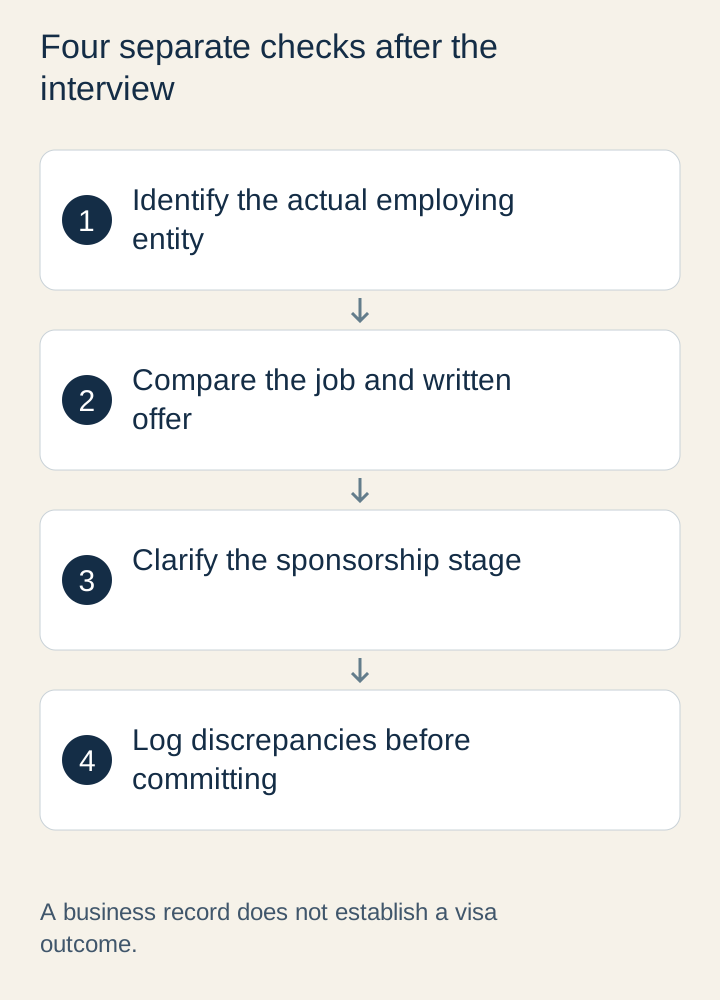
Your practical asset is a document-to-promise discrepancy log. Use one row per unresolved issue and include the original statement, document name and date, conflicting information, question asked, responsible business contact, response, supporting evidence and next decision. “Not confirmed” is a valid answer. Do not mark an issue resolved merely because someone replied.
For example, an illustrative entry could read: “Interview location and contract worksite differ. Ask whether the worksite changed and request the final role description. Status: waiting for written clarification.” No real company or vacancy is implied. This record helps you discuss the actual uncertainty without accusing a business or forgetting what was said.
Separate ordinary clarification from a reason to suspend action. A missing reporting-line detail may be resolved during recruitment. An unexplained change of employing entity, a request to falsify experience or pressure to pay for a sponsorship place needs independent review before you proceed. A traffic-light color can help organize a conversation, but it is not a fraud score or legal conclusion.
Set a review point based on the recruiter’s stated timetable. If an answer changes, retain both versions and ask which is current. If a business declines to provide enough information to understand the job, record the limit and decide whether to stop pursuing it. You do not need to prove a scam before deciding that an opportunity is insufficiently clear for your own commitments.
Keep this log separate from the wider search record in our guide to finding a sponsoring employer. That article helps find and contact vacancies; this one concerns resolving evidence after a substantive recruitment discussion. It is not a second directory of sponsors.
6. Review payment requests and commencement assumptions separately
Home Affairs’ work-visa scam guidance warns against arrangements involving benefits in return for sponsorship. A request to pay for a guaranteed job or return part of your wages must not be treated as an ordinary administrative detail. Ask for independent review before entering an arrangement involving money or other benefits for sponsorship.
Fair Work’s 482 workplace-rights fact sheet also explains sponsor responsibilities and restrictions on transferring relevant recruitment and sponsorship costs. Obtain an itemized statement identifying each service, payer, recipient and refund condition. Personal application or independent professional costs should be examined according to their actual purpose; the label “consultancy”, “deposit” or “training” cannot settle responsibility on its own.
Independently verify the recruitment contact through a channel you locate yourself. Scamwatch cautions that legitimate-looking platforms can carry fraudulent advertisements. An interview does not remove the need for checks, and a missing interview coupled with payment pressure is a reason for particular caution. These are risk indicators, not findings against an identified employer.
Finally, do not confuse an agreed start date with permission to work. Before resigning, relocating or commencing duties, establish the applicable visa and work conditions for your situation. If you already have an Australian visa, obtain an assessment of any conditions relevant to changing work. This article does not prescribe a universal transfer timetable or suggest that a visitor can start working while paperwork is prepared.
For the separate immigration framework, read the PremierVisa 482 verification guide. Detailed visa assessment should use current official rules and your own documents.
7. Frequently asked questions and your next action
Is an active ABN proof of sponsorship approval?
No. It supports a limited business-registration check. It does not establish the employer’s sponsorship status, the genuineness of your vacancy or your individual eligibility. Ask each question separately and record the evidence used.
What if the recruiter and employer have different names?
Ask who represents whom, who signs the employment contract and who is responsible for the proposed sponsorship. Different names may have an ordinary explanation, but the relationship should be clear enough to document. Do not assume the recruiter is the sponsor.
Can another employee’s approval letter prove my case?
No. It may describe a different role, entity, period or personal situation. Do not request unnecessary personal information from another worker. Your case requires its own employer-side and applicant-side assessment.
Should I change my experience to fit the offer?
No. Clarify inconsistencies in the role and retain a truthful history. Improving the wording of real duties is different from inventing duties, dates or qualifications. A document mismatch should be resolved at its source.
What can I do if the employer will not answer?
Record the unanswered points and pause any commitments that depend on them. You can seek independent review or stop pursuing the vacancy without making a public allegation. Incomplete information is a decision limit, not a finding of guilt.
Your next step is to compare the interview note, written job terms and sponsorship explanation, then choose one unresolved issue to clarify. If you need individual assistance, submit your career background to discuss preparation and appropriate next questions. HKJobHunt, within the PremierVisa Group service network, confirms its scope separately and does not guarantee a job, sponsorship or visa.
Prepared with AI assistance. General career information; no named professional review has been confirmed. AI cover illustration does not depict our staff, clients or partner employers.
Sources: Home Affairs 482; ABN Lookup FAQ; Business-name FAQ; Home Affairs work-visa scams; Fair Work 482; Scamwatch.