
Prepare a 482-related recruitment advertisement from the real job, then check the applicable advertising and employment requirements before publication. A clear advertisement should help suitable people understand the duties and selection criteria; it is not merely a document to collect for a nomination. This guide gives an original duty-to-advertisement record, a wording example and a version handover process for employers. It does not certify labour market testing, decide an exemption or replace review of the actual role and proposed nomination.
- 1. Give the advertisement one real job to describe
- 2. Turn genuine requirements into assessable wording
- 3. Check advertised pay separately from immigration salary questions
- 4. Confirm the advertising route before selecting a product
- 5. Use a duty-to-advertisement correspondence record
- 6. Preserve the published version and manage changes honestly
- 7. Frequently asked questions
1. Give the advertisement one real job to describe
Start with the approved role brief: legal employing entity, business activity, workplace, reporting line, employment arrangement and principal responsibilities. Ask the hiring manager to describe a normal working week and the decisions the employee will actually make. If the role remains undefined, return to the employer-readiness guide before buying advertising. An overseas-search label cannot repair missing management decisions.
Separate a duty from a characteristic of the preferred applicant. “Prepare maintenance records and explain unresolved faults to the supervisor” describes work. “Must be exactly like our previous employee” does not explain the capability required. Choose criteria that can be assessed against the job, rather than reproducing a particular person's resume. Do not invent a specialist responsibility solely to make an occupation label appear suitable.
The Australian Human Rights Commission recruitment guide recommends clear duties, essential and desirable criteria, relevant information requests and fair assessment. Use those principles to improve the brief. A preference for a particular nationality, age or family situation should not be disguised as a technical requirement. Any claimed exception or necessary job requirement needs appropriate consideration of the actual circumstances.
2. Turn genuine requirements into assessable wording
List each essential capability and the evidence that would demonstrate it. A specific technical task may be supported by an explanation of past work, an appropriate qualification or an interview demonstration. Different evidence serves different purposes. A confident answer is not a professional registration check, while a certificate title alone may not establish practical experience. Identify the outstanding verification instead of asking applicants to provide every conceivable document.
For a fictional maintenance role, a weak line might be: “Overseas technician wanted, any background considered, sponsorship assured.” An original teaching revision is: “The role involves identifying equipment faults, documenting work and coordinating scheduled maintenance. Applicants should explain their relevant hands-on experience and their contribution to a completed repair.” This example supplies no actual vacancy, salary, occupation code or sponsorship offer. The employer must develop its own truthful advertisement.
Add the real workplace and work pattern once approved. If travel between sites is necessary, describe the requirement rather than assuming a candidate's home or family arrangements. Specify essential versus desirable qualifications accurately. A desired software package or industry background may be useful without being indispensable. Making every preference mandatory can unnecessarily restrict the pool and make later assessment inconsistent.
Fair Work's discrimination guidance explains protection for prospective employees and recognizes that necessary job requirements and other legal circumstances matter. This article does not decide whether a proposed requirement is lawful. Where wording involves a protected attribute or an unusual restriction, obtain suitable review before using it. Do not copy a competitor's advertisement and assume its criteria are appropriate for your business.
3. Check advertised pay separately from immigration salary questions
Fair Work's job-advertisement page explains that advertised rates cannot undercut applicable minimum entitlements. Confirm the relevant employment arrangement and pay basis with the person responsible for remuneration. A number in an advertisement should correspond to the genuine job and the applicable award, enterprise agreement or other relevant minimum arrangements. Do not infer a lawful rate from another employer's posting.
Make the components understandable. Check whether a stated annual figure includes or excludes employer superannuation, how hours are expressed and whether a range accurately represents the approved offer. A maximum dependent on uncertain bonuses is not the same as guaranteed pay. This guide does not supply a universal salary or certify that a package satisfies every employment requirement.
The immigration salary assessment is another task. The applicable stream, market salary evidence and lodgement date need to be considered by the person handling that assessment. A salary disclosure rule for an advertisement is not the visa income threshold. If the role, location, hours or package changes, flag that change to both the remuneration owner and the nomination contact. Do not leave the old advertisement silently inconsistent with the job now being offered.
| Item to check | Recruitment question | Separate review question |
|---|---|---|
| Duties | Can an applicant understand the actual work? | Does the proposed occupation reflect that work? |
| Skills | Can the requirement be assessed fairly? | Is any registration or assessment required? |
| Pay | Is the approved package described accurately? | Are workplace and nomination rules satisfied? |
| Advertising | Is the real vacancy accessible to applicants? | Does the selected route meet applicable LMT rules? |
The table distinguishes tasks; completing one column does not approve the other. For help refining the vacancy and screening brief, submit the employer's recruitment requirements to discuss search and interview arrangements. The scope of any service must be confirmed separately.
4. Confirm the advertising route before selecting a product
Home Affairs' labour market testing guidance distinguishes standard advertising, exemptions and alternative arrangements. For most standard Core Skills and Specialist Skills nominations, the rules involve at least four weeks of advertising within the four months immediately before nomination lodgement and evidence of two qualifying advertisements. Those numbers alone do not establish compliance; content, media, application acceptance and other circumstances also matter.
Ask the responsible nomination professional to identify the applicable route before purchasing a package. The fact that a platform sells recruitment advertising does not make every product on that platform suitable for LMT. A public recruitment advertisement, a social-network update and a post restricted to a private audience may serve different purposes. Confirm the product's reach and the records available from the provider without treating a sales assurance as a government decision.
Keep the applicant-facing advertisement clear while handling detailed legal assessment separately. The employer should know who is responsible for checking the stream, evidence window and any relevant changes. Labour Agreement arrangements must be assessed against their own terms. This article does not determine nationality-based exemptions or reproduce a full LMT compliance guide. An existing overseas candidate does not itself establish that advertising can be skipped.
5. Use a duty-to-advertisement correspondence record
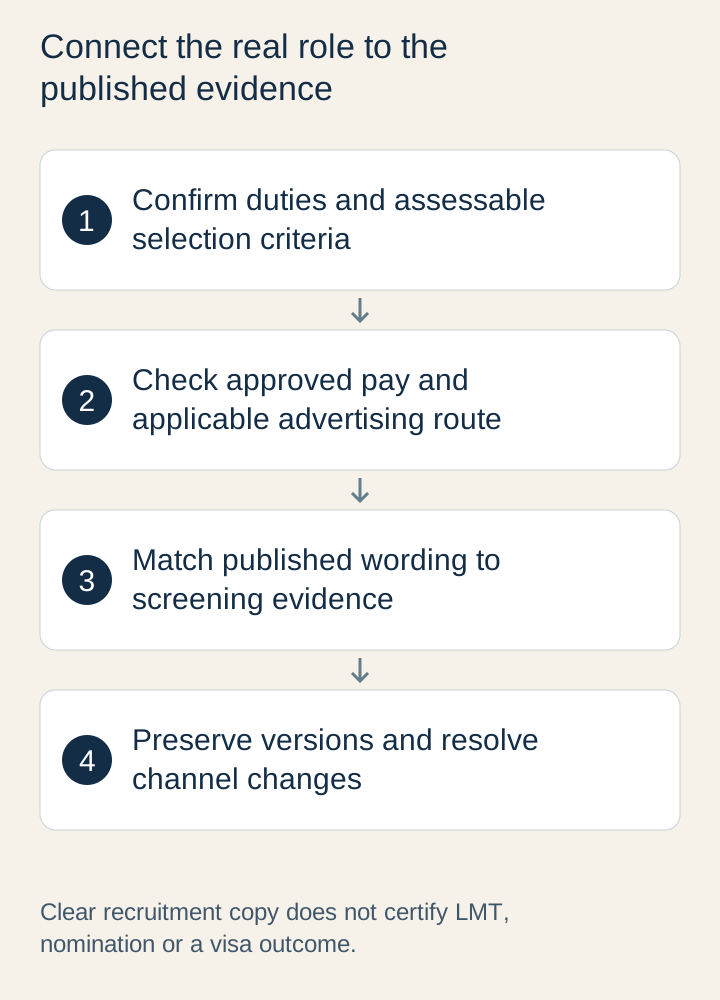
Create a six-field record for each important requirement: genuine duty; essential or desirable capability; wording approved for the advertisement; evidence used in screening; pay or professional-review question; and version owner or next action. This is an original editorial and recruitment tool, not a prescribed government form. It connects the job to what applicants see and to what interviewers later assess.
In the fictional maintenance example, the duty is diagnosing recurring equipment faults. The capability is relevant diagnostic experience. The approved line asks applicants to explain a completed repair and their contribution. Screening notes then identify the experience actually described and any question for a technical interview. The record does not contain an invented skills pass or a fabricated reason to reject a local applicant.
Use a practical handover question: “Which line in the advertisement tells applicants about this essential requirement, and how will we assess it consistently?” If the panel cannot answer, the criterion may need clarification. If a requirement appears only during interviews, examine whether candidates received a fair description of the job and obtain appropriate advice where needed. Do not retrospectively rewrite the published file to conceal the difference.
Keep unnecessary personal information out of the shared record. Recruiters and managers need enough information to assess relevant capability, not unrestricted access to passports, family details or private documents. Record an evidence location and responsible person rather than attaching complete applicant files to every planning email. Establish suitable access and retention arrangements for the actual recruitment process.
6. Preserve the published version and manage changes honestly
Before publication, have the hiring manager, remuneration owner and appropriate nomination contact check the same identifiable version. Record who approved which part and what remains outstanding. Approval to publish recruitment copy is not approval of a future nomination. If a review is incomplete, keep it visible instead of turning an internal deadline into an assumed sign-off.
After the advertisement goes live, compare the public version with the approved copy. Check that the role, workplace, pay expression and application route appear correctly and that applications can actually be submitted. Retain the actual published content, platform, reference and relevant dates. A receipt establishes a purchase; it may not show the wording or real publication period. If an agency controls the account, agree how the employer receives the records.
Where the job or advertisement changes, retain the original, identify the revision and record when and why it occurred. Ask the person handling LMT whether the change affects evidence or timing. Do not alter old screenshots, invent applications or manufacture interview outcomes. A useful change log explains what happened; it does not make an unsuitable advertisement retrospectively suitable.
At shortlisting, compare applicants against the genuine criteria and document the actual reasons. The Human Rights Commission guide emphasizes consistent decisions based on relevant skills and experience. An unsuccessful recruitment outcome does not by itself approve sponsorship. Keep the employment decision, advertising evidence, nomination and individual visa stages distinct. For immigration background, see PremierVisa Group's 482 explanation.
Check the application destination as part of the handover. An advertisement may look correct while its contact address is misspelled or its application page is unavailable. Agree who monitors incoming applications and what happens if the channel fails. Record the actual interruption and ask the responsible professional how it affects the relevant evidence; do not substitute a successful advertising payment for proof that applicants could respond.
7. Frequently asked questions
Does writing a good advertisement prove LMT has been completed?
No. Clear content is only one part of the work. The applicable route, media, periods, acceptance of applications and evidence still need assessment for the actual nomination.
Can a recruiter write the advertisement for the employer?
A recruiter can help under an agreed scope, but the employer should confirm the real duties and conditions. Identify who checks remuneration, nomination requirements and the actual published version; do not assume every task transfers with copywriting.
Should every preferred skill be marked essential?
No. Distinguish what the employee must genuinely be able to do from useful additional experience. Unnecessary restrictions can reduce the pool and create inconsistent assessment. Review sensitive requirements appropriately.
Does a paid advertising invoice prove the advertisement ran correctly?
Not on its own. Preserve the actual published content and relevant publication and application records, and have the nomination contact confirm the evidence needed.
Can we edit a saved screenshot after the role changes?
Do not change historical evidence to depict a new role. Preserve original and revised versions and obtain advice on whether the changed advertisement or timing remains usable.
Submit the real vacancy requirements to discuss talent search, screening and interviews with HKJobHunt. Provide the role, location and essential capabilities in the initial enquiry, without applicants' confidential files. This guide advertises no live job and promises no employer approval, candidate availability or visa outcome.
Prepared with AI assistance. General career information; no named professional review has been confirmed. AI cover illustration does not depict our staff, clients or partner employers.