
Plan a 482 hire by separating employer-side government charges, recruitment services, ongoing employment costs and any agreed personal or relocation support. Then attach each payment and proposed start to the event it depends on. There is no single fee or fixed processing period that covers every employer and candidate. This guide provides an original cost-and-dependency ledger and a clearly conditional official-fee example, helping a business approve a realistic plan without promising a visa, refund or arrival date.
- 1. Define the hire and the decisions before asking for a total
- 2. Keep official employer charges in their own budget section
- 3. Separate recruitment, employment and personal support costs
- 4. Allocate payment responsibility before approving commitments
- 5. Build a timeline from dependencies rather than a promised number of weeks
- 6. Use the ledger to test delay, withdrawal and arrival scenarios
- 7. Frequently asked questions
1. Define the hire and the decisions before asking for a total
Record the legal employing entity, role, worksite, intended employment arrangement and proposed sponsorship stream. Check whether the business already has the required sponsor position or needs further work. Identify the candidate stage: no search started, screening, conditional offer, nomination preparation or individual application. A quote that does not identify these assumptions may be impossible to compare with another service proposal.
Use the employer-readiness guide to settle the job before building a budget around it. A changed worksite, different occupation or revised employment period can create new questions for the responsible professional. Do not treat an old estimate as current simply because it still carries the same applicant's name. Keep the version, assumptions and date beside every important figure.
Home Affairs' sponsoring process separates business sponsorship or nomination work from the individual's visa application. Recruitment is another activity again. A recruiter can estimate its agreed work; it cannot turn all other decisions into a guaranteed completion date. Assign a business approver, recruitment contact and appropriate immigration professional so each estimate has an accountable owner.
2. Keep official employer charges in their own budget section
On the Home Affairs cost-of-sponsoring page, checked on 25 October 2026, becoming an approved sponsor under the SID 482 program is listed at AUD420 and nominating a SID applicant at AUD330. Whether a new sponsorship application is required must be confirmed for the actual business. These are separate charges, not a complete hiring price.
The same page lists the SID Skilling Australians Fund levy at AUD1,200 per year or part of a year for a business with annual turnover below AUD10 million, and AUD1,800 per year or part for a business with turnover of AUD10 million or more. The actual calculation depends on the relevant business and proposed period, with the online nomination form calculating the charge. Do not divide an annual levy casually by months to invent a prorated charge.
The levy is payable in full when lodging the nomination. That payment timing matters even if the business plans to spread other spending over the employee's service. Home Affairs also describes special arrangements and limited exemptions; this general budget example does not determine one. Check current charges and actual applicability again before payment, particularly if the role, business details or intended period changes.
| Conditional teaching example | Calculation in AUD | What is excluded |
|---|---|---|
| Turnover below AUD10 million; a two-year SID nomination | SAF: 2 × 1,200 = 2,400 | Recruitment, personal application and employment spending |
| Add the listed nomination charge | 2,400 + 330 = 2,730 | All other service and practical costs |
| If a new sponsor application is also required | 2,730 + 420 = 3,150 | Not a total cost or approval quote |
This is hypothetical arithmetic using the official page's listed charges, not a finding that your company qualifies, needs a two-year period or will obtain approval. All amounts are Australian dollars. No Hong Kong dollar, Taiwan dollar or renminbi conversion is implied. An existing sponsor and a different business size or duration can have a different calculation.
3. Separate recruitment, employment and personal support costs
Add recruitment advertising, agreed search or screening services, interviews, reference work and internal staff time as separate items. Obtain written service scopes and current quotes instead of borrowing a market average from another industry. Identify what the service delivers, its charging trigger and what happens if the role changes or no suitable person is found. Do not invent a replacement guarantee, refundable fee or candidate pool.
Ongoing employment needs a different budget section: lawful remuneration, superannuation, applicable hours or allowances, induction, equipment and management support. Fair Work's hiring guidance emphasizes understanding employer responsibilities and getting pay right. A government nomination charge does not include wages, while a visa salary threshold does not replace the full workplace assessment. The actual role needs an appropriate pay calculation.
Personal visa application expenses, health or other checks, family applications, travel and temporary accommodation require separate itemized discussion where relevant. Do not assume that every possible personal expense is an employer obligation, or that every employer contribution can later be recovered. Specify what the business proposes to support, for whom, when and subject to which lawful conditions. Unknown quotes should remain unconfirmed rather than becoming zero.
For help defining the recruitment work, submit the employer's requirements to discuss search, screening and interview arrangements. Ask for the actual scope before treating an indicative discussion as an agreed service. Immigration or contractual questions require the appropriate separate assessment.
4. Allocate payment responsibility before approving commitments
Home Affairs says costs associated with becoming a sponsor and nominating and sponsoring an applicant cannot be transferred to the visa holder or family members. Its SAF guidance also prohibits passing that levy to the applicant. The Australian Border Force page addresses specified recruitment, sponsorship and nomination cost recovery and the prohibition on benefits exchanged for sponsorship. Do not finance a hiring plan by selling sponsorship.
Keep employer-side professional work distinct from services for the individual's application. A combined invoice should identify the actual services and responsible parties. Paying through an associated company, describing the charge as training or proposing later wage deductions does not by itself settle the real cost category. Ask the appropriate adviser to resolve uncertainty before the business relies on reimbursement in its cash-flow plan.
Some proposed support may involve separate contractual questions. Fair Work's payment and repayment guidance explains restrictions on unreasonable employer-benefiting payment requirements. Do not assume a signed repayment clause validates every cost. This guide neither approves a relocation agreement nor decides an actual debt; obtain suitable advice on the items, terms and circumstances.
For each payment, record the quoted amount or unconfirmed status, source and date, lawful payer, payment trigger, approval owner and outstanding question. Identify whether a quote includes tax where relevant rather than adding an invented tax treatment. This original ledger is a management tool, not a government form or an authority to charge a worker.
5. Build a timeline from dependencies rather than a promised number of weeks
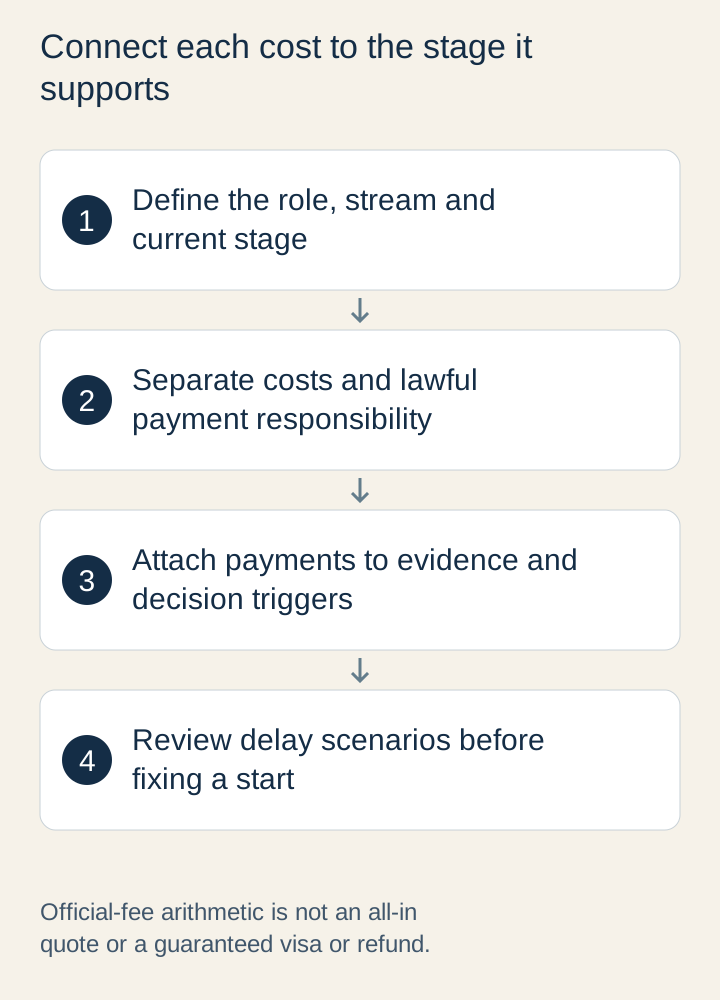
List the events that control progress: approved role, applicable local recruitment evidence, candidate assessment, business documents, nomination, individual application, any necessary registration and actual permission to start. Some preparation can run in parallel, while other work depends on a decision or evidence. Ask the responsible person to confirm the actual sequence; do not add several unrelated website processing figures and call the total a reliable arrival date.
The official visa-processing guide describes an indication based on recently decided applications. It does not guarantee a decision within the displayed period or examine the specific facts of your application. Record when an estimate was checked and which visa or stream it concerns. A visa estimate is not automatically an estimate for sponsor work, nomination, recruitment or relocation.
Where labour market testing applies, its advertising and evidence conditions must be reflected in the plan. Standard arrangements, exemptions and alternative evidence need appropriate assessment. Finding a preferred candidate does not erase the relevant dependencies. An operational need to fill tomorrow's roster also does not establish permission for an overseas applicant to start work.
Use an internal planning window with explicit assumptions rather than a public guarantee. Give each unresolved item a next review date and owner, and explain which commitment it blocks. A manager can approve preparation while holding a non-refundable travel booking until the appropriate conditions are satisfied. The decision should match the actual uncertainty instead of treating all stages as one completed status.
6. Use the ledger to test delay, withdrawal and arrival scenarios
The practical asset combines six fields: cost or stage; source and amount; lawful payer; payment or evidence trigger; uncertainty and responsible owner; and management action. Link spending to the stage it supports. Keep committed costs separate from possible future costs and distinguish recoverable amounts from items whose refund position has not been assessed. Do not book an uncertain refund as available cash.
Consider a fictional employer that has approved a role and recruitment budget but still lacks a business document required for nomination preparation. The useful question is not “Can we promise next month?” It is “Who obtains this document, what cannot proceed without it, and what should we avoid committing meanwhile?” Update the dependency and review the proposed start with the candidate using accurate language. Do not describe preparation as a lodged or approved application.
Home Affairs lists limited circumstances in which nomination fees or SAF amounts may be refunded, depending on the stage and facts. Its cost page should be read as a whole; the general no-refund warning is not the complete account of every specified exception. Equally, a candidate not arriving, a withdrawal or an early departure does not support a universal refund promise. Check the applicable scenario and procedure before making a financial assumption.
Plan lawful continuity if the start moves: reschedule work, review internal capacity or consider other legitimate staffing options. Do not put a person to work without establishing the actual permission and conditions. Confirm practical onboarding, supervision and worksite arrangements when the start becomes feasible. For immigration background, see PremierVisa Group's 482 explanation; a business plan cannot guarantee the government result.
For management reporting, distinguish quoted, approved, invoiced and actually paid amounts. They are different states of the same item, not four separate costs to add together. A revised quotation should identify what it replaces, and a payment record should identify which invoice or charge it settles. This helps prevent double counting while keeping outstanding liabilities visible. Have the business's finance contact confirm the actual treatment rather than using this planning ledger as accounting advice.
7. Frequently asked questions
Is the official-fee subtotal the whole cost of hiring?
No. The example excludes recruitment services, individual application expenses, relocation, wages and other employment costs. Its assumptions may also differ from your business.
Can the worker reimburse all the employer's spending?
No such general assumption is valid. Specified sponsor and nomination costs and the SAF levy cannot be shifted as described in official guidance. Other proposed payments and repayment terms need separate assessment.
Does the processing guide tell us the employee's start date?
No. It describes recently decided applications and is not an individual guarantee. Recruitment, evidence, nomination, permission and practical arrival have separate dependencies.
Can we assume unused SAF will be refunded if plans change?
No. Refunds are limited and conditional. Identify the actual stage and circumstances and obtain confirmation before recording a refund as expected cash.
What should we send for an initial recruitment discussion?
Provide the role, worksite, essential skills, current recruitment stage and important operational constraints. Do not include applicants' confidential identity or financial documents in a general enquiry.
Submit your recruitment requirements to discuss talent search, screening and interview arrangements with HKJobHunt. Immigration work may be referred to PremierVisa Group under an appropriate engagement. No fixed total, available worker, approval date or guaranteed refund is promised.
Prepared with AI assistance. General career information; no named professional review has been confirmed. AI cover illustration does not depict our staff, clients or partner employers.