
A cover letter for a potential 482 role should explain why your experience fits that vacancy, then state your actual work-right position and what employer discussion you need. Do not claim approval, hide a sponsorship requirement or offer to buy it. This guide helps experienced overseas candidates prepare a concise, truthful letter with original example sentences and a cross-check sheet; it cannot make an employer sponsor you or establish visa eligibility.
- 1. Read the vacancy's instructions before choosing your message
- 2. Open with a role and a reason, not a request to be rescued
- 3. Select evidence that supports the role-specific claim
- 4. State sponsorship needs accurately and without a bargain
- 5. Assemble the letter with a six-field message-control sheet
- 6. Check all application surfaces and retain a clean record
- 7. Frequently asked questions
1. Read the vacancy's instructions before choosing your message
Confirm the role, employer, reference and requested documents. Some employers want a separate letter, some require responses to selection criteria, and others ask only for a résumé or answers within a form. The government's JobAccess application guide makes that distinction and recommends checking both what to include and how to submit it. Do not use a generic attachment to avoid answering a required question.
Read work-right wording literally. An advertisement mentioning possible sponsorship invites a discussion, not an individual promise. An advertisement requiring existing rights may not fit your present circumstances. If its meaning is unclear, ask the appropriate contact a short question about this vacancy. Do not assume a job-board filter, occupation category or recruiter message proves that the actual employing business will consider you under subclass 482.
Keep a private note of the source, date and exact condition so that your later letter responds to the correct version. A vacancy can change or close. You do not need to repeat every advertisement phrase, but you should be able to explain which requirement your opening addresses. If the job demands qualifications or responsibilities you lack, record the gap rather than rewriting your history to resemble the selection criteria.
This article concerns a job application, not a submission arguing for a visa grant. The Home Affairs Skills in Demand overview separates approved-sponsor nomination, appropriate skills and relevant English requirements. A well-written letter does not establish those conditions. Use the current visa name and appropriate stream questions rather than describing every 482 opportunity through an old TSS template.
2. Open with a role and a reason, not a request to be rescued
Give the employer enough information to recognize the application: the role and reference, where you found it if requested, and the most relevant contribution you can substantiate. The Department of Employment and Workplace Relations' application guidance recommends a letter tailored to the employer and vacancy, generally a few paragraphs rather than a long life story. Follow any specific instructions the employer supplies.
An original hypothetical opening is: “I am applying for the maintenance-planning role advertised on your company website. My experience coordinating equipment-service records and escalating overdue work is relevant to the planning and documentation duties described.” Use this only if the underlying experience is yours. The example is not an actual vacancy, a partner employer or a statement that this role meets a nominated occupation's requirements.
Notice the limits of the wording. It identifies a contribution without inventing an Australian employment history, a senior title or a measurable saving. A stronger opening is not necessarily one with more impressive numbers. If you do have a genuine result, explain its period and your part when relevant; if it belongs to a team, do not attribute the entire result to yourself. Keep the detailed history in the résumé and the supporting records separate.
Avoid opening with a promise to accept any work, relocate immediately or waive normal conditions. That makes it harder to establish a coherent role fit and may contradict your actual permission. You can be flexible about discussion without claiming you are already authorized to perform the job. The aim is a useful employer assessment, not a sentence that secures an interview regardless of the facts.
3. Select evidence that supports the role-specific claim
Choose a small number of relevant examples and connect each to a duty. JobAccess recommends keeping experience mentioned in the letter consistent with the résumé. Use that as a practical check: can the reader find the relevant employer, period and responsibility in the résumé, and could you explain the example at interview? A letter should provide a reason to examine your application, not introduce a different career history.
For a documentation-heavy role, you might describe how you checked records and escalated discrepancies. For a technical role, identify the type of problem you handled and the boundary of your responsibility. Do not reproduce a previous employer's confidential file to make the point. You can prepare an independently created, clearly fictional demonstration where appropriate, but it is not paid-work evidence or a substitute for required registration.
Use the following original comparison to review the wording. These are fictional teaching examples, not recommended claims for every applicant or an official template.
| Weak or risky statement | More useful direction | Fact to verify |
|---|---|---|
| I can do any job in your company | Identify one role and a relevant task | Your experience really matches it |
| I led all regional work | Describe your own action and approval limits | Personal versus team responsibility |
| My visa is easy and guaranteed | State the actual position and need for assessment | No approval or eligibility invented |
| I can start immediately | Separate interview availability from lawful commencement | Current permission and practical timing |
If you need more detailed rewriting, use the 482 résumé evidence guide. If the main concern is a lack of Australian work history, use the overseas-experience interview guide. This letter should connect those prepared facts, not duplicate the entire résumé or portfolio.
4. State sponsorship needs accurately and without a bargain
Keep two matters separate: what permission you actually hold now, and what arrangement you would need to take this particular role. A passport, visitor entry or willingness to move does not establish unrestricted work rights. If you already have Australian permission, read its actual conditions and obtain appropriate clarification when unsure. Do not copy someone else's status line simply because it appears to attract more replies.
For an overseas candidate without the necessary permission, original teaching wording is: “I am currently based outside Australia and would need an appropriate employer-sponsored arrangement and work authorization before commencing this role. I would welcome a discussion about whether the position and my background are suitable for that assessment.” This is deliberately conditional. It does not claim the employer is approved, your occupation qualifies, the route is settled or a government decision is assured.
Where you have an existing permission, describe only what you can confirm and identify any unresolved issue about this proposed employment. If you do not understand the implications of an employer change, seek appropriate advice rather than inserting “no sponsorship required” as a guess. A simple, accurate sentence is better than an unsupported legal explanation. The letter need not contain passport numbers, complete immigration files or a prediction of approval time.
Do not offer to purchase sponsorship, return part of your wages or meet any charge merely to make the letter appealing. Cost responsibility needs separate, proper review; it is not an opening negotiation tactic. Similarly, do not promise that English, skills or registration requirements can be ignored. You can tell an employer that you are prepared to supply relevant evidence without pretending the assessment has already happened.
For writing and interview preparation, you can submit your job-search background to discuss your experience, messages and realistic employer-contact directions under the confirmed service arrangements. Recruitment preparation and individual immigration advice remain distinct; no named employer, professional licence or sponsorship outcome is implied.
5. Assemble the letter with a six-field message-control sheet
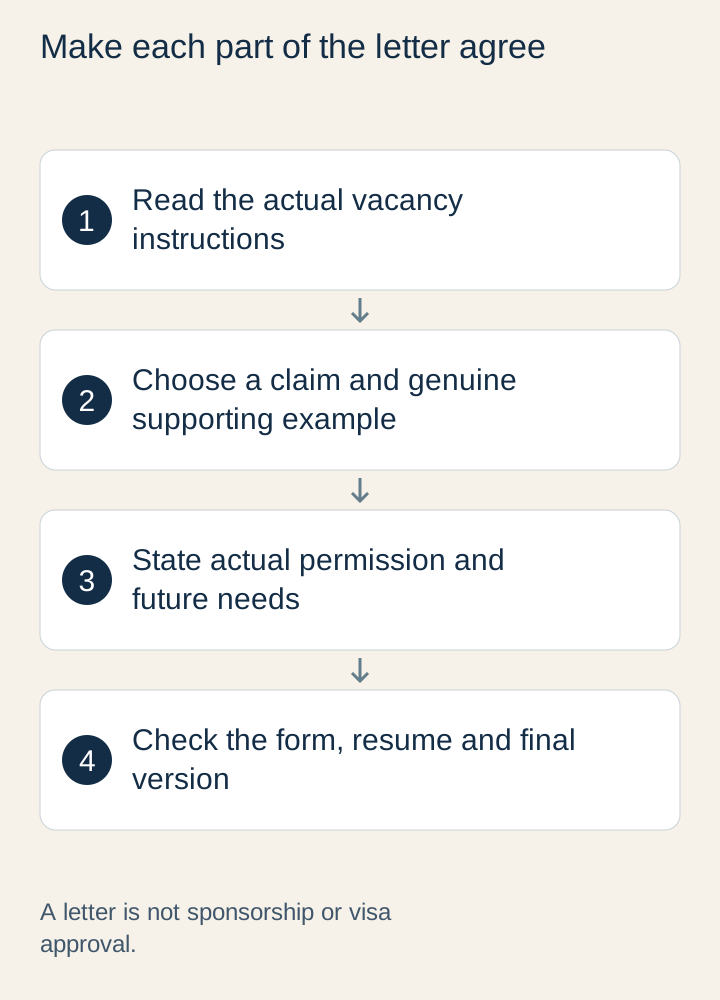
Use six fields before drafting: vacancy and instruction; opening claim; supporting example and résumé location; actual permission and sponsorship question; interview availability and proposed next step; and final version or unresolved correction. This original sheet is the practical asset for this topic. It helps prevent a convincing sentence in one part of the application from contradicting another part.
Then write a short sequence: identify the role, explain the evidence-based contribution, state the relevant work-right need, and suggest a reasonable next step. The location of the permission sentence can follow the employer's instructions and the natural flow, but a required direct question must still be answered. Do not conceal a material need in a misleading checkbox while using softer wording elsewhere. Clear prose cannot repair an inaccurate form response.
An original hypothetical closing is: “I can attend a remote interview at a mutually agreed time and explain the examples in my résumé. Please let me know if you would consider an overseas applicant who needs an appropriate employer-sponsored work arrangement.” That invites a discussion without promising a start date. Adapt the timing to your actual location and commitments, and do not insert a local telephone or address you are not entitled to use.
Check the document type requested. JobAccess distinguishes a short covering email from a separate cover letter: an email can identify you, the role and the attachments without repeating everything. If the application portal specifies a text field or file format, use it. A table like the teaching table in this article belongs in your preparation, not automatically in the letter you submit. Keep the employer-facing document simple and readable.
6. Check all application surfaces and retain a clean record
Compare the letter with the résumé, form answers and any recruiter message. Names, dates, qualifications, employment periods, permission description and availability should tell the same true story. If a recruiter has changed a sentence or added a sponsorship claim, review it before it is used. Do not let “we will polish it” become permission to invent Australian experience or government pre-approval.
Read the final exported file rather than only the editing view. Check the role, company, attachment name, spelling, legibility and that no comment or draft note remains in the employer-facing copy. JobAccess recommends a simple presentation and checking against the advertisement; it does not guarantee that any format will pass an automated system. Avoid claims about a universal ATS formula, a compulsory word count or a guaranteed response rate.
Keep a dated copy of what you actually submitted, through which channel and for which vacancy. A saved draft, an upload attempt and a confirmed submission are different statuses. When following up, refer to the actual application and ask a specific unanswered question. Do not send repeated “any sponsorship?” messages disconnected from the role. If the employer declines to consider sponsorship, record the answer and redirect the search rather than repeatedly changing the same letter's wording.
For verified visa further reading, see PremierVisa Group's 482 explanation. Use it alongside the official source and appropriate individual assessment. A letter can make your skills and needs easier to evaluate; employer selection, nomination, visa approval and any later permanent-residence application still require their own facts and decisions. None is completed by saving or submitting a cover letter.
7. Frequently asked questions
Should sponsorship be the first sentence?
Follow the employer's instructions and answer direct questions honestly. Usually the role and relevant contribution provide useful context, with a clear, accurate permission statement where it fits. Do not use placement within the letter to conceal a required disclosure.
Can I say I am eligible for 482 because my job title appears on a list?
That title does not establish the actual job, nomination or your personal conditions. State what has genuinely been assessed and keep unresolved matters conditional. A cover letter is not an eligibility decision.
Do I need a full visa history in the letter?
Not ordinarily as a writing principle; give accurate information relevant to the application and follow legitimate instructions. Sensitive supporting records should use an appropriate process once their purpose and recipient are clear.
Can I reuse the example sentences?
Use their structure only where the facts are yours. They are original fictional teaching materials, not evidence of your experience, an official template or an employer-approved script.
What if the employer only requests a résumé?
Follow the stated process and answer any form questions. A short covering message may identify the application where needed, but adding an unsolicited long letter is not a substitute for the requested information.
Choose one real vacancy and complete the six-field sheet before writing. If you need help preparing a truthful application, submit your background to discuss the evidence and next employer conversation.
Prepared with AI assistance. General career information; no named professional review has been confirmed. AI cover illustration does not depict our staff, clients or partner employers.