
Choose an Australian job-search location by matching actual vacancies, working conditions and household needs, rather than assuming a famous city has the best jobs or a regional label guarantees sponsorship. For overseas 482 candidates, compare the workplace and commute, a realistic budget, and the employer's actual visa proposal. This guide provides a location decision record and a clearly hypothetical cost comparison. It does not rank cities, verify available employers or promise a migration outcome.
- 1. Start with the work you can do and the vacancies you can verify
- 2. Separate a liveable place from a migration geography
- 3. Compare the workplace commute and the whole household
- 4. Build a comparable budget without inventing market prices
- 5. Use a location decision record with evidence and a next action
- 6. Choose the next search step before making relocation commitments
- 7. Frequently asked questions
1. Start with the work you can do and the vacancies you can verify
Define a target role using your actual experience, qualifications and any professional requirements. Then examine real advertisements in Sydney, Melbourne and selected regional centres using comparable job terms. Record the search date, filters, workplace and employer source. A broad search for sponsorship can return unsuitable roles, duplicates, agencies or advertisements that require existing work rights. Do not count every result as a sponsor willing to recruit you.
For each plausible vacancy, inspect the position description and employer's own application instructions. Ask whether overseas applications are considered and whether sponsorship is available for that particular position. Past sponsorship, an occupational shortage or a company operating across Australia does not answer those questions. The exact employing entity and workplace matter more than the brand's national presence.
Keep your first search sample comparable. If one search covers a whole state and another a small suburb, their result counts do not describe the same recruitment market. Nor does a general job advertisement count measure unique employers, current nominations or your probability of an offer. This guide provides no verified city vacancy totals or success rates; unknown information remains unconfirmed.
The 482 Core Skills overview connects the proposal to nominated work, occupation, skills and other conditions. Do not treat the word regional as a replacement for those requirements or read the standard 482 route as a universal regional-only programme. Establish the actual stream and employer proposal before drawing conclusions about a location.
2. Separate a liveable place from a migration geography
Home Affairs' designated regional-areas explanation uses a migration definition that is not simply the everyday meaning of a remote town. It includes cities and major regional centres, with Perth and Adelaide among its examples. Sydney and Melbourne are major-city examples in that explanation. This classification does not establish that any particular job offers sponsorship or that every incentive applies to a 482 applicant.
Use the actual regional postcode table for a relevant proposal, checking the purpose and applicable dates rather than relying on a suburb's marketing description. The workplace, residence and geographical rule may serve different purposes under a particular arrangement. Do not assume living outside a major city makes an unrelated job satisfy a regional requirement.
A DAMA is also a separate arrangement. The official individual-facing DAMA guidance says individuals cannot directly access it. The employer framework distinguishes the regional head agreement from an employer's individual agreement. Ask about the actual employer, occupation, location and applicable terms; a town appearing within a region does not complete those steps.
Keep ordinary job-search geography, designated regional status and a particular agreement in separate columns. Do not choose a home or resign because someone says all regional employers can sponsor, or because a favourable concession appears in another agreement. A later permanent-residence option has its own conditions. This article does not certify postcode eligibility, an individual DAMA or a future pathway.
3. Compare the workplace commute and the whole household
A city name is too broad to describe a daily journey. Ask for the actual site, roster, start and finish times, travel between sites and any remote-work expectation. Check the journey for the proposed hours, not only a convenient daytime service. A location that looks close on a map may not fit a particular shift, while a more distant home may have a workable direct route. Verify the actual journey instead of applying a city-wide stereotype.
For a household, list essential services and constraints: a partner's own employment or professional requirements, schooling or childcare questions, healthcare access, language support and contact with family overseas. Availability, eligibility and cost need their own evidence. A principal applicant's possible job does not establish a partner's occupation registration, a childcare place, a school offer or a specific benefit entitlement.
Ask what you could do if the roster changed or a household member needed a different service. This is a planning question, not a prediction of job loss or a reason to dismiss regional living. Equally, do not assume a large city automatically solves every practical need. Compare actual options, waiting arrangements and alternative transport rather than ranking places by population or personal familiarity.
Keep preferences separate from non-negotiable needs. You may prefer a familiar community, but the decisive issue could be a shift-compatible journey or a particular service. Record why a need matters, what evidence would resolve it and who will check it. An honest unresolved need is more useful than a numerical score that disguises missing information.
4. Build a comparable budget without inventing market prices
ASIC's Moneysmart moving guide distinguishes ongoing costs from one-off moving expenses and recommends budgeting before a move. Apply that principle to the actual household: housing, utilities, food, transport and relevant insurance, alongside relocation and setup costs. This is a budgeting method, not a claim that every listed item or fee applies to every tenancy.
For housing, save a dated quotation or advertisement with its location, property type and conditions. An advertised price does not guarantee availability, an accepted rental application or the final agreement. For transport, include the actual proposed journey and any vehicle costs relevant to it. Do not compare a whole dwelling in one place with a shared room in another and call the difference a city cost ranking.
The following original example is entirely hypothetical. All amounts are AUD per week, concern only housing and transport, and are not market estimates for Sydney, Melbourne or any regional centre.
| Hypothetical option | Housing | Transport | Subtotal |
|---|---|---|---|
| Option A | 500 | 100 | 600 |
| Option B | 450 | 180 | 630 |
Here, B's housing is 50 lower, but transport is 80 higher, making this limited subtotal 30 higher. Food, utilities, tax, healthcare and other costs are not included. The lesson is to compare the same basket, not to claim a cheaper location is always more expensive after travel. Replace every assumption with actual evidence before making a decision.
Keep the currency and time unit beside every entry. A weekly rental quotation cannot be compared directly with a monthly transport budget, and an Australian-dollar estimate should not be silently mixed with a Hong Kong-dollar or Taiwan-dollar commitment. Record the conversion method and date if a household needs another currency, and keep the original amounts for checking. If a quoted service is unavailable at the required time or excludes a necessary item, record the limitation rather than retaining the attractive headline price. The comparison should be reproducible from the saved information.
Salary also needs its own check. Separate guaranteed components from possible overtime and clarify the applicable employment and immigration basis. A gross annual package is not take-home spending money. Use the 482 salary-offer guide for the relevant questions rather than treating a national threshold as a city affordability recommendation or a complete household budget.
5. Use a location decision record with evidence and a next action
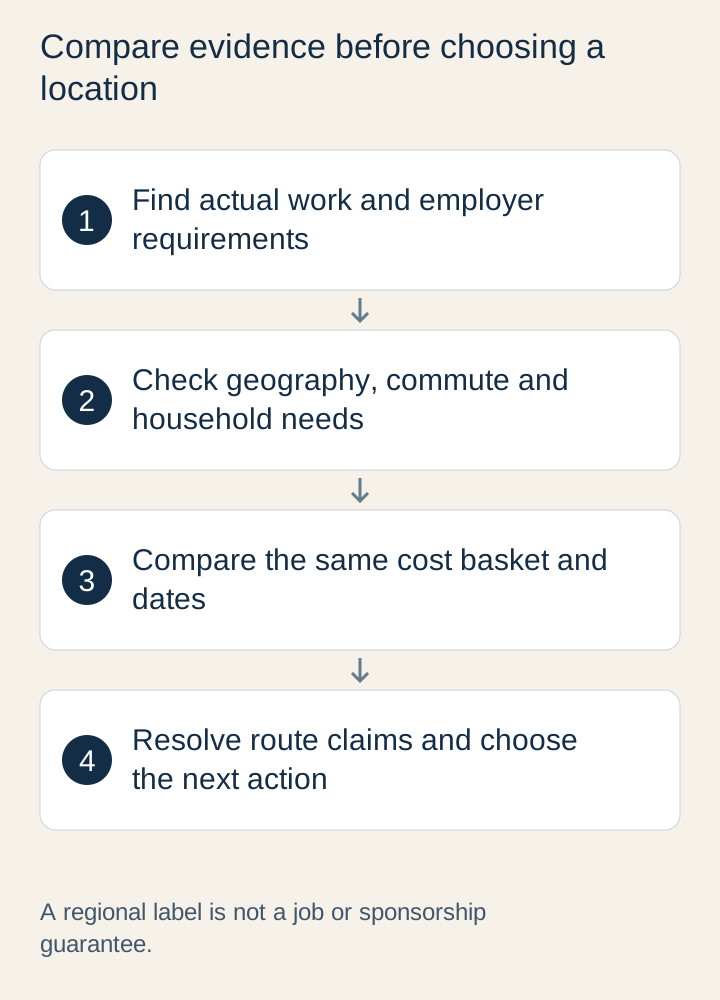
The distinctive worksheet has six fields: location, workplace and postcode; real vacancy and employer evidence; roster, commute and household needs; comparable budget and its date; actual visa or agreement claim; and unresolved issue, responsible contact and next decision. Prepare one record per genuine option. Do not fill the employer column with occupational categories or assume a research sample is a partner-employer list.
An original fictional row might say: “Sydney-area role under discussion, site not confirmed, commute cannot yet be checked, housing quotation provisional, sponsorship discussion only, request exact workplace before comparing.” Another could concern a regional-centre role whose position description is clear but whose household service question remains unresolved. Neither is a real vacancy or a migration assessment.
Use simple evidence states: confirmed for this purpose, provisional, not obtained, or changed. A recruiter saying housing is affordable remains a claim until you have a comparable basis. A postcode finding is not confirmation of a job. If a proposal changes, preserve the earlier record and note what changed; do not silently carry the most favourable old answer into a different offer.
For help turning the comparison into an employer conversation, submit your job-search background with your role, location options and practical constraints. Discuss résumé, interviews and possible employer approaches under the confirmed service scope. Immigration matters need appropriate individual assessment; the enquiry does not verify a vacancy or a professional licence.
6. Choose the next search step before making relocation commitments
Ask each employer the same core questions: where is the actual work; what duties and roster apply; are overseas candidates considered; what sponsorship arrangement is genuinely proposed; and which conditions remain? This makes the answers comparable without assuming a standard recruitment procedure. An interview can clarify the work, but it cannot itself establish every document or permission.
Fair Work's migrant-worker fact sheet explains that workplace protections generally apply equally and that employment and immigration laws both matter. A regional label or sponsorship promise is not a reason to ignore the actual pay, hours and lawful conditions. Confirm the applicable arrangement rather than accepting a blanket claim that a smaller location allows different basic treatment.
If the strongest available evidence supports interviewing in two locations, do that before turning a preference into an irreversible household move. If a non-negotiable need cannot yet be met, record the specific gap and investigate another option. You do not need a universal best city to make a useful next decision. You need a real opportunity with conditions and a workable plan you can verify.
For immigration context, see PremierVisa Group's verified 482 explanation. Keep detailed visa decisions separate from the location worksheet. Do not book a move, assume immediate work rights or predict permanent residence from a city comparison. Recheck when the employer, site, household requirements or applicable route changes.
7. Frequently asked questions
Is regional Australia always a remote town?
No. The official migration definition includes cities and major regional centres. Check the relevant postcode and purpose, rather than relying on an everyday translation of regional.
Does a regional vacancy guarantee 482 sponsorship?
No. Verify the actual employer, occupation, stream, nomination and individual conditions. A location is not an available sponsor or a granted visa.
Can I apply personally for a DAMA because I like the region?
The official guidance says individuals cannot directly access a DAMA. An applicable employer and occupation arrangement is needed; the regional framework alone does not establish your case.
Should I select the place with the lowest advertised rent?
Compare the same housing type, actual journey and whole household costs. Availability and final conditions also need confirmation. The hypothetical table is a method, not a market ranking.
Does a higher gross salary settle the location decision?
No. Check the actual offer, pay basis and relevant conditions, then build a separate realistic household budget. Gross pay does not automatically establish disposable income or affordability.
Choose a shortlist you can investigate. If you need help prioritising employer questions, submit your background with the target role and unresolved location needs, without private family records.
Prepared with AI assistance. General career information; no named professional review has been confirmed. AI cover illustration does not depict our staff, clients or partner employers.