
If you hold a primary subclass 482 visa and want a different employer, distinguish the ordinary nomination transfer from the limited arrangements after sponsored employment ends. A new offer does not settle either question. Check your actual conditions, visa expiry, occupation and previous periods away from compliant sponsored work. Then coordinate the new proposal, any required decisions and the old-job handover in one evidence record. Do not treat resignation as automatic cancellation or a pending nomination as an extension of permission.
- 1. Identify the employment arrangement you are changing
- 2. Separate ordinary transfer from limited post-cessation work
- 3. Keep a period ledger alongside the expiry date
- 4. Prepare the new-employer discussion before making commitments
- 5. Use a six-field transfer and handover dossier
- 6. Reconcile resignation, final pay and first-day readiness
- 7. Frequently asked questions
1. Identify the employment arrangement you are changing
Start with the visa grant and current conditions, the original employing entity and the actual new duties. Home Affairs' change-in-situation guidance explains the ordinary employer-change process: the new sponsor lodges a nomination, and approval is required for the new sponsored arrangement. A new employer's enthusiasm or history of sponsorship does not establish that decision for your role.
Ask whether the occupation remains the same, whether the location changes and whether the old and new sponsorship arrangements differ. Home Affairs says changing occupation requires a new nomination and a new visa, with grant required before starting the new role under that arrangement. It also identifies a new-visa requirement when moving from a Labour Agreement to a Standard Business Sponsor. Do not simplify every change to “transfer the visa without a new application.”
For a same-occupation employer change, a new visa is generally not required unless the current one is expiring, but the actual arrangement still needs assessment. A nomination does not extend the existing visa's expiry. Historical TSS grants and transitional provisions can matter; a headline about current SID arrangements is not an individual assessment of every older grant. Identify the relevant grant before acting.
2. Separate ordinary transfer from limited post-cessation work
The current Home Affairs explanation of condition 8607 includes both the sponsored-work restrictions and a limited arrangement after sponsored employment ends. The official mobility announcement, effective 1 July 2024, explains that during the permitted period holders can work for other employers, including in work outside the nominated occupation. Applicable licence and other conditions remain relevant.
That is different from approval of the new long-term sponsored arrangement. It is therefore too broad to say that no other work is ever permitted before a new nomination is approved. It is equally wrong to say a 482 holder can freely change jobs without limits. Unless exempt, the official announcement says the worker must have ceased work with the sponsoring employer before working for another employer under this arrangement. It is not a general permission for a second job while continuing the original sponsored work.
| Situation to clarify | Relevant distinction | Evidence still needed |
|---|---|---|
| Continuing the original sponsored work | Existing occupation and sponsor restrictions remain relevant | Actual conditions, employer and duties |
| Taking work after sponsored employment ends | Limited post-cessation provisions may apply | Cessation, time already used, valid visa and other conditions |
| Starting the new ongoing sponsored arrangement | New nomination and any necessary visa decision | Actual approval, occupation and sponsorship framework |
This comparison is a planning aid, not permission for a named person to take a shift. Establish which legal basis is being relied on for the actual work and date. An employer's onboarding checklist cannot answer that question by itself. Where the circumstances are unclear, obtain suitable advice rather than choosing whichever interpretation gives the earliest start.
3. Keep a period ledger alongside the expiry date
The current Migration Regulations, Schedule 8 condition 8607 specify no more than 180 consecutive days in a period and 365 days in total during the visa period when not working in accordance with the relevant occupation and sponsor requirements. The official condition page confirms the 180/365 structure. The aggregate is not renewed every year, and separate shorter periods can still use it.
Do not record only unemployed days. Work for another employer during a permitted post-cessation period does not, by itself, restore compliant sponsored employment or automatically stop the relevant count. Keep the actual sequence of work and non-work events, the basis relied on and documentary evidence. Do not assume that signing an offer, lodging a nomination or working temporarily resets the clock.
Home Affairs states that periods before 1 July 2024 are not included under the change. An existing grant's history, remaining validity and applicable transitional rules still require individual consideration. This guide does not calculate a personal final lawful date. Do not build one from a resignation email alone: actual cessation, previous periods and the relevant conditions must be established first.
Keep visa expiry on a separate line. A remaining employment-mobility allowance cannot keep an expired visa valid. Nor does a reported application automatically extend the 180-day or aggregate limit. Claims that a pending nomination always permits work beyond the limits are not adopted here without a verified applicable legal basis. Obtain advice early enough to act on the available options, rather than treating an employer's estimated processing date as a safeguard.
4. Prepare the new-employer discussion before making commitments
Create a concise role comparison: actual employing entity, occupation and substantive duties, workplace, reporting line and proposed conditions. Ask who is coordinating nomination information and what stage can actually be evidenced. A similar job title can hide different duties; a familiar brand can use a different employing entity. Explain the relevant facts rather than relying on an assumption that the new role is identical.
An original question could be: “Can we confirm the employing entity, proposed duties and occupation, the nomination stage and the basis for any proposed start? I also need to reconcile my actual visa conditions and employment history before confirming an unconditional date.” This is a fictional preparation example, not a government template or a message sent on your behalf.
If an interim post-cessation role is proposed, identify that arrangement explicitly and assess its conditions and time implications. Do not allow temporary work to be described as proof that the ongoing sponsorship transfer has been approved. Likewise, do not promise a fixed long-term start solely because a recruiter expects a fast decision. Ask what changes if the decision or role details differ from the current plan.
For help organizing your experience and employer questions, submit your job-search background. Discuss résumé, interview and possible employer approaches within the confirmed service scope. Visa-condition interpretation and a personal period calculation require suitable separate assessment.
5. Use a six-field transfer and handover dossier
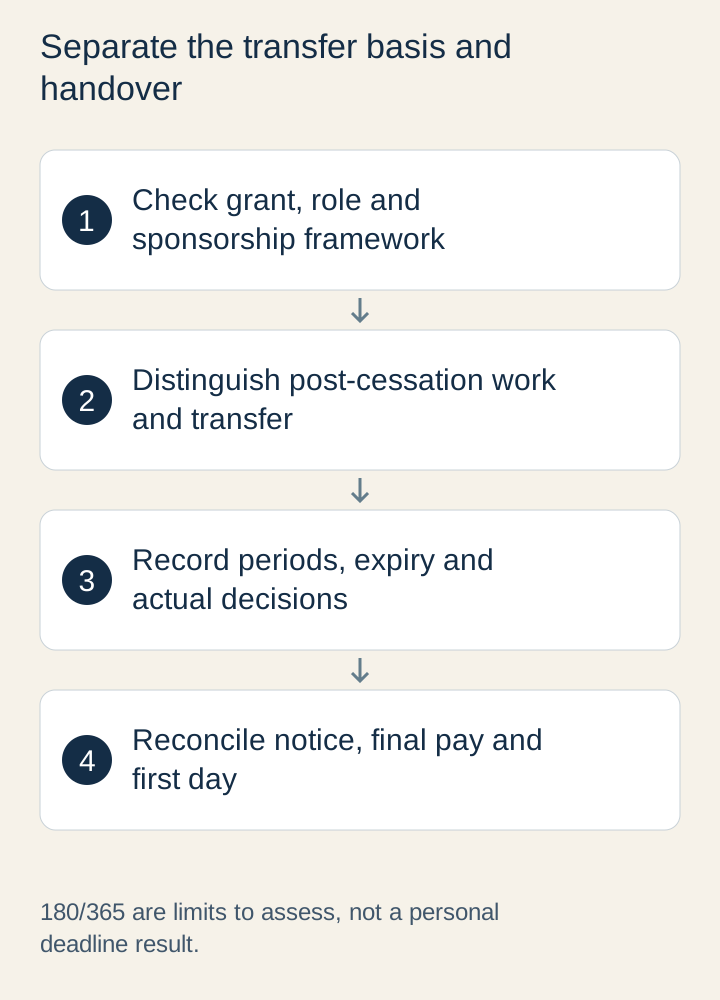
Keep one private dossier with six fields: actual cessation and supporting evidence; relevant periods and their records; new entity and role comparison; nomination and any visa stage; notice, pay and professional requirements; and responsible person, next evidence and decision. Do not put identity numbers, former customers' information or full grant documents into a widely shared worksheet. Refer to securely held evidence instead.
The period field should preserve separate episodes and unresolved dates rather than force a guessed total. Where the status of a day is unclear, mark it for assessment. The dossier is a discussion tool, not an automated eligibility calculator. A blank row or downloaded worksheet does not verify an employer, notify Home Affairs or make a visa application.
A fictional handover problem illustrates the value: the new employer wants an induction date, but the old manager's proposed final shift differs from the resignation letter's last employment date. Record both and ask the appropriate people to clarify what actually happens. Do not silently choose the later date because it appears to leave more time. Keep employment notice and immigration cessation analysis distinct while reconciling the underlying facts.
Before accepting changes, compare the written offer with the interview account and retain the dated versions. The employer-verification guide helps resolve entity and document contradictions. The salary-offer guide helps organize remuneration questions. Neither can establish that the new nomination or personal permission is approved.
6. Reconcile resignation, final pay and first-day readiness
Fair Work's resignation guidance recommends written notice stating the last day of employment and explains that notice obligations depend on applicable instruments and arrangements. Check the award, enterprise agreement or contract relevant to you; do not assume every sponsored worker owes the same number of weeks. Clarify any agreed change to notice and preserve the written outcome.
Prepare a practical handover: work status, authorized records, access return, equipment and the person receiving unfinished tasks. Do not remove customer files or proprietary material as proof of experience. Arrange references through appropriate channels rather than making them a condition for handing over passwords. Employment obligations remain relevant even where the recruitment relationship has become uncomfortable.
Fair Work's final-pay guidance identifies components such as outstanding wages and applicable unused annual leave, with timing depending on the relevant rules. Ask for an itemized calculation and the applicable payment timing. This article does not prescribe a universal seven-day deadline or calculate a named person's entitlement. Record a discrepancy for follow-up rather than assuming every missing item is lawful or unlawful without checking.
Home Affairs says sponsors must report relevant employment changes within 28 days. That employer reporting period is not an extra 28 days for the worker, and it does not reset mobility time. Fair Work's migrant-worker fact sheet explains that only Home Affairs can grant, refuse or cancel a visa. An employer report or resignation is not itself automatic cancellation, but the holder must still address actual conditions and expiry.
Before the new first day, recheck the duties, entity, permission, any required registration and the stage actually reached. For broader context, see PremierVisa Group's 482 explanation; use suitable individual advice for the specific transfer. Keep later permanent residence separate from the immediate employment and visa decisions. A new employer's interest cannot guarantee either outcome.
7. Frequently asked questions
Must every 482 holder wait for nomination approval before doing any other work?
That is too broad. Ordinary new sponsored employment and limited post-cessation work have different requirements. Establish the actual conditions, cessation, time used and other restrictions before relying on the latter arrangement.
Is the 365-day aggregate available again each year?
No. The official condition refers to the total over the visa period, alongside the consecutive-period limit. Previous relevant episodes matter; do not track only the most recent gap.
Does a nomination receipt extend my current visa?
No. Lodgement is not approval or an extension of the existing expiry. Do not assume it resets employment-mobility limits either; obtain suitable advice on the actual position.
Does every employer change avoid a new visa application?
No. Home Affairs distinguishes circumstances including occupation changes, expiry and a Labour Agreement to Standard Business Sponsor move. Compare the actual arrangements before assuming the same-occupation general position applies.
Can my employer cancel my visa when I resign?
Only Home Affairs makes visa decisions. Resignation and employer reporting do not themselves equal cancellation, but actual conditions, time limits and expiry still need prompt attention.
Start with the actual grant, work history and new role. To prepare the recruitment conversation and handover record, submit your background, keeping identity records and confidential employer files out of the initial enquiry.
Prepared with AI assistance. General career information; no named professional review has been confirmed. AI cover illustration does not depict our staff, clients or partner employers.